








Pope’s visit highlights Christian resilience in Lebanon


BEIRUT—Over the past few decades, hundreds of thousands of Christians have left parts of the Middle East for good, driven by wars and the rise of Muslim extremists.
In Lebanon, it has been different. Despite the many crises that have battered the small nation, Christians continue to enjoy religious freedom and significant political influence.
Pope Leo XIV’s visit to Lebanon over the weekend is a recognition of the importance of Lebanon’s religious pluralism and a message to Christians not to abandon the region.
In Iraq, large numbers of Christians fled after the US-led invasion in 2003 and the rise of the Islamic State (IS) group that followed. A decade later, in 2014, IS declared a caliphate in large parts of Iraq and Syria, leading to an exodus by Christians as well as followers of other religions.
IS blew up churches in areas they once controlled in Syria and Iraq and confiscated many Christians’ property.
A recent church bombing in Damascus this year made some Christians who stayed in Syria consider leaving. Many Christians in Syria have been concerned about the direction of the country’s new government under interim President Ahmed al-Sharaa, former leader of the Islamist insurgent group Hayat Tahrir al-Sham.
In Lebanon, despite others emigrating, many Christians refuse to leave.
The country’s sectarian power-sharing system is prone to deadlock and has been criticized by reformists who want a secular state, but it has also ensured that minorities are not marginalized.
“More than half the advantage comes from Lebanon’s political system when it comes to Christians,” said Catholic priest Msgr. Abdo Abou Kassm, who is the director of the Catholic Center for Information.
“There is a democratic system where people can express their opinions freely without getting killed, oppressed or sent to exile,” said Abou Kassm. “You can live freely with dignity in Lebanon.”
Syria
Synthia Khoury, 25, a business graduate from Syria who joined a delegation to Lebanon to see the Pope, said that after the takeover of power in her country by an Islamist-led government last year, Christians in the war-torn country were worried that they would not be able to practice their religion freely, although so far this has not turned out to be the case.
“We know that the conditions of Christians in Lebanon are somewhat better than ours, but we also know that they passed through many wars,” Khoury said, adding that despite the hardships Lebanese Christians had faced, “they did not leave and stayed in their country and preserved their customs and traditions and this is beautiful.”
Deeply rooted since the early days of the faith, Christians in present-day Lebanon have survived wars and genocide over the past two millennia.
For many years, Christian monastic communities lived in caves in the rugged mountains to protect their faith and avoid persecution. Since the establishment of the State of Greater Lebanon in 1920 following World War I, Christians have played an instrumental role in shaping the country’s politics and economy.
Maronites
Today, Christians make up around a third of Lebanon’s 5 million people, giving the small nation on the eastern coast of the Mediterranean the largest percentage of Christians in the Middle East.
Lebanon is home to 18 different religious sects, of which more than half are Christians. Maronite Catholics are the largest Christian group, followed by the Greek Orthodox.
Christians have a presence in most parts of Lebanon, from villages bordering Israel and Syria to the coast. Mount Lebanon, which remains the Christian heartland, is mentioned frequently in the Bible.
Since Lebanon gained independence from France in 1943, a power-sharing agreement has been in place in which the president is a Maronite, the parliament speaker is a Shiite Muslim and the prime minister is a Sunni Muslim.
This makes Lebanon the only Arab country with a Christian head of state.
“People can practice religion wherever they are, but the Lebanese identity is something that is sacred for us too,” says Christian legislator Camille Dory Chamoun, who heads the National Liberal Party. His late grandfather, Camille Chamoun, was the president of Lebanon in the 1950s.
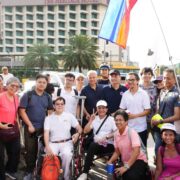
He is allied with the Christian Lebanese Forces Party, which has 19 seats in the 128-member legislature.
“Our Lebanese identity is as important as our Christian identity,” said Chamoun.
Other senior posts held by Maronites are the army command as well as the head of the central bank. The deputy parliament speaker and deputy prime minister are posts allocated to the Greek Orthodox.
The command of two of the country’s four security agencies is also given to Christians, with a Maronite general heading the Army Intelligence while a Greek Orthodox heads State Security.
Toward the end of the 1975-90 civil war in Lebanon, which largely pitted Christians against Muslims, an agreement to end the war was reached in the Saudi city of Taif. Since then, seats in parliament and the Cabinet have been equally divided between Christians and Muslims.
Charles Hayek, a historian and researcher, says that the ties between Lebanon and the Vatican are old and deep, adding that there is a tradition that states that St. Peter, the first Pope, established churches in Beirut, Byblos, Batroun and Tripoli, along Lebanon’s coast.
Hayek added that two men of Phoenician origin from what is now the port city of Tyre in south Lebanon were elected popes in Rome in the 8th century.
“You have also unbroken correspondence especially between the Maronite Church, the local Catholic Church and the papacy since 1215,” Hayek said.
Despite the civil war and sectarian strife in Lebanon, Muslims and Christians peacefully coexist today and followers of both religions accept one another as partners.