











BSP wary of further bank reserve cuts

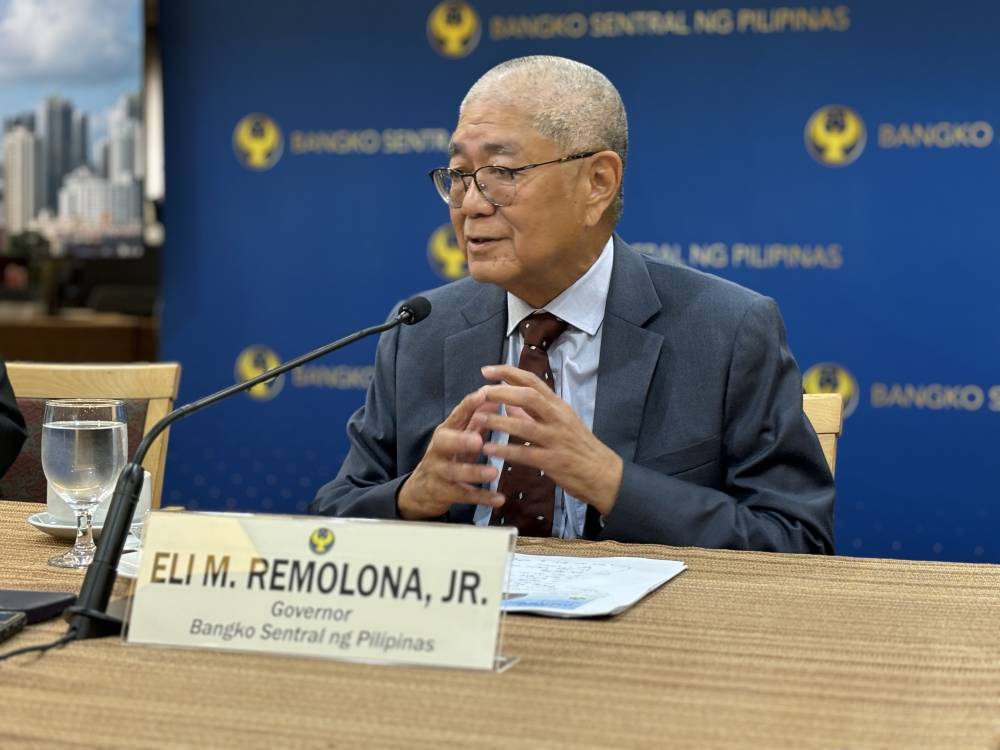
A fresh reduction in banks’ reserve requirement would do little to rouse an economy slowed by a graft-probe fallout, Bangko Sentral ng Pilipinas Governor Eli Remolona Jr. said, though he noted that additional cuts remain on the table.
The reserve requirement ratio (RRR), now at 5 percent for big banks, is “already very low, so a further cut won’t do that much,” Remolona told reporters on Wednesday.
“So, when you go from 5 percent to, say, 2 (percent), that’s not a lot when it comes to the reserve requirement,” he added. “But still, it might help.”
The RRR refers to the certain amount of deposits that banks must set aside as standby funds, which do not generate returns because they cannot be used for lending activities. This is among the mopping-up tools of the central bank, and likewise a mechanism to ensure that lenders have enough buffer to meet liabilities in case of sudden withdrawals.
The BSP last adjusted the ratio in March. Apart from lowering the RRR for big banks, the BSP also reduced the cash requirements of digital banks to 2.5 percent, and to zero for thrift banks.
Easing lenders’ cost
When Remolona took office as central bank governor in 2023, the RRR for large lenders stood at 9.5 percent. He signaled back then that the ratio should come down, even raising the possibility of bringing it to zero over his term.
Unlike interest rate cuts, which can weigh on the peso, the BSP chief previously described the lowering of the RRR as a “neutral” move that injects liquidity into the financial system, frees up more funds for lending and reduces the intermediation cost of banks.
That could potentially provide some relief for an economy that grew at a four-year low of 4 percent in the third quarter, as a widening graft scandal saps business and consumer confidence.
But Remolona said the timing of the next RRR cut would depend on domestic liquidity conditions, as too much money chasing too few goods could risk reigniting inflation.

“I didn’t commit to the timing. Because at present, we still have too much liquidity in the system,” the BSP chief said.
“A cut in the reserve requirement will add to that liquidity. So we want to absorb the liquidity before we [move],” he added.
Based on estimates, each 1 percentage-point cut in the RRR for large banks could inject nearly P200 billion in additional liquidity to the local financial system.
M3, or domestic liquidity, the broadest measure of money supply in the economy, grew by 7.3 percent year-on-year to about P18.9 trillion in September, beating August’s 6.6-percent increase, according to the latest central bank data.