











Silvana Diaz and the 50 years of Galleria Duemila

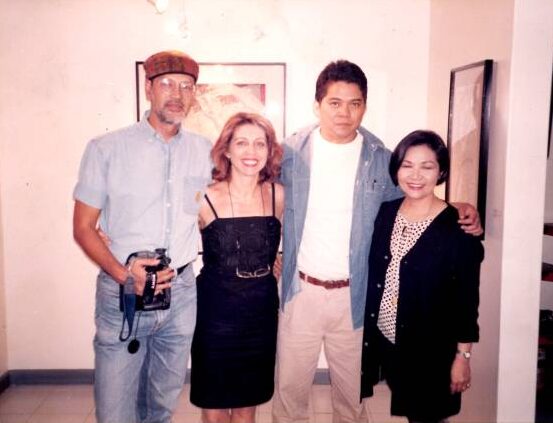
A 50-year anniversary, in any context, sounds like quite a feat. This is more so the case with Galleria Duemila, as gallery founder Silvana Ancellotti-Diaz celebrates its milestone. Since opening on Dec. 5, 1975, the space has witnessed some of the greatest artists in the country walk through its doors.
In January 2026, the gallery will celebrate its golden anniversary with the comprehensive exhibition, “Avanti, Sempre Avanti / Forward, Always Forward: 50 Years of Philippine Modern Art (1975-2025),” curated by Angel Velasco-Shaw.
The exhibit will feature works from multiple generations of national artists and masters.
“It was really quite painful (choosing for the show). I’ve worked with so many artists, and I love many of them! So it was really very hard because they are all so good, but of course, we are limited.”
She continues, “I wanted to share culture and spread art to the Filipino people as much as possible… to have historical relevance for future generations.”
Galleria Duemila, which translates to “Gallery of the Twentieth Century,” has its name cut out for them. Under the direction of Silvana, it has become a cornerstone in the Philippine art scene, chronicling the evolution of modern Filipino art, all the while supporting generations of artists.
Silvana’s early days
Silvana traveled the world twice as a stewardess for Alitalia, living her life based in Africa, South America, and Asia in rotating three-month assignments. Eventually, Silvana found herself in the Philippines in the early 1970s. While in the archipelago, she met and married former businessman and now-painter Ramon Diaz, brother to Miss Universe Gloria Diaz.
She recalls how her first steps to starting a gallery began while on honeymoon in New York. It was then that they considered where her sister-in-law, Isabel Diaz, could show her artwork. Silvana recalls, “Ramon said you must absolutely come and have an exhibit in the Philippines.”
With little knowledge of the local art scene, Silvana set out to find a gallery space. “You have to remember I knew nothing about the Philippines. I had a baby at the time, and most of these galleries were full already.”
The only available (and most serendipitous) option was Miladay Art Center, a large space divided between a school in the back and a gallery at the front. A last-minute cancellation gave Silvana the perfect opportunity, and the artwork in the exhibition sold out. Eventually, she began working in Miladay’s gallery. She recalls how curator Lino Severino, who was also a pilot, carried over some responsibilities to her. Silvana took to it well, sending out invitations and setting up paintings while hosting collectors at openings.
At some point, Miladay had to close the gallery. “It broke my heart,” she says. But this experience helped her realize how much she loved the gallery world.
The gallery’s evolution
Galleria Duemila began as a modest endeavor with limited resources. Silvana recalls her father-in-law giving her P20,000. “The worst investment he ever made in his life!” she recalls him joking. But art ended up being a very good investment after all, as the gallery has flourished all these years.
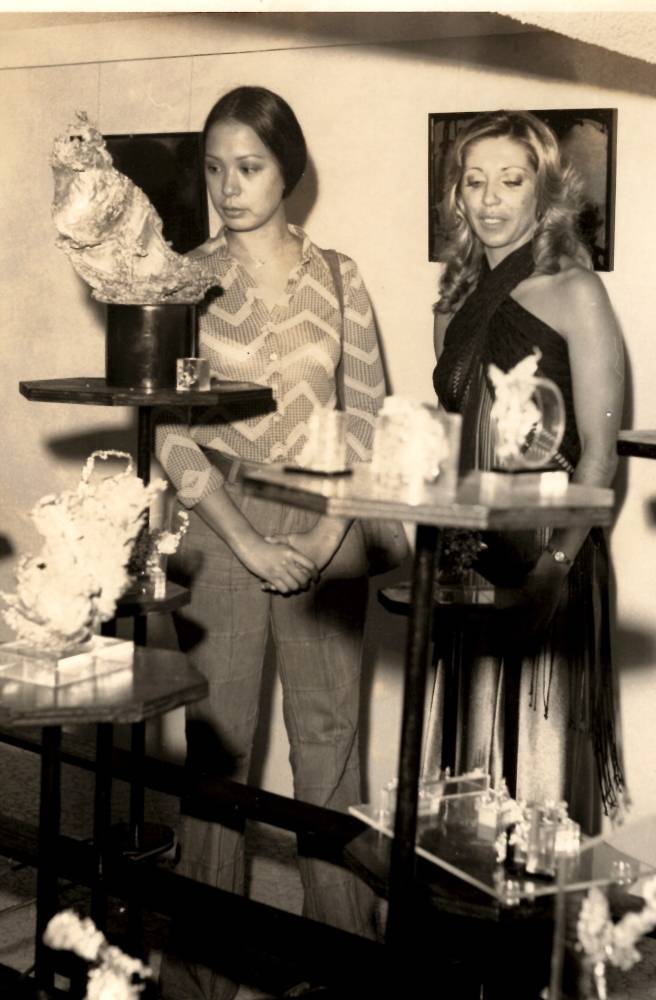
With support from her father-in-law and a close friend, she opened the first Galleria Duemila brick-and-mortar on Amorsolo Street in Makati. The inaugural exhibition featured “Sculptmetal Jems,” works by May Baddour, a Lebanese sculptor in exile. The invitation itself, made out of lead, remains preserved in the gallery’s archives.
After floods and the circumstances of life, the gallery moved from Amorsolo to various locations in Makati, and eventually to a space in SM Megamall in the ’90s. “Before, very few people would go to galleries. Only artists and a handful of collectors,” she notes.
“The beauty of this in Megamall is that anyone can walk in, so the education and the aesthetic will be seen by everybody. Before, few people would go to galleries, only artists and a very few aficionados. I believe it served a great service to the country,” she says, giving credit to Hans Sy, too, for giving art such a space.
At present, Galleria Duemila stands in its current space on Loring St. in Pasay, literally close to home, in Silvana and Ramon’s sprawling residential property. Including a studio space for her husband, the property is filled with plants, vintage cars, and a palpable sense of warmth. There is no doubt that for the Diaz family, the borders between art and life have merged together, becoming one.
Immersion in the art scene
Silvana is humble enough to say that she is not actually an artist, and had to learn the Philippine art scene from the inside out.
She recalls that as a foreigner, she had few friends in her early life in the country, and found her fulfillment in “art, reading books, concerts, and theater. It was the only thing that really made me happy.”
“My major concern then was to know Philippine artists,” she recalls. “I knew about Italian and European art. What can you know at 22, 23? I was a good reader but still at the beginning of my life. So I started getting to know Filipino artists.”
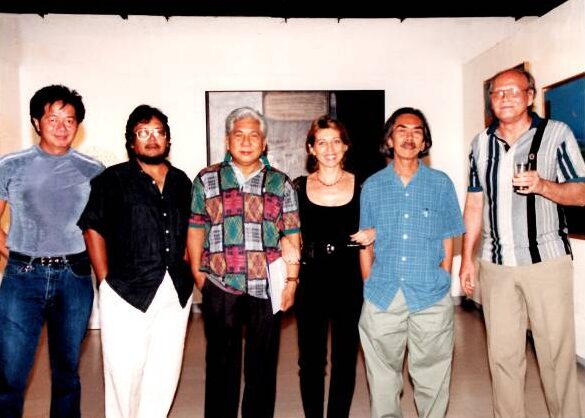
She began mingling with the legendary Saturday Group, a circle of artists, writers, and gallery owners who met every week to exchange ideas. She expresses fondness for her friends and founders, Afredo “Ding” Roces, Tiny Nuyda, Eduardo Castrillo, Manuel Baldemor, Juvenal Sansó, Mauro Malang Santos, and Rodolfo Paras-Perez.

“It was a long table of artists, dancers… everyone involved in the arts,” she says. “Through that, I met a lot of artists, and I started learning Filipino art from the inside.”
She talks about this period with razor-sharp memory, wistfully recalling driving an old MG with the top down, enjoying the freedom and fresh air of the era.
She also recalls being introduced to other galleries, including Gallery Blue, Gallery One, Luz Gallery, Casa Linda, and Sining Kamalig, building a gallery network of spaces, which are unfortunately no longer around today.
The values of Galleria Duemila
For Silvana, a gallery is more than a space, but an institution that preserves history. “I wanted to know the artists very well… there was little documentation then,” she says. “So I started to document everything on paper, photographs, and newspaper clippings.” And it shows, in the paper-filled shelves of the Galleria Duemila backroom.
She also recalls her time working and learning from Rod Paras Perez, who taught Silvana to record data for each piece, like size, medium, and pricing.
Beyond Duemila, Silvana volunteered for 12 years at the National Commission for Culture and the Arts, working with Ray Albano to establish standards for gallery ethics and operations. For example, she criticizes the practices of exhibiting in restaurants or corridors, believing it undermines the integrity of the work. “We have to establish the organization of an art gallery to have credibility and make it an honest work,” she says.
Throughout the years, Galleria Duemila has held exhibitions that have introduced modern sculptors and painters to a growing audience, many of whom were then encountering art for the first time.
From a young Italian stewardess navigating Manila’s art scene to a respected gallery owner documenting Philippine modern art, Silvana’s years with the gallery feel long and full. Beyond the monthly rotation of exhibits, her life has been marked by travel, encounters with artists, and countless moments watching how art can move the human spirit.
As the gallery moves forward, it carries with it not only the works on its walls but the stories, relationships, and passion of half a century. Avanti, sempre avanti.


