






The clothes that stay


Sustainability in fashion is usually framed in environmental terms: materials, carbon, waste, and production systems. These conversations are necessary yet partial. They often measure impact at the point of production rather than across a garment’s lifespan.
What is less acknowledged is that sustainability also operates through time. It concerns longevity, decisions around keeping and discarding, and the mechanisms that allow garments to remain in circulation instead of being erased.
But there is another logic at work: The preservation of knowledge and histories embedded in garments through collecting—technical, affective, and conceptual.
On keeping
On a work trip to Lane Crawford in 2011, I bought a pink skirt from Raf Simons’ Spring/Summer 2011 collection for Jil Sander. It was a retail translation of a more complex runway proposal, made for wider circulation. Once the season ended, it simply remained in my wardrobe. Fourteen years later, the decision to keep it reads differently.
Simons’ years at Jil Sander, between 2005 and 2012, marked his first engagement with womenswear. That period is now understood as formative in his trajectory, preceding his appointments at Christian Dior and later as co-creative director of Prada, along with shaping the visual language of early 2010s fashion. What had initially been an ordinary purchase now sits within a body of work that has acquired historical weight.
Over time, only a small number of garments from that period stayed with me. Most were resold, given away, or forgotten. The ones that remained were not necessarily the most dramatic or expensive. They were the ones who continued to hold across time. Their longevity follows certain patterns. Many introduce shifts in silhouette, proportion, or thinking that later filter into broader fashion language. Some are absorbed into mass circulation through high-street translations and derivative designs. Others persist through image systems—seasonal campaigns, magazine editorials, museum exhibitions, and subsequent cultural citations.
Yet visibility alone does not explain why some endure. What distinguishes those that persist is a density of meaning: the way construction, material logic, and internal coherence continue to generate value beyond their moment. They not only endure materially. They persist as thinking objects, continuing to produce significance, long after their season has passed.
On revisiting
My relationship with clothing shifted from acquisition toward preservation over time. In the Philippine context, where institutional fashion archives are virtually non-existent, garments circulate through stylists’ wardrobes, rental systems, and private closets. They serve short-term visual or commercial purposes.
Once their immediate use value fades, they are rarely studied, catalogued, or stored with care. What disappears is not only fabric but also ways of seeing, making, and thinking. Because of this absence, my collection gradually began to function as a small working archive. It is not an institution and does not present itself as one. It is simply a space where garments are kept in conditions that allow them to be handled, examined, and revisited.
On collecting
In “Collecting Fashion: Nostalgia, Passion, Obsession,” stylist Alexandra Carl documents private collections built as systems of care and commitment. Her subjects—from Hamish Bowles to Carla Sozzani—approach clothing as something to be maintained, studied, and returned to rather than simply consumed.
Retail psychologist Dimitrios Tsivrikos and fashion journalist Angelo Flaccavento both describe fashion’s relationship with time as structurally unstable. It moves forward yet constantly loops back.
In this sense, archives are not only buildings or repositories. They are accumulations of care: sustained acts of memory, attention, and selective preservation.
Against disappearance
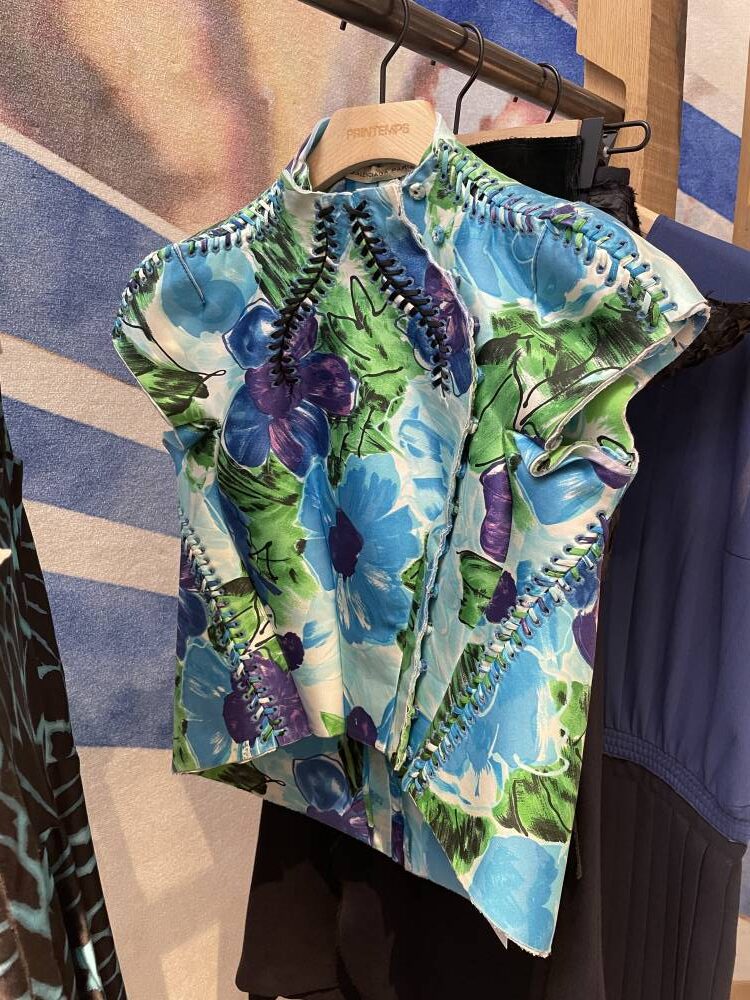
The Balenciaga years under Ghesquière reveal a particular temporal fragility. Though his work continues to re-enter circulation—most recently through Rosalía wearing his Spring/Summer 2004 tunic dress in her “Berghain” music video, loaned from the Barcelona-based rental archive Algo Bazaar—the period remains archivally unstable. It predates fashion’s full absorption into Instagram culture and algorithmic visual memory.

As a result, much of his most consequential output persists through fragments, recollection, and dispersed private ownership rather than being consolidated through museum acquisition, monographic study, or other forms of institutional record.
This instability extends to its documentation. Beyond his inclusion in “Balenciaga: Paris 2006–2007 (Musée des Arts Décoratifs),” there remains no comprehensive monograph dedicated to his Balenciaga years.
For a designer who introduced a futuristic, almost prosthetic logic into Balenciaga’s tradition of form, this absence is telling. It exposes how fashion history continues to privilege figures that are easier to mythologize, market, and monumentalize rather than those whose legacies resist institutional packaging.
If sustainability is understood as a system’s capacity to maintain resources across time, then keeping and collecting become part of fashion’s sustainability infrastructure.
In an industry driven by speed, replacement, and visual amnesia, collecting operates as a counter-practice, redirecting garments away from obsolescence and toward long-term use as cultural, technical, and intellectual resources.
Read the full feature on lifestyle.inquirer.net