



Corruption and climate (in)justice (1)

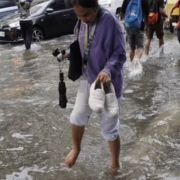
Corruption kills. Insatiable greed among our government officials and their capitalist collaborators has caused misery and death to vulnerable groups, especially those who live near mountainous areas whose forest cover has been lost to rapacious past logging and mining activities.
In early November, Typhoon “Tino” battered the province of Cebu, leaving in its wake the deaths of more than 200 people and the displacement of thousands of families. This disaster has become the emblematic example of how corrupt practices have killed innocent people. Corrupt government officials in regulatory bodies like the Department of Environment and Natural Resources have turned a blind eye to capitalist/corporate business to transform Cebu’s mountains into hotels, resorts, and other capitalist ventures. These officials were also supported by equally greedy local government officials who had been paid off with bribes to allow these questionable projects to be built in ecologically fragile areas.
Amid all these scandals, some nongovernment organizations have taken the lead in urging people to sustain their rage against these corrupt individuals in both government and the construction business community through various mass movements, such as indignation rallies. Rallies have been held here and there, some of which had dubious intentions toward creating a coup-like scenario for a change in leadership. Thankfully, this did not materialize—to the consternation of those who had been waiting in line and preparing themselves to take over the reins of government.
But for some human rights groups, grounded in the plight of many indigenous peoples who are always at the receiving end of the adverse consequences of massive government projects, one effective way is for people to take action collectively.
With the theme, “From Crisis to Collective Action: Defending Land, Life, and Self-Determination in Mindanao,” the two-day conference on Climate Justice and Solidarity was held at the Diocesan Pastoral Center in Malaybalay, the capital city of Bukidnon province. The conference on Nov. 27-29, 2025, brought together religious leaders from various congregations and faiths. It also invited some academics, notably from the Mindanao State University main campus in Marawi City, as well as legal and medical professionals, social development practitioners, thought leaders, bishops, and pastoral leaders of the Catholic hierarchy.
The Mindanao Climate Justice Resource Facility Inc., with its head office in Marikina City but with projects in many localities in climate change-vulnerable parts of Mindanao, took the lead in conducting the conference.
For two days, participants were engaged in serious discussions on how they could come up with collective action to defend their rights to their land (which is their life). They also tackled several capacity-building strategies to assert self-determination and human rights to a safe and stable environment that celebrates, rather than kills, life in all its forms.
As a discussant in the plenary session on the first day, I was tasked with presenting my reflections on the topic of gender and climate justice. I shared with the participants the findings and recommendations from two exploratory studies, where I served as a coresearcher for the first and as the research team leader in the second one.
The first case study was exploratory in nature. Titled “Climate Fragility Risks in the Bangsamoro, it delved into how communities have coped with armed conflicts that intersected with adverse consequences of extreme weather events. Our study tackled how climate change events, like typhoons and droughts, can strongly impinge on the vulnerabilities of people who are frequently exposed to violent armed conflict episodes. Many times, violent conflict episodes took place while a typhoon raged, and floodwaters swept away people’s homes and their livelihoods.

The second study was more inclusive. It tackled how gender inequality, social exclusion, and other vulnerabilities of marginalized and impoverished populations exacerbate the situation of communities that are frequently exposed to violent armed conflict, especially in some areas in the Bangsamoro autonomous region. In the second study, we included the armed conflict-prone areas in the province of Lanao del Sur, including the city of Marawi.
(More next week.)
—————-
Comments to rcguiam@gmail.com