






When Rody’s curses rained on PH press

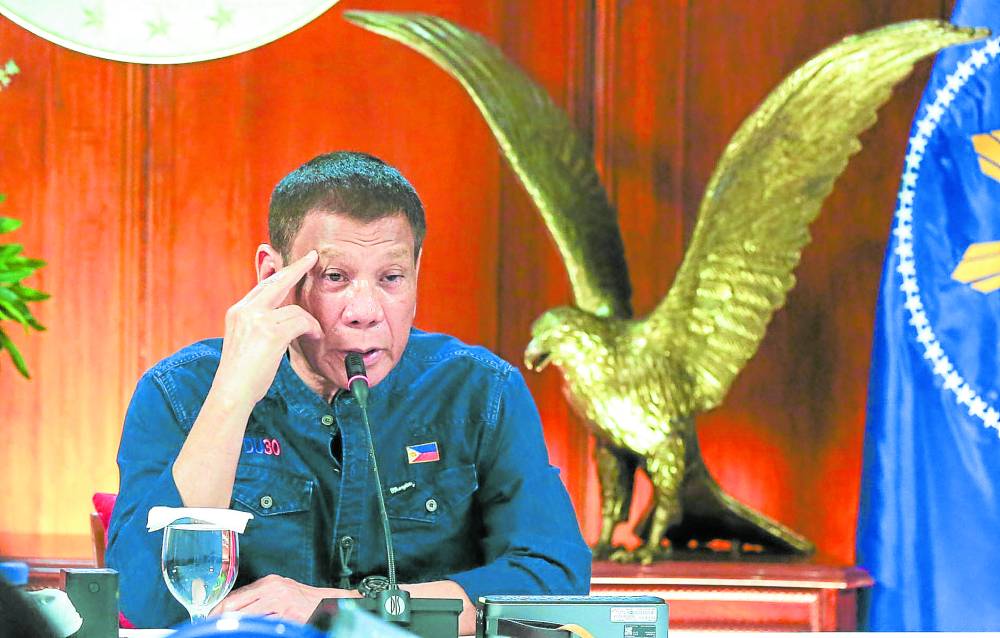
Covering Rodrigo Duterte was an eventful, bumpy ride. It meant dealing with an unconventional president who cursed wantonly, used violent rhetoric, threatened critics, and attacked news organizations.
Duterte’s tough antidrug and anticrime message, punctuated by his blunt remarks, served him well in the 2016 campaign.
When he won, his unorthodox style, language and habits continued, flouting the formality expected of the top Palace occupant.
Some said it was interesting, even refreshing. But the novelty soon wore off.
Violent language
Following Duterte at public events often meant witnessing the Commander in Chief threaten to kill or do harm, his words directed at drug suspects and others who crossed him.
Hearing such violent language from the country’s highest, most powerful official was shocking the first time. I thought these words could hardly be seen as mere empty threats.
It was also jarring for me to see officials applauding him and defending his words, even as the body count in his drug war soon rose and drew condemnation both locally and abroad.
But no amount of criticism stopped him. The barrage of curses was his way of lashing out at those who questioned or disagreed with his statements and policies, whether about the drug war or other programs.
He spared no sector, taking umbrage at comments from a wide range of critics, including justices, the clergy, rights groups, foreign organizations, activists, and businessmen.
Hostile to media
The media was not spared. Combative or hostile to the press, he dismissed mainstream media as tools of the elite or of oligarchs.
He zeroed in on specific organizations, with ABS-CBN, Rappler, and the Inquirer becoming targets of his vitriol, accusing them of unfair coverage.
One of Duterte’s pointed remarks against the Inquirer came during his first State of the Nation Address, where he called out the broadsheet over a “dramatic” banner photo showing Jennelyn Olaires weeping as she cradled the body of her husband Michael Siaron. The pedicab driver was shot dead by “motorcycle-riding gunmen,” who also left a cardboard sign branding him a “pusher.”
The “Pieta-like” photo was circulated widely, becoming one of the most striking images of his so-called drug war.
In March 2017, barely a year into his term, the President started his attacks specifically on the Inquirer and ABS-CBN.
In a speech in Malacañang for an oath-taking ceremony of certain officials, he went off-tangent, cursing at the two news organizations: They were all “rude,” their “oligarch” owners “full of shit,” and “karma” would soon come their way.
A month later, he signaled that he would block the renewal of ABS-CBN’s franchise.
Uncomfortable, concerning
The Inquirer is no stranger to criticism from Malacañang, having survived an advertising boycott during the presidency of Joseph Estrada.
But when rumors of the possible sale of the Inquirer began a few months after Duterte’s speech in March, it brought home the fear that the paper might fold under his attacks and leave me and my colleagues jobless.
The Inquirer survived Estrada, but I could not help but wonder if it would survive Duterte.
Hearing the President constantly lash out at my employer and other media outlets while I covered his events was both uncomfortable and concerning.
There was always the worry that there might come a day when Inquirer reporters would be barred from Malacañang coverage.
Fortunately, Inquirer reporters were not restricted from covering Duterte’s events.
But it was not the case for Rappler, which Malacañang barred from physically covering the President, citing the shutdown order from the Securities and Exchange Commission.
The Palace also said Rappler’s accreditation had been revoked. The Malacañang Press Corps, however, said it was keeping Rappler as a member and asserted its prerogative to accept, suspend, or revoke membership in the body.
Preferential access
Still, some media outlets or reporters received preferential access. There were times when a handful of reporters were invited to his official residence in Malacañang for an interview with the President.
Inquirer reporters were never included in these events, which meant that we had to play catch-up with the stories coming from that meeting.
Another challenge in covering Duterte was his tendency not to stick to his schedule, as he was often tardy.
Palace officials chalked this up to his nocturnal habits that supposedly started when he was mayor of Davao City. Duterte was said to have personally patrolled the streets at night, which meant waking up late the next day.
His tardiness as President meant keeping guests and officials waiting for hours and disrupting the schedule for subsequent events.
When the pandemic hit, his meetings were also held late at night and his public addresses, called “Talk to the People,” were aired at midnight or in the wee hours.
He tended to ramble, jumping from topic to topic, rarely sticking to prepared talking points.

This often proved to be a problem because some of his statements were vague or incomplete; accurate reporting became tricky.
Keeping up with Duterte could be physically taxing because he was active at night and early morning, and rested during the day. Yet reporters still had to cover other daytime events at Malacañang.
Stark focus
These hassles, though, were nothing compared to the impact of his attacks on the media.
This was brought into stark focus when the House of Representatives, dominated by his allies, rejected ABS-CBN’s franchise renewal at the height of the pandemic, just when it was crucial for people to be kept informed on the health crisis.
The Palace tried to distance Duterte from the network’s closure, but the connection between the President’s threats and the franchise rejection was hard to ignore.
It was a dark time in the media because it showed that angering the President could actually shut you down.
Not a few thought that if it could be done to a giant like ABS-CBN, it could be done to any media outlet.
This is not to say that the media is infallible; all of us have our lapses.
But targeting outlets for closure was certainly a disproportionate response. There are mechanisms for raising complaints about errors or perceived bias in reporting, and opportunities to correct mistakes. Trying to silence a media agency is never the answer.
Standing our ground
By the time the ABS-CBN franchise issue was heating up, Duterte’s attacks on the Inquirer had waned.
But I was always on alert, as one could never know when he might set his sights on the paper again. I never stopped writing stories because of Duterte’s rants and threats, but these gave me pause every so often.
There were also times when I debated with myself about whether I should calibrate my words, to avoid worsening Duterte’s assaults on the Inquirer.
Many warned us about the chilling effect of such attacks. While the intensity might have varied, still it was real.
Self-censorship is a danger to journalism. This is why the media needs to stand its ground and push back against efforts to stifle reporting. An emasculated press means a less informed public.
Even when access can be revoked and franchises rejected, journalists who continue to dig, question, and write make sure that the truth reaches the public. Covering Duterte was a test of resilience, but it also showed that curses or threats couldn’t stop a determined press.