








Theater in a cafe? A discussion on alternative theater spaces

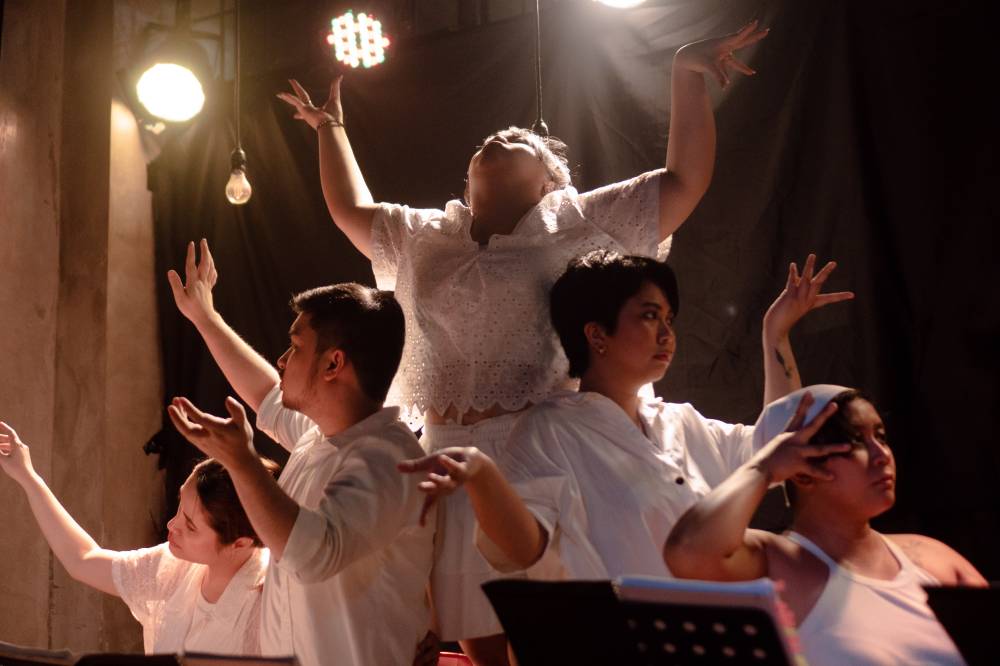
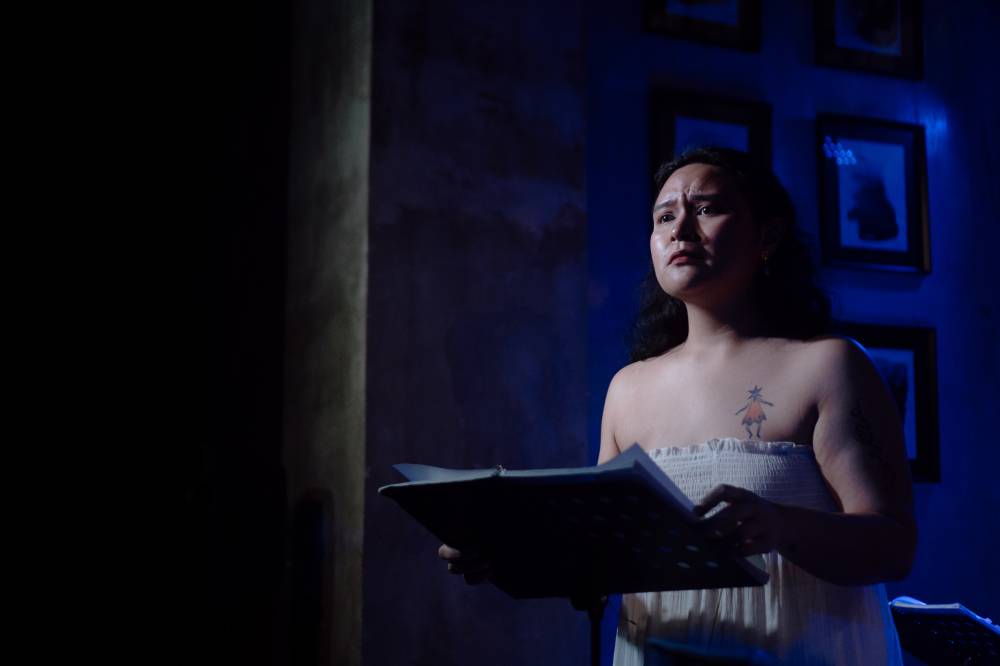
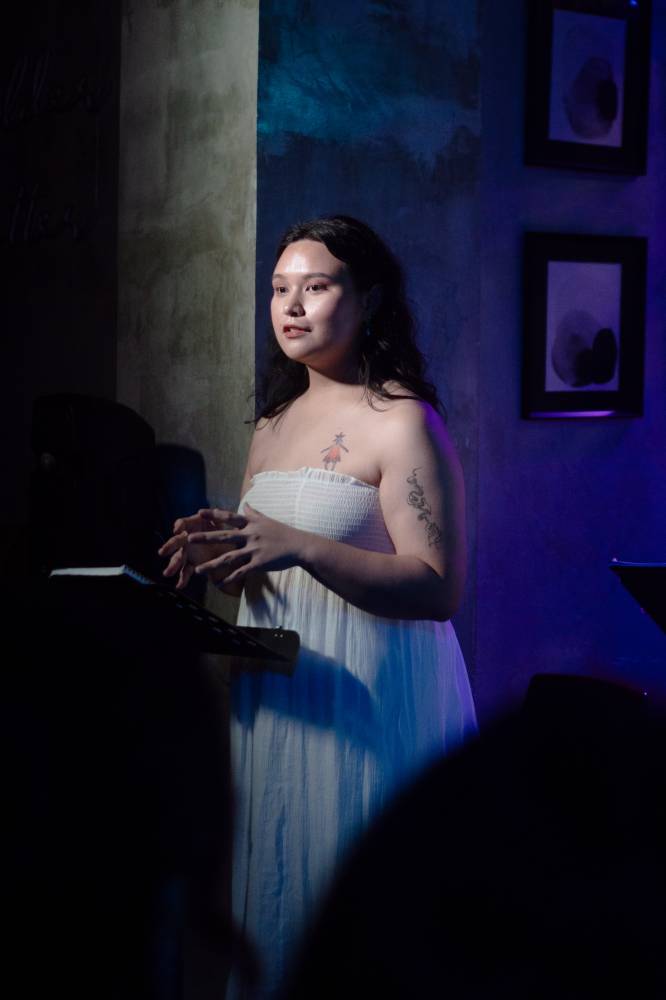
Last Dec. 5 and 6, Infinite Cantina held a staged reading at the Dark Roast Coffeehouse in Maginhawa for Bea Racoma’s play “Lost Tongue.” Directed and performed by Racoma, along with Ranz Aganan and a chorus starring Iman Ampatuan, Maia Dapul, Joy Delos Santos, Cholo Ledesma, and Senanda, the play is a dense work of overflowing emotion. In Racoma’s own words, it is “a surrealist play about this woman going through a lot of grief because, in her life, there’s this spectre—a spirit of a loved one who has passed away—who continues to haunt her.”
“The play tackles her dreams, her memories, her what ifs that push her to confront her grief and sense of self,” she adds.
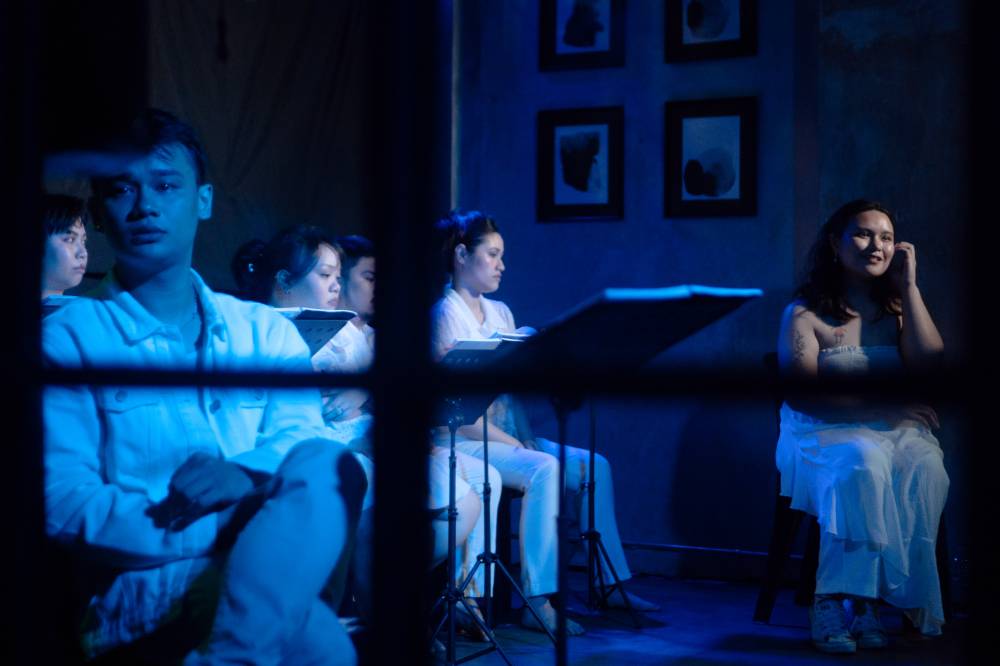
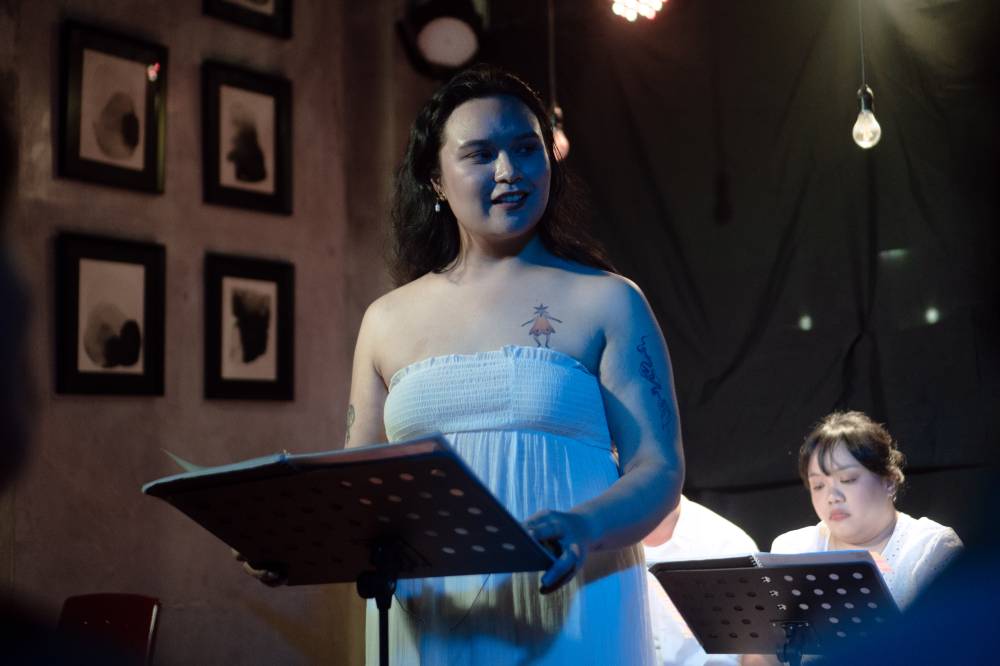
The cafe seats about 60 people, and the audience members in the front row seats are a mere five feet away from the actors. As a staged reading, the performers are seated in a firing line with a music stand to hold their scripts. Someone off stage reads the stage directions while the actors read off their lines from the script, and sometimes, physically act out some scenes (though this is not the norm for many staged readings, but not uncommon either).
From poetic to the mundane
With minimal stagecraft—no set design, some music, and someone operating the house lights—the play comes to life from just the performative reading of it.
“Lost Tongue” is highly lyrical, with Racoma’s text seamlessly slipping back and forth from the poetic to the mundane. I call it dense because it’s highly symbolic. After all, it operates in the level of the interior mind, from dreams to memories, and even fantasy, and oftentimes, the symbols have no easy access to what it is they are representing.
The play is cut up into chapters, and it jumps back and forth through time (after all, the experience of grief is never linear). The overall effect is dizzying but engaging. Strangely enough, the scenes per chapter seem impossible to mount outside of a staged reading concept—some scenes require an ocean, which the actors are swimming in; others a playground, or even a bar. The scene shifts, and if it were to be produced on an actual production, it would be hard-pressed to deliver the materiality of the play’s mercurial settings. And it would require extensive video projections.
But as a staged reading, with the actions and scene changes read out by a narrator, “Lost Tongue” has the effect of hitting you like a freight train of unbridled emotion.
Ad infinitum: Two plays in memoriam
“Lost Tongue” is the first play in Ad Infinitum, a sort of double-header produced by Infinite Cantina for Dark Roast Coffeehouse. Dec. 5 and 6 is for Racoma’s “Lost Tongue,” while this coming Dec. 12 and 13 is for “The Black Bordello” of BJ Crisostomo. Both theater practitioners decided to work together when Crisostomo caught wind of Racoma rehearsing “Lost Tongue” and decided to help her produce it.
For Racoma, a theater practitioner whom I met when she was working in the marketing and PR arm of The Barefoot Collective, she felt that she needed to scratch an itch. “The year is ending, and I still need to do another acting project,” she says. “And I want to put my play out there. Even if I have to produce it myself.”
Crisostomo then chimes in, saying, “She was already rehearsing before I came along. I then offered her three of my works that I have never staged, and ‘The Black Bordello’ ang pinaka bagay. They are both surreal and are about confronting the past, dealing with trauma, and dealing with memories. They work together well.”
Crisostomo’s “The Black Bordello” is a story about a criminal running away from the law, who stumbles into a rundown bar-slash-tomb. He meets two people who then help him confront and reconcile with his past. It’s a piece he wrote four years ago, when his art space Dito Bahay ng Sining closed due to the pandemic. It was a way for him to deal with the loss of something he had worked hard on since 2013.
Now, he gets a chance to direct the play he wrote. He revisited the piece and has made adjustments to it. “I’m trying to make it tighter, trying to make it punch better, make it more accessible,” he says, also mentioning that it runs for 130 minutes.
“I have a problem with length,” he jokes. “I’m known for these kilometric running times.”
Alternative venues for theater
There have always been theatrical productions performed in alternative spaces in Metro Manila. In my discussion with Racoma and Crisostomo, renting out theatrical spaces is expensive, and smaller companies don’t have the capital to produce the work. Thus, a lot of these smaller companies find coffee shops, rehearsal studios, clubs, and other venues to produce their shows.

I remember catching Sipat Lawin’s “Battalia Royale” at the Museo Pambata, where the whole museum grounds were used to stage an interactive play with multiple characters in multiple areas, with the audience choosing who to follow. Recently, Eksena PH produced “Kapeng Barako” in Shylo Cafe, and just recently, I heard about the play “Ateng,” which was performed at Rampa Drag Club.
“Outside of the traditional theater, even outside of a black box, we see more opportunities,” explains Crisostomo. “Mas nagiging malaro ang utak. Because we have to play with the space. Like site-specific theater, we have to use the architecture of the space. We have to speak differently, we have to move differently. It’s more exciting.”
Racoma describes the distance one gets from watching a big theatrical production, saying, “You know you are watching a show [in comparison to theater performed in smaller venues, where] you are a few feet away from the actor and you can see every nuance in their eyes and every expression in their face. It can be life-changing in its own way.”
Different venue, different experience
And the staged reading is a different experience altogether. “There’s an appeal in the rawness of the material and the intimacy of it,” shares Racoma. “The intimacy of a staged reading, in a small venue… you are sharing that space with the performers, with the people in the tech booth—sharing air—and there’s such an appeal [there] because it’s communion.”
“In a staged reading, the text is put forward,” says Crisostomo. “There’s also the phenomenon of theater of the mind—like when we read, the visuals are not supplanted or given to us.”
“Similarly, in a reading, we are confronted with just the words; we become production managers ourselves, as the audience,” he adds. “We become the lighting designers of the show. We co-create the show. It’s more democratic than when the spectacle is forced on us. It is a shared dream, it’s what I see in a staged reading.”
If my experience with “Lost Tongue” is any indication, it definitely is a shared dream. “It’s also proof of concept,” finishes Crisostomo. It’s a chance for playwrights outside the bigger companies to get their works out there. To test run it, to work out the kinks. To see how it thrives with an audience.