







Edsa rehab finally a go: To take 8 months starting Dec. 24

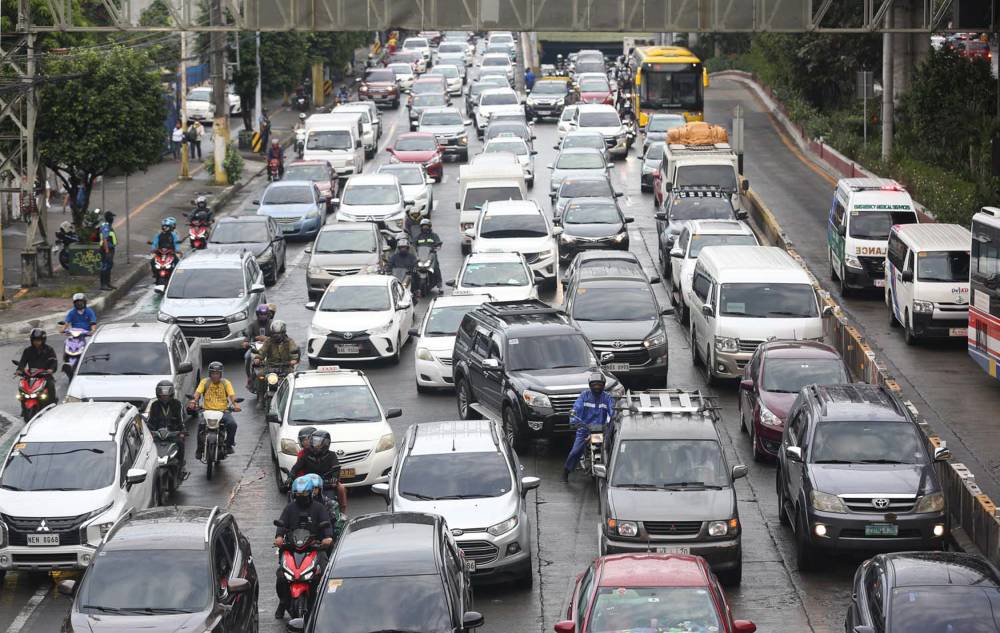
After several postponements, the rehabilitation of Epifanio de los Santos Avenue, or Edsa, where about 400,000 vehicles pass daily, will finally start on Christmas Eve and will be done in two phases over at least eight months.
It will also now cost only P6 billion, a fraction of the initial P17-billion budget, said Public Works Secretary Vince Dizon, who also presented a detailed schedule of the daily work.
At a joint press conference with the Department of Transportation and Metropolitan Manila Development Authority (MMDA) on Wednesday, Dizon assured that there will be “minimal disruption” to traffic while the much-needed rehabilitation—set to start on Dec. 24—is ongoing.
“We really need to fix Edsa. Not just Edsa, almost all our roads in major cities need to be fixed, but the President said there should be minimal disruption to our motorists and commuters. So, the [Department of Public Works and Highways] have been working on finding a better way these past months,” Dizon said.
Work schedule
“Today, we are here to present that better way,” he added. “This is very different from the original plans that were presented in the earlier days.”
President Marcos earlier postponed the project to allow the government to conduct further studies on its impact, following concerns raised by commuters that it will further prolong their travel time.
The updated plan is composed of two phases, each one taking at least four months to complete. The first phase focuses on fixing the portion of Edsa from Roxas Boulevard to Orense Street in Makati, while the second deals with the rest.
This covers a shorter period compared to the previous plan that was expected to take two years, said Dizon, who explained that the DPWH initially wanted to conduct reblocking works and asphalt overlay for the entire stretch of Edsa. But given the need to ensure minimal disruption, he explained, the new plan will fix only selected portions.
“You all know we are all very angry (when it comes to) reblocking because sometimes we see beautiful new roads are suddenly destroyed. That won’t happen again. Here in Edsa, we will only reblock what needs to be reblocked,” Dizon said.
Starting at 11 p.m. of Dec. 24, he said asphalt overlay and reblocking of busway lanes will be conducted 24/7 until Jan. 5 at 4 a.m. to finish all reblocking works for phase one.
“We will be working 24/7 on Edsa during the Christmas and New Year holiday. As [MMDA Chair Romando Artes] said, not many people will use Edsa during this time. Even passengers on the busway—they are not that many. So we will take advantage of that,” Dizon said.
New asphalt tech
Transportation Secretary Giovanni Lopez said the bus lane will be moved to another lane during the rehabilitation period, while Artes assured that there will be no changes to the number coding scheme.
After the holidays, starting Jan. 5, asphalt overlay will be done lane by lane (northbound and southbound) on weekdays from 10 p.m. to 4 a.m., with the asphalted portions opened to traffic by 5 a.m.
Any additional asphalt overlay and reblocking works, meanwhile, will be carried out from Friday to Sunday, from 10 p.m. to 4 a.m.
“When 5 a.m. arrives, the road they are working on, which is being paved, will be opened and used by our countrymen,” Dizon said.
Work on the asphalt overlay is scheduled until May 31, with an additional month allotted as a contingency measure.
The project cost has been reduced to P6 billion, which Dizon attributed to adjustments in the price of construction materials used for public infrastructure projects, as well as the new technology that will be used in the repair.
“We will be using new asphalt technology,” he said. “Now, we will be using Stone Mastic Asphalt Technology. I don’t think it has been used on our national roads yet.”
While this type of asphalt is more expensive, Dizon said it is more durable and easier to maintain than traditional asphalt. He added that it is important to use a stronger material given how only selected areas will be reblocked.
Postponements
The start of Edsa’s rehabilitation has been moved several times in the past.
In February this year, Artes announced that it was set to begin in March starting with the southbound lanes.
The goal was to complete the rehabilitation in time for the Philippines’ hosting of the Association of Southeast Asian Nations (Asean) Summit in 2026.

But the government later postponed the start to May 15, or three days after the midterm elections.
In May, then Public Works and Highways Secretary Manuel Bonoan announced that preparations for the rehabilitation would begin on June 13, and would last until 2027.
Scientific studies
In June, however, plans were changed again after Mr. Marcos ordered the project’s postponement to allow the government to conduct scientific studies on measures, including the use of “new technology,” to alleviate its effects on traffic flow.
Mr. Marcos suggested revising the plan to complete the work in six months to a year, instead of two years.
The President, in a vlog released on June 8, said the postponement should remain in effect until “a solid rerouting plan” is proposed and local government units are fully ready.
A month later, in July, Bonoan said the rehabilitation would push through in 2027 and might take only six months. He also said the cost may be lower than original budget.
In October, Dizon ordered the indefinite suspension of all road reblocking works in the country due to allegations of corruption in the implementation of these projects.
The rehabilitation of Edsa involves the replacement of nearly the entire 24-kilometer stretch of Metro Manila’s busiest thoroughfare to ease traffic congestion, enhance safety, and prolong the road’s lifespan.
Among the planned works are concrete reblocking and laying of new asphalt on damaged portions, road widening and sidewalk improvements, drainage upgrades, improvement of lighting and signage, and bridge and flyover maintenance. —WITH REPORTS FROM MARY JOY SALCEDO AND INQUIRER RESEARCH
Source: Inquirer Archives