









On John Cena’s retirement and the maturity of giving up

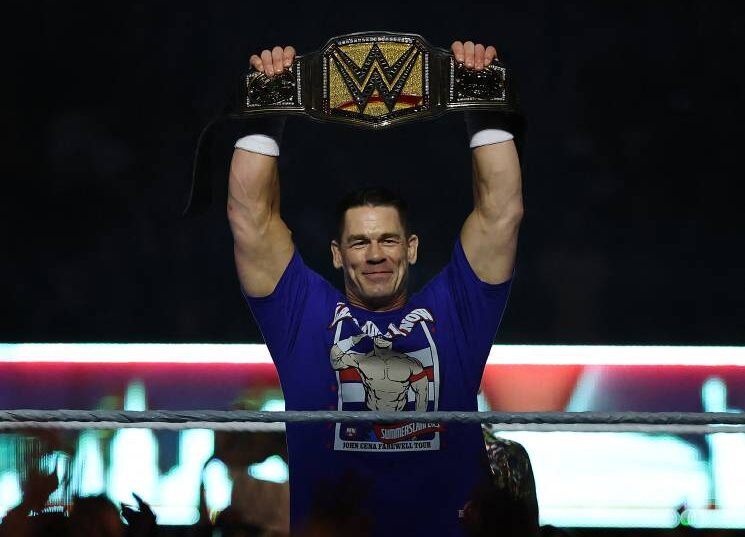
On a near-freezing mid-December evening, in front of nearly 20,000 adoring fans inside a storied basketball stadium at the capital of the United States, pro wrestling legend and future Hall of Famer John Cena gave up.
He did this to end a 26-year wrestling career, 23 of which were spent in WWE, the world’s most popular company—and for most of those 23 years, he insisted with his whole chest that he never gives up. Because that is who he is: passionate, persevering, unrelenting. That is what got him to the top of the business as a multiple-time champion, and that is what got him to cross over into other ventures, chief of which is acting in movies and TV, where most people can see him now.
But he gave up.
And the fans were absolutely not having it. His final match should have been a feel-good moment, they cry. Who cares about the time-honored tradition of the outgoing star, the past of the business, handing a much-needed win to a younger athlete who would be considered the future, if not the present? We wanted to salute him with a smile, not with a frown and tears, they say.
This isn’t what we wanted at all, they angrily declare—especially now that professional wrestling has been very open recently about how it tells its stories.
The final yarn
For those who are not fully familiar with how pro wrestling operates, yes, it’s not “real,” in the sense that everything that happens on screen is predetermined in the same way all fiction and drama is.
Haters of wrestling (who tend to be adults who prefer real combat sports because their intelligence isn’t being insulted) begrudge the fact that the sport that presents itself as reality is actually very much not. This hatred makes them completely unable to appreciate the art as live sports theater and cinema.
And it’s that drama that Cena hung his wristbands and APL sneakers on, opting to honor tradition and tell one last story to help his opponent Gunther instead of indulging the crowd’s—his adoring fans, many of them doe-eyed children, and children-at-heart who grew up in the rise of his career—desire for a happy moment to bookend his legendary career.
The story was simple, and it was this: after over two decades of hustling hard and never giving up, he finally let everyone know that it’s okay to let go. It’s not “giving up” in the traditional sense; it’s the final breath of relief after a long, long time of giving everything he’s had, and in the crucial moment in which he could not overpower a threat that was much greater, much younger, much more relentless than he is, it was okay to let go to finally find peace.
“Never give up,” while noble, carries a small inkling of toxicity, sometimes goading people to push beyond their physical, mental, and emotional limits, and sometimes irreparably damaging themselves in the endless pursuit of their goals.
Somewhere along the way, I like to think that John Cena grew up and realized that the superhuman ethos of his onscreen character, which he also embodied in real life, also still had some maturing to do when it came to this. The final story he wanted to tell was that while you have to give it all you’ve got, there are times when one must leave things to fate.
It’s okay to lose.
Overwhelming feelings
Cena’s final defeat was actually a selfless act. Not to his legions of fans (the “CeNation,” they were once called), but to the unstoppable opponent that put him down, the villainous Austrian Gunther.
To the very end, the move to tap out with a smile was purely to provoke the crowd’s strongest displeasure, all meant to build up Gunther’s stardom further as the bad guy, not just in Cena’s story, but in wrestling’s larger tapestry moving forward. Whether the masses were aware of it or not, the decision’s wisdom was reinforced in the opening minutes of the “Monday Night Raw” that followed the retirement, where the crowd rained thunderous boos on Gunther, who soaked and even reveled in the hatred.

Cena knew. The story he told in the moment was one thing, but this visceral reaction was exactly why he retired on a downer.
For those who have been around long enough to witness Cena’s initial rise, this opposition to what the people wanted is also what will define his legacy as a pro. The wins he scored at the top of the mountain were decisions that were hugely unpopular at the time, but helped shape his resume and credibility as wrestling’s face.
So it should not be surprising that the decision to lay down for someone to help them along—the right thing—was one of the most unpopular things he could’ve ever done.
Every last bit of his art
Like a good share of art painted, written, and sculpted throughout history, a lot of times the work goes at odds with the viewer’s expectations. Most times, the meaning sails over their heads, sometimes outright rejected simply because it was not palatable to them. It’s been something he’s been trying to do in his last lap this entire year, to mixed results.
It is in this complex intentionality that professional wrestling reveals itself from time to time as a valid art form, and Cena himself as a consummate artist who completely understands what he does—and doesn’t blink and shrink when the audience does not.
And to the end, he gave every last bit of his art that he had, whether or not it was what we thought we wanted. With one smile and three gentle taps, Cena let go to move on and know the peace that had eluded him in decades of (staged) war.
And even if it isn’t yet okay with everyone today, Cena also knows that in due time, it will be.