








Filmmaker ‘directing’ FAP carries out vision of movie workers’ welfare

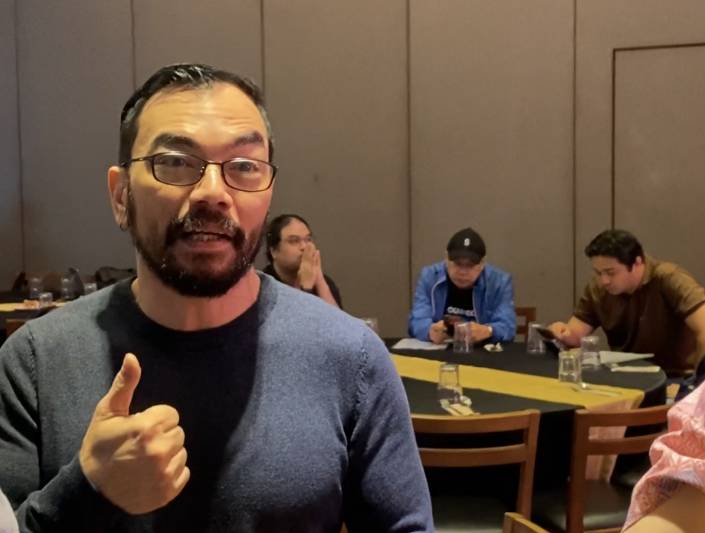
Since his appointment in September 2024 as director general of the Film Academy of the Philippines (FAP), Paolo Villaluna has established several functions in the agency needed “to further professionalize the industry,” considering that many of its workers are freelancers and contractuals coping with a lack of job security and other benefits.
This is before FAP could secure a budget and even a permanent office space—the conditions still confronting the agency when it was launched as a reorganized body on Dec. 12.
Villaluna, already a year into his new job, had originally turned down that position.
“I felt like para siyang malaking batong ipupukpok sa sarili mo (I felt the job was like pounding a rock on your head),” said the acclaimed film and TV director whose credits include his first full-length feature “Ilusyon,” a love story whose meta structure suggests his own passion for cinema, and the ANC news program “Storyline.”
Critical issues
Then, on second thought, he realized the critical issues affecting the film community—which needed to be tackled in the FAP. Although his role there is largely administrative, it is as meticulous as the craft of filmmaking itself.
“Some of the reasons [I took that job] included the fact that the Eddie Garcia law was passed,” Villaluna said at the launching, referring to Republic Act No. 11996 which provides proper work conditions for film and TV workers.
The law was prompted by veteran actor Eddie Garcia’s fatal accident during a shoot in 2019. Villaluna said he wanted to see how this legislation would benefit the workers.
Another issue that prompted him to reconsider the FAP offer was the detention of fellow filmmaker Jade Castro.
In January last year, Quezon police arrested Castro and three others for arson in connection with the burning of a jeepney. But a court in that province dismissed the charges two months later and ordered their release.
“What if you’re not a director? What if you’re just a worker and you’re unjustly jailed?” Villaluna said about that episode. “So it kind of dawned on me that an active film academy might do something for the film industry.”
FAP’s mandate
Following Villaluna’s appointment, President Marcos issued Executive Order No. 70 on Oct. 5 reorganizing the FAP and transferring the agency from the Department of Education to the Department of Trade and Industry. The order cited as its basis the need to “strengthen the FAP” and “maximize the full potential of the Philippine film industry.”
The FAP still has as its chief mandate “the professionalization of the film industry,” Villaluna said. “Our [tasks include] upskilling, workshops, training and industry support [as well as ensuring] the welfare of workers in the audiovisual industries.”
FAP also “oversees the selection and support of the official Philippine entry to the annual Academy Awards and other similar industry-led international awards.” Another government agency sometimes confused with FAP is the Film Development Council of the Philippines (FDCP), the policymaking body on supporting and advancing film production in the country.
In line with his agency’s mandate, Villaluna convened on Dec. 9 the First Guild Consultation Summit, including the group he used to head, the Directors Guild of the Philippines.
Among the groups he cited were the 600-member group of background actors, the Philippine Talents Guild, and the 700-member Alliance of Filipino Stunt Professionals.
“We all know how factions have emerged among these guilds. So we asked all the leaders, can we unite under one umbrella?” he said.
Villaluna had also met separately with Trade Secretary Cristina Aldeguer-Roque and, before her resignation, Budget Secretary Amenah Pangandaman. The meetings led to the establishment of permanent positions in the reorganized FAP and its approved budget which later hurdled the Senate’s scrutiny.
Accreditation, benefits
FAP’s approved budget required the accreditation of the guilds to certify that these groups were legitimate. “In the Labor Code, freelancers and contractuals cannot form unions, unlike in the US where they have the SAG-AFTRA (Screen Actors Guild—American Federation of Television and Radio Artists),” Villaluna said. “But we are allowed to create guilds for collective bargaining, for collective representation. That’s why accreditation is very important.”
Being formally organized, the guilds also served the purpose of establishing a database of workers so they can be given benefits. “This includes maintenance medication, surgical benefits up to three times a year, death benefits and others,” Villaluna said. “We will be having consultations and diagnostic exams for free. But you have to apply to become an Academy member.”
FAP has also introduced a grievance reporting system called Sine-Sandigan, wherein workers can file grievances either through physical submission at the Academy or via grievances@filmacademy.gov.ph
“This legal help desk includes consultation for contracts,” Villaluna said. “In fact, our lawyers already created 16 contract templates, because we know that each and every worker should have a contract.”
Trade Assistant Secretary Kris Ablan commended Villaluna and his team for their efforts even ahead of their budget’s approval. “All this time up to mid-year of 2025, this guy was working for free,” Ablan said. “[But] we were able to get the budget for 2026 at around P80 million inside the NEP (National Expenditure Program).”
No Hollywood ending yet
Despite its aggressive campaign, FAP’s bets for the Oscars—Lav Diaz’s “Magellan,” Baby Ruth Villarama’s “Food Delivery” and Don Eblahan’s “Vox Humana”—failed to make it to the shortlists of their respective categories of best international feature film, best documentary feature and best live action short film.
Another film supported by FAP, King Palisoc’s music drama “Song of the Fireflies,” lost in its bid to secure a nomination in the best song category in the Golden Globes.
But for Villaluna, “the key strategy for this year is that Hollywood realizes we are serious in our campaign [to promote our films].”
“We are known creatively in Cannes, Berlin, Venice,” said the film director who definitely knows his medium’s history.
It was in these festivals, after all, where Manuel Conde, Lino Brocka and Mike de Leon became established internationally and where Raymond Red’s now-classic short “Anino” (2000) won the only Palme d’Or so far for a Filipino film.
More recently, Brillante Mendoza won best director in Cannes for “Kinatay” (2009), Jaclyn Jose triumphed as best actress also in Cannes for her role in Mendoza’s “Ma’ Rosa” (2016), and John Arcilla won best actor in Venice for his role in Erik Matti’s “On the Job: The Missing 8” (2021).
Villaluna acknowledges that “Hollywood doesn’t see us as a serious player. [But] we’re starting to change that this year,” he said.