


Failure to ease inflation


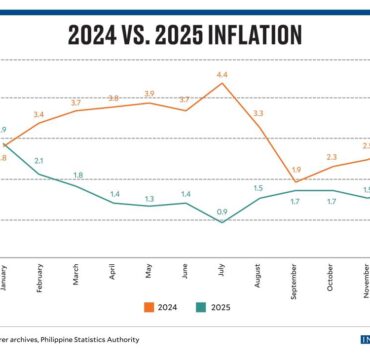
The Philippine Statistics Authority (PSA) reported on Tuesday that inflation, or the rate of increase in the prices of basic goods and services, accelerated to 1.8 percent in December, faster than market consensus and November’s 1.5 percent but within the Bangko Sentral ng Pilipinas’ (BSP) projection of between 1.2 and 2 percent for the month.
The December number brought the 2025 average inflation to 1.7 percent, significantly slower than the previous year’s 3.2 percent and also remained at the lower end of the official target for the year of between 2 and 4 percent.
The full-year average was also the slowest since 2016, when inflation registered at 1.3 percent, giving the BSP room to further reduce its policy rate that banks use to guide their own loan rates, such as those for housing, car, and credit card loans.
BSP Governor Eli Remolona Jr. described the December result as a “welcome number” and noted how inflation has consistently kept within the BSP’s target range in 2025.
Department of Finance (DOF) Secretary Frederick D. Go said the inflation rate in 2025 “reflects the effectiveness of our collective efforts,” noting that the number was lower than the expected global inflation rate of 4.2 percent for 2025, based on the International Monetary Fund October 2025 World Economic Outlook report.
Biting reality
Go particularly welcomed the PSA finding that the average inflation for the bottom 30 percent income households slowed to just 0.3 percent in 2025, much lower than the peak of 5.8 percent in July 2024 and the average of 4.2 percent in the same year.
However, while the numbers look good on the surface, they fail to capture the biting reality that Filipinos still need more meaningful relief from high food prices, as anybody who has gone to the public markets, groceries, and supermarkets and attempted to have a decent holiday meal with just P500 can attest to.
Stubbornly elevated prices have weakened their purchasing power, thus making it more difficult for Filipinos to stretch their budget to cover their essential, everyday needs, with hardly any left over–if at all–for the occasional wants.
This explains why for the fourth straight year, Filipinos have ranked controlling inflation at the top of their most urgent national concerns, despite the fact that the rate of increase has already sharply decelerated from a post-pandemic high of 8.7 percent posted in January 2023.
Urgent national concern
According to the Pulse Asia survey released last Dec. 30, an overwhelming 59 percent or almost three of five of respondents surveyed from Dec. 12 to 15 last year said that controlling the prices of basic goods and commodities was an urgent national concern, even as the flood control and infrastructure corruption crisis accounted for a bigger share of the headlines.
Indeed, while concern over widespread corruption and the misuse of public funds has surged, with 48 percent of Filipino now citing it as a top national issue from just 15 to 26 percent between 2022 and 2024, inflation still trumps other important issues such as reducing poverty, fighting criminality, and the spread of illegal drugs.
The issue on inflation is likewise tied closely to raising wages, ranked as the third top issue of national concern as it is the quickest and most effective way to cope with steadily rising inflation, which in December was driven almost entirely by the increase in the prices of food and nonalcoholic beverages brought about by typhoons and traditional holiday demand.
Given that inflation has hounded the Marcos administration from the beginning of its term, it is imperative that it devotes more attention and resources on fulfilling a campaign promise to bring down the prices of basic goods and commodities.

The government does have weapons at its disposal to ease these pressures, among them the significantly increased funding to the Department of Agriculture (DA).
Tangible benefits
The agriculture sector was allocated P297.102 billion this year, one of the single biggest items in the recently signed P6.793-trillion 2026 budget and the highest in more than a decade.
Agriculture Secretary Francisco Tiu Laurel Jr. vowed that the increased public spending would translate into tangible benefits that would be felt on the ground, including increased output of the livestock, poultry and dairy sectors, wider distribution of subsidized rice, and additional postharvest and distribution facilities to increase farm output and thus stabilize market prices.
“Investments in farm-to-market roads, irrigation systems, storage and cold chain facilities are seen critical to improving farmer incomes while keeping consumer prices stable,” said the DA.
Go has also assured the Filipino public that the DOF was ready to “implement necessary measures to keep inflation manageable and ensure that Filipino families are protected from price shocks.”
But as proven in the past three years, words are cheap. What Filipinos with stretched incomes demand now is concrete action to fulfill these promises.