



Senate president: No reply from long-absent Bato

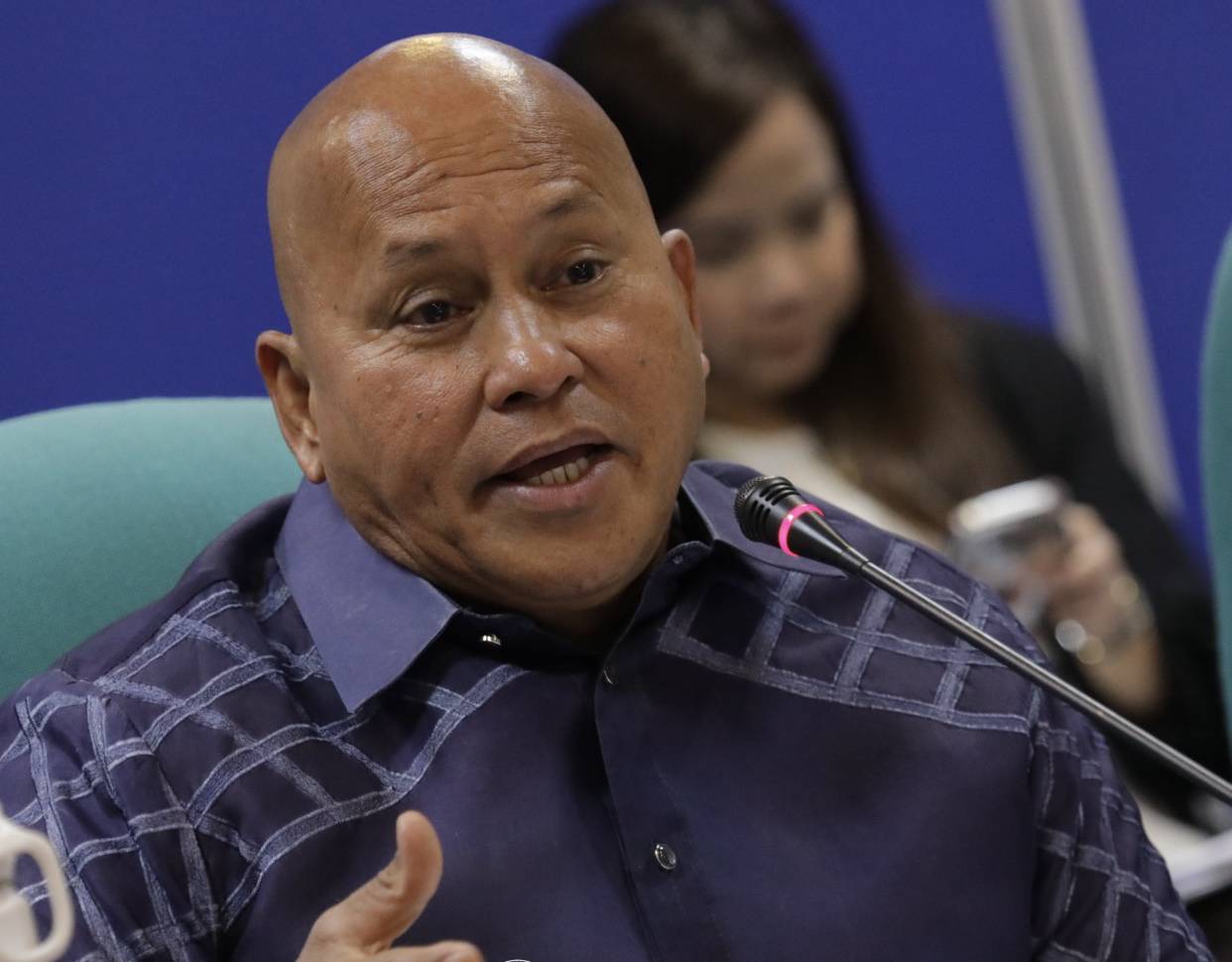
Senate President Vicente “Tito” Sotto III has made several attempts to contact Sen. Ronald “Bato” dela Rosa, who hasn’t responded since he stopped appearing in the Senate in November last year following reports that the International Criminal Court (ICC) had issued an arrest warrant for the former national police chief.
When Dela Rosa also stopped responding to the Senate’s group chat, Sotto said on Friday that he sent a personal text message to the senator to check on him.
That was about two months ago, about the same time that his daughter, Ciara, met Dela Rosa’s wife, Nancy, at an event in General Santos City.
“Ciara had many nice and heartwarming stories about how well she and Nancy got along, so I texted Senator Ronald to check on him and to thank him, telling him how wonderful the relationship was between his wife and Ciara, as well as with their children,” Sotto said.
“Those were my text messages. I texted him two to three times, but I never received any reply,” he added.
Sotto also recalled texting Dela Rosa about the 2026 national budget, as the latter was designated as a member of the bicameral conference committee, being the vice chair of the Senate committee on finance.
His last text message to Dela Rosa was before the bicam meetings on the 2026 budget last month.
Can’t compel appearance
Sotto said that the Senate could not compel senators to come to work, so long as their offices continue to function.
“To each his own—that’s how it is. He chooses not to come in, but his office is still functioning,” he added.
The Senate chief also pointed out that even in the past, he never questioned his colleagues on whether they come to work or not. “So why now?” Sotto said, admitting his predicament as everyone knew about Dela Rosa’s situation.
Dela Rosa started skipping Senate work since Ombudsman Jesus Crispin Remulla claimed in a radio interview that a warrant of arrest had been issued by the ICC against the senator.
As former President Rodrigo Duterte’s first national police chief, Dela Rosa spearheaded the war on drugs that killed thousands of suspected drug offenders.
Duterte is being held in a detention facility in The Hague, the Netherlands, awaiting trial for murder as a crime against humanity in the drug war.
“That situation was difficult for me because I know—and we all know—that he is avoiding the problem,” Sotto said.
“So why would I force him if he’s avoiding the problem? It’s his own lookout. He should answer to those who voted for him. As long as his office does its work, then we keep the office running,” he said.
Only when vote needed
The only time the Senate can force a member to report for work is when his vote is needed, Sotto said, citing a rule that allows the Senate president to order the arrest of a senator if the vote of every member is required. It already happened several times in the past, according to Sotto.
“There is an instance when that can happen—if your vote is important and you are absent. Unless you are abroad, in which case there is nothing we can do—you are beyond the powers of the Senate, or even of the country, of the Philippines,” he said.
So far, Sotto said there has been no instance that required Dela Rosa’s vote.
“If his vote is absolutely needed in the bicameral conference, and his vote is, let’s say, crucial, we would call on him to come in. If he doesn’t show up, we could even issue an arrest order to bring him to the Senate to vote,” Sotto said.
Lacson’s advice
Senate President Pro Tempore Panfilo “Ping” Lacson, who once called himself a “fugitive from injustice,” last November said he had intended to speak with Dela Rosa and advise him on how to handle criminal charges.
Lacson was in hiding from January 2010 to March 2011 to evade arrest after he was linked to the murders of publicist Salvador “Bubby” Dacer and his driver, Emmanuel Corbito, in 2000.
He denied involvement in the killings and alleged that the Arroyo administration was out to persecute him.
In an ambush interview last December, Lacson, who is also a former national chief, said he called Dela Rosa after word spread that the ICC had issued an arrest warrant for him.
Asked what advice he would give Dela Rosa, Lacson said he only wanted to share his personal experience “within the bounds of law.”

When he was pressed on whether he would teach Dela Rosa how to evade arrest, Lacson said in jest: “He has yet to decide whether or not he would hide. But if he ever decides to hide, I’ll teach him how.”
When Dela Rosa responded to his text message late last year, he told the senator to take care of himself.
“He joked: ‘Sir, I’m going to break your record for hiding, then followed by a ha-ha,” Lacson said in an interview with Senate reporters.
“My advice to him was that if he has no intention of surrendering, he should hide well,” he said, adding: “And my advice to law enforcement is to search for him thoroughly. That’s their job, to look.”
When Ping also disappeared
In August 2010, while Lacson was in hiding, the Department of Foreign Affairs canceled his passport upon a directive from the Department of Justice based on court orders. He was also included in the Interpol’s red notice.
In October 2010, the Commission on Audit (COA) forced the Senate leadership to close and stop all payments to his office.
Then Senate President Juan Ponce Enrile reportedly held an emergency caucus in the middle of their session after he learned that the COA was poised to question disbursements made by Lacson’s office without the lawmaker’s certification.
The COA needed Lacson to personally certify expenses culled from budget items, such as maintenance and other operating expenses and capital outlay under his office.
The senators reportedly “unanimously” decided to close Lacson’s office and withdraw its funding.
On Feb. 3, 2011, the Court of Appeals reversed the finding of probable cause by the Manila Regional Trial Court against Lacson. He appeared in public the following month.
In November 2011, the Supreme Court dismissed with finality the case against Lacson in the Dacer-Corbito double murder case. —WITH A REPORT FROM INQUIRER RESEARCH