
China cries ‘slander’ over Tarriela’s use of altered Xi images

Beijing’s Embassy in Manila late on Friday said it had lodged diplomatic protests against Philippine Coast Guard (PCG) Commodore Jay Tarriela for crossing the line by using apparently altered images of Chinese President Xi Jinping to supposedly start a smear campaign against China’s leader in his public engagements and on social media.
Guo Wei, deputy spokesperson of the Chinese Embassy, accused Tarriela of “serious violation of China’s political dignity and open political provocation” to which the embassy responded with “solemn representations” and protests in Malacañang, the Department of Foreign Affairs (DFA) and the PCG against Tarriela.
“In the face of Tarriela’s malicious provocations, we must ask: as a spokesperson of the Philippine Coast Guard, do his smears and slanders against China and Chinese leader represent the stance of the Philippine government?” Guo said. “As a uniformed service member, should he not be subject to the most basic standards of discipline and ethics? Why is he able to act so recklessly without being held accountable?”
“We hope the Philippine side will provide clarification and an explanation.”
There was no immediate response from Malacañang, the DFA and the PCG on Beijing’s protest against Tarriela, the PCG spokesperson for the West Philippine Sea (WPS).
The National Maritime Council (NMC) on Saturday made a comment but did not directly address the Chinese Embassy’s complaints against Tarriela. “Our actions in the WPS are lawful, responsible, and firmly grounded in international law,” it said.
Campus talk
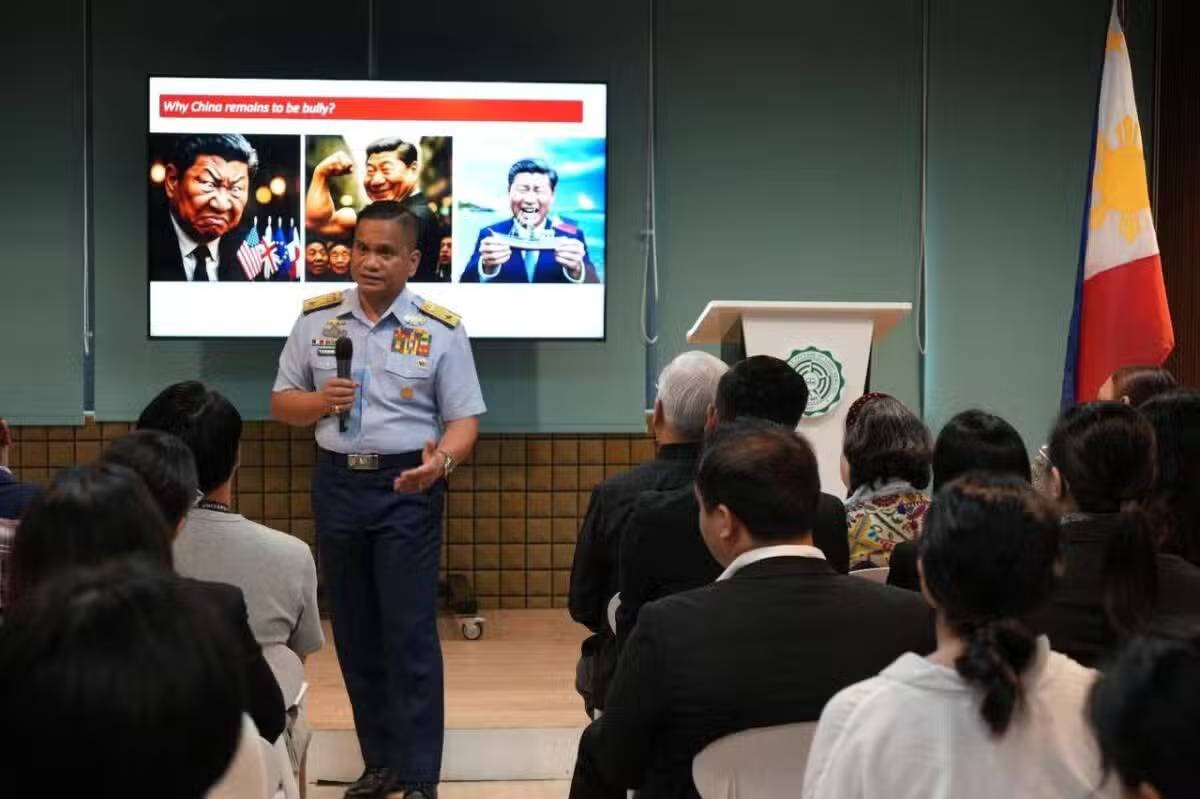
On Jan. 14, Tarriela said on Facebook that he was the keynote speaker at De La Salle-College of Saint Benilde forum on “Directing the Tides: The West Philippine Sea and its Impact on National Security.”
One of the pictures he posted showed him holding a microphone speaking to his audience on “Why China remains to be bully.”
Behind him on a screen were three apparently artificial intelligence (AI)-generated images of Xi—one showed Xi with an angry scowl while looking at flags of the United States, United Kingdom, France, Japan and the European Union; another showed him flexing his muscles as people watched in awe; and the third was Xi laughing at a toy boat with a Philippine flag which he was holding.
“This constitutes a serious violation of China’s political dignity and a blatant political provocation, which has crossed the red line,” Guo said in his statement. “China expresses strong indignation and strongly deplores this, and has lodged solemn representations with the Malacañang Palace, the Department of Foreign Affairs, and the Philippine Coast Guard.”
Tarriela on Friday responded, saying that the demand from the Chinese Embassy for an explanation on whether his statements were official policies was “not only a clear violation of the Vienna Convention on Diplomatic Relations but also an attempt to deflect from the core issue: China’s repeated aggressive and illegal actions in the (WPS).”
‘Attempt to deflect issue’
He cited Article 41(1) of the Vienna Convention, which states that diplomatic missions have a “duty not to interfere in the internal affairs” of the country in which they are posted.
“By pressuring our own government over my personal and professional expressions as the PCG spox on the WPS, the Chinese Embassy is engaging in precisely the interference it is obliged to avoid,” Tarriela said in a statement.
“This is not legitimate diplomacy; it is an effort to intimidate and suppress truthful reporting on matters of Philippine sovereignty,” he said in a statement.
Tarriela pointed out that the Chinese Embassy should instead be made to explain the “well-documented incidents” of aggression in the WPS.
In another post on Saturday on X, Tarriela showed a video montage showing intentional ramming and dangerous maneuvers by Chinese ships against Filipino vessels, including water cannon attacks and harassment of Filipino fisherfolk over the last two years.
Research vessels
“Defending every square inch of our territory is a solemn commitment to the Filipino people—but not surrendering the voices that fight for our sovereignty is even more vital,” he said.
The diplomatic protest by the Chinese Embassy follows the continuing heated spat between Tarriela and Guo over tensions between Filipinos and Chinese in the West Philippine Sea, waters within the country’s 370-kilometer exclusive economic zone.
On New Year’s Eve, Tarriela called out the presence of a Chinese scientific research vessel in Cagayan waters, saying it might have been conducting operations without a green light from the Philippine government, in violation of local and international laws.
Last week, Guo shot back at Tarriela after the latter posted on X about the “illegal presence” of a People’s Liberation Army (PLA) vessel on Jan. 8 and a China Coast Guard (CCG) vessel the next day near Capones Island off the coast of San Antonio town in Zambales.
“Here you go again—trying to drag everything into the SCS (South China Sea) issue. These cheap tricks and made-up stories might get clicks, but they won’t fool people for long,” Guo wrote on Jan. 9.
In its remarks on Saturday, the NMC stressed that movements by PCG vessels or Filipino fisherfolk in the WPS were “consistent with the United Nations Convention on the Law of the Sea (Unclos) and the 2016 arbitral award, which is final and legally binding.”
China claims nearly the entire South China Sea, which is disputed not only by the Philippines but also by Vietnam, Brunei, Taiwan and Malaysia. Beijing’s nine-dash-line claim was invalidated in a 2016 arbitral ruling on a case filed by the Philippines.