









Trump puts Gaza plan at risk with Greenland threat

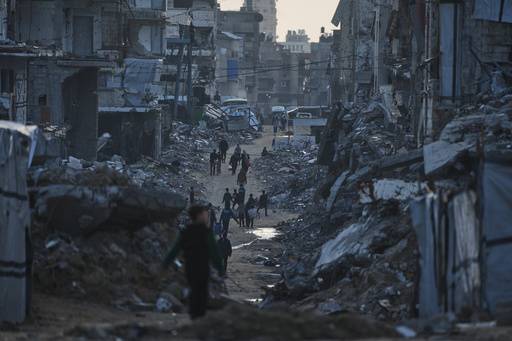
President Donald Trump closed out 2025 with his plan to end the Israel-Hamas war in fine fettle. With an endorsement from the UN Security Council to form a “Board of Peace” to oversee Gaza’s future, Trump entered 2026 riding high in his self-described role as a “president of peace” who sought to end conflicts and certainly not create new ones.
But after having ordered a military operation to capture then Venezuelan President Nicolás Maduro in the first days of January and threatened to use force to annex Greenland from fellow Nato member Denmark, the next steps in his Gaza ceasefire plan and his attempt to expand the mandate of the Board of Peace to other global crises appear to be at risk.
Series of insults
Just last week, the Board of Peace seemed set to be formed without much controversy on the sidelines of the World Economic Forum meeting in Davos, Switzerland, this week with Trump at the helm of a selection of world leaders focused on Gaza.
Then, Trump upended that scenario with an abrupt threat on Saturday to impose tariffs on European allies that had rallied to the defense of Greenland and Denmark.
He followed up with a series of insults and provocative social media posts about seizing Greenland. In one message to Norway’s prime minister, Trump accused the Norwegian government of blocking the independent Nobel committee from awarding him the Nobel Peace Prize, suggesting his primary focus would no longer be peace.
With more than 60 invitations to the Board of Peace sent out, fewer than 10 have so far been accepted, including from a handful of leaders considered to be antidemocratic authoritarians.
And, perhaps more important, several of America’s main European partners have declined or been noncommittal, including Britain, France, and Germany. It marks another potential fracture point for the Nato allies, as Trump’s aggressive foreign policy moves have threatened to alienate even the United States’ closest friends and put some of his own priorities at risk, from discussions about halting Russia’s war in Ukraine to next steps in the Gaza ceasefire process.
Saying no
Many skeptics have noted with displeasure that Russian President Vladimir Putin, Chinese President Xi Jinping, and Belarusian President Alexander Lukashenko have all been invited to join.
French Foreign Minister Jean-Noel Barrot said “no to creating an organization as it has been presented, which would replace the United Nations.” Spokespeople for British Prime Minister Keir Starmer and German Chancellor Friedrich Merz said they were looking over the terms. Starmer has concerns about its makeup, spokesperson Tom Wells said.
Britain and France are the two other veto-wielding Western powers on the UN Security Council, which many believe the Board of Peace has ambitions to rival by working on other global conflicts.
Trump said on Tuesday that “it might” replace the United Nations even as he noted the UN has great potential despite what he called years of failure.
“I wish we didn’t need a Board of Peace,” Trump said at a White House news conference. “The United Nations never helped me on one war.”

In an apparent attempt to allay some concerns, he added, “I believe you got to let the UN continue, because the potential is so great.”
In a somewhat more even tone on Greenland, he said, “I think that we will work something out where Nato is going to be very happy and where we’re going to be very happy.”
But amid an outcry in Europe over his designs on the mineral-rich Arctic island, Trump still has refused to back down.
“You’ll find out,” he said coyly when asked how far he is willing to go to acquire Greenland.
******
Get real-time news updates: inqnews.net/inqviber