




Tiananmen vigil organizers face Hong Kong trial

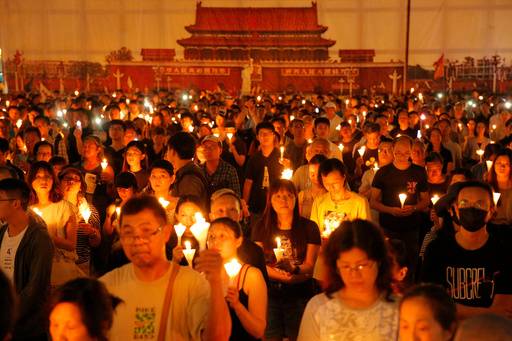
Two former leaders of a Hong Kong prodemocracy group that for decades organized a vigil commemorating people killed during Beijing’s 1989 Tiananmen crackdown are set to stand trial in a case brought under a national security law that has all but silenced dissent in the city.
A third codefendant is expected to plead guilty at Thursday’s hearing.
Observers say the disappearance of the only large-scale public commemoration of the 1989 crackdown within China is part of a decline in Western-style civil liberties, which Beijing promised to maintain for 50 years when it took control of the former British colony in 1997.
The government said its law enforcement actions were evidence-based and strictly in accordance with the law.
Chow Hang-tung, Lee Cheuk-yan, and Albert Ho, former leaders of the Hong Kong Alliance in Support of Patriotic Democratic Movements of China, were charged with incitement to subversion in September 2021 under a law imposed by China following massive antigovernment protests in 2019.
Taboo topic
The Hong Kong Alliance voted to disband weeks after its leaders were charged under the law.
The 1989 Tiananmen Square prodemocracy protests, led by students, posed one of the most significant challenges to the Communist Party’s rule in China. They ended after the Chinese government sent tanks into Beijing, with troops opening fire in a bloody crackdown that killed hundreds, possibly thousands.
The crackdown has long been a taboo topic in mainland China, but for 30 years the alliance held annual vigils in Hong Kong. The gathering drew tens of thousands to commemorate the victims with a sea of candles until authorities banned it during the COVID-19 pandemic.
“It was a group that aimed to seek justice,” former alliance member Tang Ngok-kwan told The Associated Press (AP) in early January. Tang, who was a senior member of the group, was charged alongside Chow in another case related to the group.
Tang said he felt a moral burden about the deaths, because he thought the city’s financial support for the movement may have fueled the demonstrators’ conflict with authorities.
Monthslong protests
The last vigil in 2019 drew an estimated 180,000 people days before the city erupted in monthslong protests.
After the pandemic, the former vigil site hosted a carnival showcasing Chinese food and products during the anniversary of the crackdown. Some residents who commemorated the event nearby were detained.
The alliance was one of dozens of civil society groups disbanded during a crackdown that started when Beijing imposed a National Security Law to quell protests.
Other people affected include former prodemocracy media mogul Jimmy Lai, who was convicted of conspiring with others to collude with foreign forces in December and faces up to life in prison.
The Hong Kong Alliance came under increasing pressure in 2021 after police opened an investigation, saying they had reasonable grounds to believe the group was acting as a foreign agent. The group rejected the allegations and refused to cooperate.
Chow, Ho, and Lee were charged in September 2021, and later that month the alliance’s members voted to disband.
Chow, Tang, and another core member were convicted in 2023 over their refusal to provide authorities information on the group and received a sentence of four and a half months each. But in March 2025, the city’s top court overturned the trio’s convictions.
Chow, Ho, and Lee are accused of inciting others to organize, plan, or act through unlawful means with a view to subvert the state power. Their charge carries a maximum jail term of 10 years. The trial is expected to last 75 days.