





Our Southeast Asian sibling has ‘adopted’ a Zara


I’m of the opinion that out of all our Southeast Asian neighbors, Vietnam seems to give the most similar vibes to that of the Philippines. Some years ago, I walked down the streets of Hanoi, and felt a similar energy as I did walking in Manila, though at the time Manila didn’t have as many scooters and motorcycles as Hanoi. Walking in Tokyo or Beijing makes you feel you’re in a completely new world. Walking in Vietnam makes you feel right at home.
The Philippines and Vietnam share that same sense of warmth and hospitality distinct from the more reserved nature of East Asian cultures like Japan. Both Vietnamese and Filipino cultures are shaped by the tropical climate, rice paddy agriculture, and a “bamboo” architecture history. Also, both our nations share a history of Old World colonization, resisting that at some point, and then eventually finding a way to “meld” these two worlds—in the process acquiring this gritty, resilient “developing nation” spirit that is very different from the industrialized order of Japan or the “isolated” culture of China.
Both the Philippines and Vietnam keep alive their ancient forms of writing or calligraphy. We have our suyat (of which Baybayin is the most famous), while Vietnam has its Chữ Nôm and the Surat Cham.
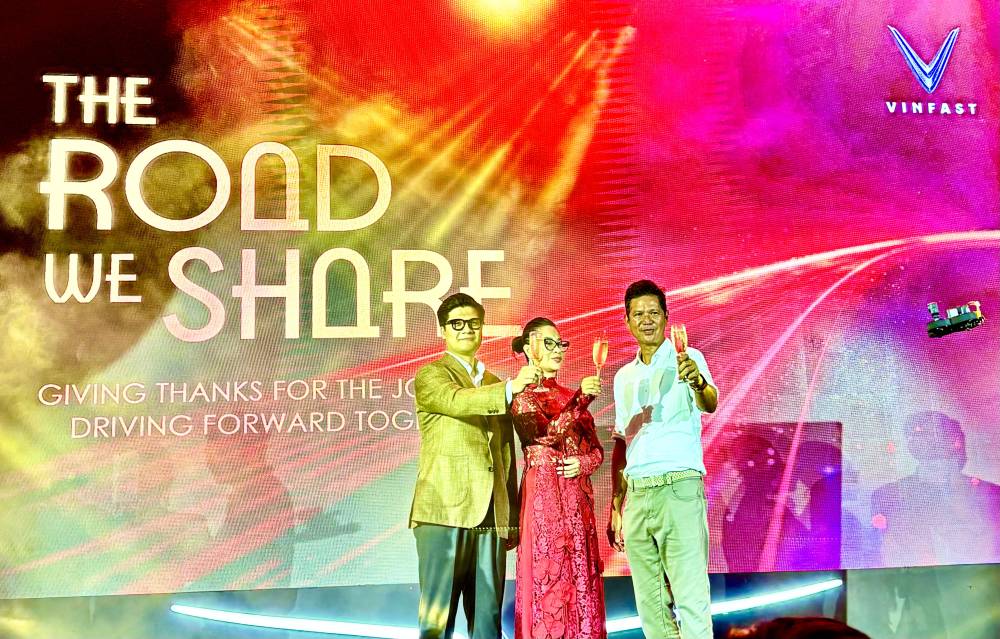
On the night of Jan. 15 at the Palacio de Memoria in Parañaque City, these two cultures met and mingled into a colorful night of sight, sound, and taste as VinFast Philippines hosted a thanksgiving dinner with the Filipino motoring media.
There, the man of the hour stood literally head and shoulders above the crowd. The CEO of VinFast Southeast Asia happens to be a Filipino by the name of Antonio “Toti” Zara, who occupied key positions in leading some of the world’s most iconic automotive marques before taking the regional helm of this upstart Vietnamese brand. Zara earned his keep leading AC Motors (now ACMobility, Ayala’s auto group) as its president, overseeing brands like Kia, Volkswagen, and Maxus, and managing a substantial chunk of the Honda and Isuzu dealership networks, eventually transitioning to an advisory role in 2025 before retiring.
Before his stint in ACMobility, Zara worked with General Motors in South Korea, Thailand, and Indonesia. He was also general manager of GT Capital Auto Dealership Holdings, of which Toyota Motor Philippines (TMP) is a subsidiary. Zara began his career in the motoring industry with TMP’s manufacturing and service departments in the 1990s. He also became the first-ever Filipino president and managing director of Nissan Philippines.
Toti Zara’s grandfather, Gregorio Zara, was a National Scientist. And though Gregorio’s grandson didn’t end up in a lab coat conducting experiments, Toti probably did end up formulating a corporate hypothesis: “What if I turned conventional motoring rules on its head using a virtually unknown Southeast Asian EV brand?”
And this is where we are now, in the middle of a Zara “Zience experiment,” waiting to see the results of some game changing ingredients the corporate scientist has added to the mix. The man just came out of retirement, and he’s moving like there’s no tomorrow.
“I’m back, and I’m so excited about the opportunities we could bring to the market given the VinGroup ecosystem,” he said in his speech.
Zara knows there’s a lot of catching up to do, not just for the brand but for the state of EVs in the country. Still, he acknowledged the big strides VinFast has already made up to this point.
“VinFast, an Asean brand—our own brand—has become number one in some markets, and we’ve surpassed some legacy Japanese brands. I’m so excited how VinGroup is now the number one mobility provider in certain markets, surpassing the top brands in Southeast Asia. I’m so excited how V-Green has successfully developed an expansive network with EV charging stations that literally and virtually has removed the notion of range anxiety.”
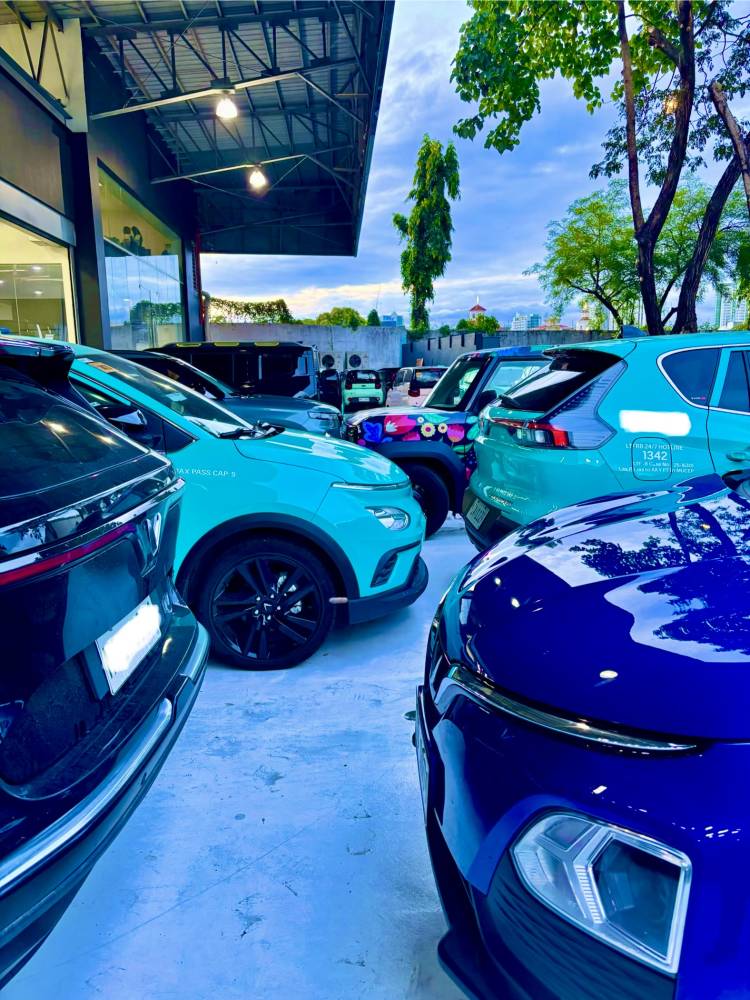
Established in 2017, VinFast made the bold shift to producing only all-electric vehicles in 2022. With that, V-Green was set up to build the charging ecosystem, offering solutions ranging from home chargers to public AC and DC stations powered by smart management technology. And as its own answer to the growing TNVS market, VinFast offered Green GSM, the Philippines’ first all-electric taxi fleet.
That night, I asked Zara what made him say yes to re-joining the automotive fray. He replied that, if he didn’t say yes, he might regret that decision later. But now that he’s here, he said, with some nervous laughter, that his greatest fear now is failure. But if he did become successful, he said he would be “hailed as a hero…in Vietnam, not here.”
Those who’ve been in this industry long enough to witness Zara at work know that if there’s anyone who could pull this off, it would have to be him.
It’s not just Zara’s reputation at stake. An entire country’s national pride is riding on his tall shoulders. The Vietnamese see VinFast as a symbol of national development and technological ambition. If there’s one brand that symbolizes the country’s shift from a developing nation to an innovation hub, it’s VinFast.
And they want to do this, um, really fast.
“In 2025, we announced that VinFast as a group rolled out 200,000 units globally. All of these are BEVs, and we are now a relevant player in the global BEV market. In the Philippines, as we end the year, we are already selling up to 300 units per month. I can say that we have become a relevant player in the Philippines and among the top brands as far as BEVs are concerned,” Zara announced in his speech.
“We are entering 2026 with strong momentum, built on the trust and support we have earned in the Philippines over the past two years. This year is about accelerating, expanding access, strengthening our ecosystem, and making electric mobility a source of confidence and pride for Filipino drivers.”
VinFast Philippines has said that we should be expecting much more of the brand, in more varied forms, on the road. Apart from the very noticeable presence of numerous Green GSM taxis, there will be more of the larger SUVs such as the VF 6, VF 7, and VF 9, as they are “set to become the company’s core growth drivers in the Philippines, responding to rising demand for spacious, family-friendly electric SUVs designed for both daily commutes and long-distance travel.”

VinFast also revealed that electric scooters and electric MPVs are also set to be brought in for Filipino urban commuters.
VinFast currently operates 30 dealerships and 34 service workshops across the country, and plans to scale this up within the year, prioritizing major cities and high-potential regions to make sales and after-sales support more accessible and convenient for customers.

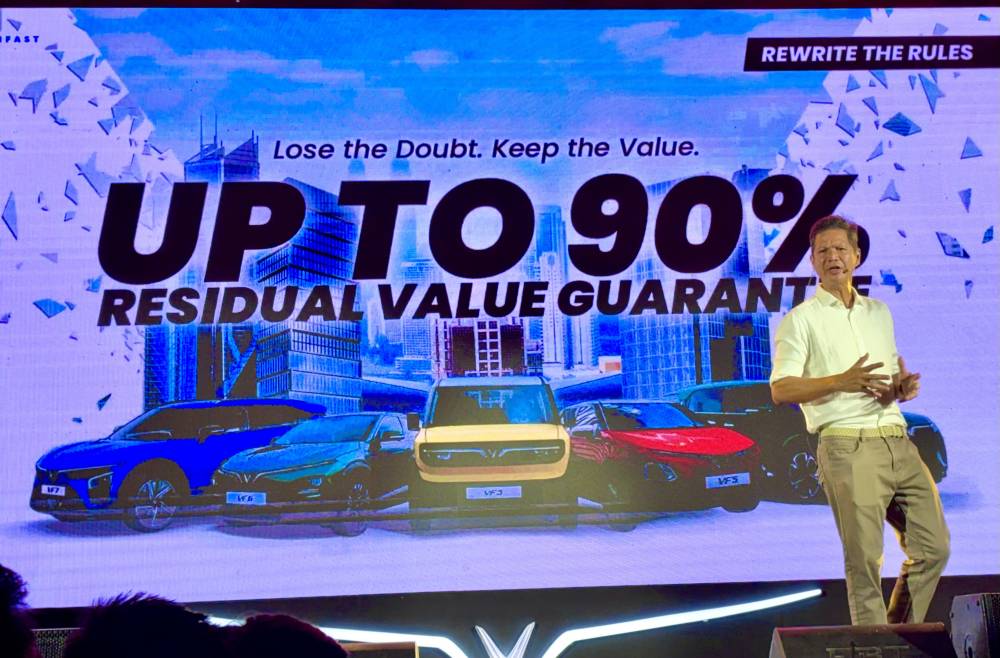
VinFast surprised the industry when it guaranteed 90 percent residual value for its EVs after six months. The program is called Residual Value Guarantee (RVG). The program claims that guaranteeing “up to 90 percent” of the car’s value within six months is a bold, confidence-building move that effectively removes short-term buyer’s remorse. Late last year, VinFast Philippines introduced the RVG that promises to buy back the vehicle at up to 90 percent of its value after six months, and up to 70% of its value after 3 years. This effectively does away with the “zero resale value” stigma attached to Chinese and new EV brands.
“In the industry, the rule was you don’t know the residual value,” quipped Zara during the Jan. 15 Vietnam-culture-themed “The Road We Share” party with the media and key opinion leaders. “At VinFast, we’re rewriting the rules. We believe in our program, within that 3-year period, customers would clearly realize how EVs will be the future of mobility.”
VinFast is still on target for 15,000 charging stations in the Philippines. The company has said that through V-Green, it has been steadily rolling out charging stations across key urban centers and major transport corridors, with further expansion planned for 2026 to support both electric cars and electric two-wheelers. This growing network is aimed at reducing range anxiety and strengthening long-term confidence in EV ownership, ensuring that customers are supported not just at the point of purchase, but throughout their transition to electric mobility.
Zara also laid out his warranty card. While the industry standard holds at three to five years, VinFast is offering a 6-year vehicle warranty and, more critically, a 10-year warranty for the battery. This is a direct shot at the number one consumer fear: Battery longevity and replacement cost.
Zara said that his team is bypassing the traditional, and often slow, dealer-centric service model. By appointing up to 100 third-party workshops to handle not just periodic maintenance but also warranty repairs, VinFast is making serviceability accessible and convenient, solving a problem that has plagued new brands for decades.
Aside from the dealerships, VinFast has appointed independent service workshops. Today, customers can go to these independent workshops for maintenance services and, of course, for warranty repairs, providing more flexibility for the customers. Combining that with the expanding network of EV chargers, there’s now a 360-degree solution for business-to-business (B2B) clients.
VinFast is also offering a “battery subscription” program for less than P2,000 a month. Zara has single-handedly neutralized the high upfront cost of EVs. As he noted, this monthly fee is far less than the combined savings on fuel and maintenance. It transforms the EV from a high-capital purchase into a low-cost utility.
******
Get real-time news updates: inqnews.net/inqviber