
Second impeach complaint vs Marcos received, sent to House panel

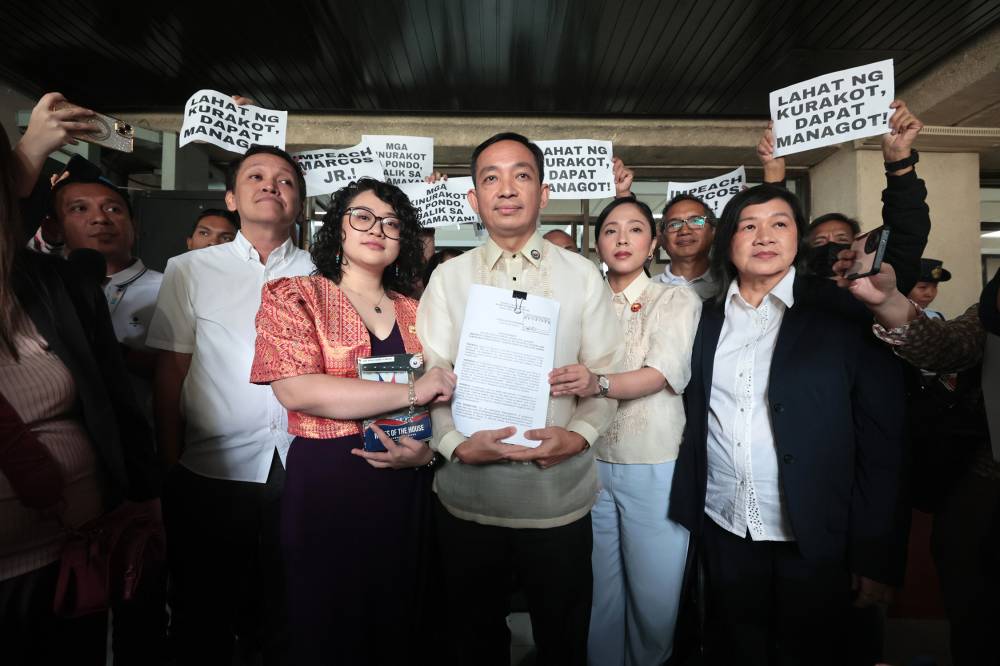
The second impeachment complaint against President Marcos filed by lawmakers of the Makabayan bloc and activist groups was referred on Monday to the House committee on justice, after it was formally received that day by the secretary general of the House of Representatives.
The transmittal of that and an earlier complaint filed by lawyer Andre de Jesus effectively triggers the yearlong ban on further impeachment complaints.
Earlier, there was a minor controversy over the Makabayan complaint when it was filed on Jan. 22, but House Secretary General Cheloy Garafil was reportedly abroad at that time to receive an award, while her staff refused to acknowledge receipt of the complaint.
On Monday, Garafil received the complaint but could not assure the petitioners if Speaker Faustino Dy III would immediately transmit the complaint to the appropriate House committee.
“What we requested was very clear. Can you transmit this to the Speaker today?” Bagong Alyansang Makabayan president Renato Reyes Jr. recalled he and other complainants asking Garafil.
“She said she cannot commit [to that]. She cited the example of the first complaint, which she said she transmitted to the Speaker the day after it was filed [on Jan. 19],” Reyes explained further.
Still, there was “no doubt” now that the complaint was duly filed and received by her office, ACT Teachers Rep. Antonio Tinio said.
“It is also clear in the [House] rules that the Secretary General shall immediately refer [this] to the Speaker,” he said.
During Monday’s session presided over by Deputy Speaker Yevgeny Emano, the two respective complaints by De Jesus and the Makabayan coalition were referred to the justice panel.
‘Trash’ complaint
Before the Makabayan complaint, De Jesus initiated the first impeachment complaint on Jan. 19 against Mr. Marcos, accusing him above all of the “kidnapping” of his predecessor Rodrigo Duterte and of drug use, as well as corruption and other charges in relation to the flood works scandal which constituted the rest of that complaint.
Some lawmakers criticized De Jesus’ impeachment bid as a “trash” complaint designed to sabotage its avowed purpose, given the constitutional ban on more than one impeachment complaint in a given year.
According to Caloocan Rep. Edgar Erice, only one of the six grounds in the De Jesus complaint deserved consideration—the issue of unprogrammed appropriations. In that complaint, it was listed as the third of six alleged violations of the President.
But Erice noted that De Jesus’ failure to attach sufficient documents might be fatal to his complaint, which furthermore comprised only 15 pages.
The Makabayan bloc, meanwhile, defended its complaint as being more substantial, since it focused on so-called “BBM Parametric Formula”—an alleged policy in the Department of Public Works and Highways that also stands for “Baselined-Balanced-Managed.”

That formula—which makes use of the President’s initials when using his nickname, Bongbong—provides “the justification for presidential and congressional infrastructure project allocations in the national budget” that are supposedly the “basis for kickbacks or commitments,” Makabayan said.
The second complaint also supported claims by resigned lawmaker and fugitive Elizaldy Co that Mr. Marcos and other Cabinet officials received kickbacks from anomalous government projects.
Sandro’s recusal
Meanwhile the President’s son, Ilocos Norte Rep. Ferdinand Alexander “Sandro” Marcos, said he would recuse himself from discussions in the House regarding an impeachment case against his father.
“In view of the impeachment complaints filed against President Ferdinand R. Marcos, Jr., who is my father, I have decided to formally recuse myself from all discussions, deliberations, and proceedings of the House Committee on Rules insofar as these complaints are concerned,” the younger Marcos, his chamber’s majority leader, said in a statement on Monday.
“This decision is guided not by legal compulsion, but by a higher obligation—to preserve the integrity of the House of Representatives, to protect the credibility of its processes, and to uphold the public’s trust in our constitutional system,” he said.
The lawmaker noted that “While I am fully aware that the Rules of the House do not require my inhibition, and while I remain confident in the independence and professionalism of my colleagues, I recognize that leadership sometimes calls for restraint rather than participation. In moments that test institutions, perception matters as much as procedure.”
“My recusal ensures that no question may be raised about the fairness, objectivity, or legitimacy of the process, and that the focus remains where it properly belongs—on the Constitution, the facts, and the rule of law,” Marcos said.