





Leading Filipino art, seen in fragments under a Singapore sky

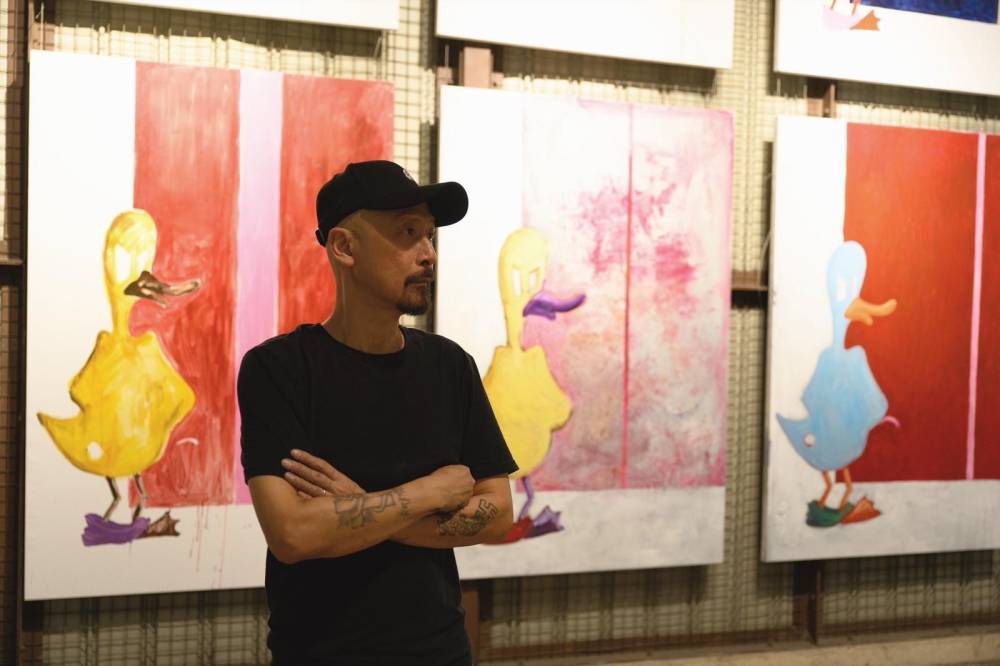
In the expanse of the cavernous Tanjong Pagar Distripark warehouse, time seems to stretch in “Isang Dipang Langit: Fragments of Memory, Fields of Now,” an exhibition showcasing leading voices in contemporary Filipino art, launched during Singapore Art Week and running from Jan. 20 to Feb. 1.
The show, curated by Dong Jo Chang, director of The Columns Gallery Singapore, has already drawn an enthusiastic audience of more than 3,500 visitors, prompting an extension beyond its initial schedule.
“Isang Dipang Langit” takes its conceptual cues from a poem by National Artist Amado V. Hernandez, which translates literally to a “sliver of sky.” In Chang’s vision, it’s both metaphor and method. “The exhibition unfolds like an open field,” he explains. “Each artwork appears as a moment in time, carrying traces of memory and history. As viewers move between these moments, connections begin to form.”
Filipino artists and their unique global responses
For over two decades, Chang has shaped the Korean and Southeast Asian art markets, with galleries in both Seoul and Singapore.
I wonder why he decided to foreground Filipino artists. Chang answers that the choice was not trend-driven, but nurtured from long-term relationships with Filipino artists, observing their practices that engage with history, labor, migration, and the body.
“I was drawn to the way Filipino artists address global conditions through grounded, material, and personal approaches,” he said, describing Filipino works as feeling “urgent yet human.”
That urgency, tempered by a sense of intimacy, runs throughout a show that thrives on multiplicity.
He goes on further to describe how Filipino contemporary art often carries “a remarkable ability to combine seriousness with play, resilience, and even humor.” It’s an observation that most Filipinos can relate to, as well.
Materials as memory
Upon entering “Isang Dipang Langit,” viewers’ gazes are drawn to the large-scale installations and sculptures that anchor the show.
Oca Villamiel’s works confront scarcity head-on with “Bahay ng Mangingisda,” which reconstructs a fisherman’s hut from discarded nylon nets, referencing the impoverished communities of Barangay Caridad, Atimonan.
Pete Jimenez similarly works with reclaimed materials in “Hard Rain,” transforming more than 100 rusted steel scrap components collected over a decade from Nueva Vizcaya and Ifugao Province. Another installation features weathered fishing vessels as a meditative sculptural landscape.
Alfredo and Isabel Aquilizan extend their long-standing engagement with migration through “pandayan,” or traditional blacksmithing. Looming over eight feet high, “Plight” shows wing-like structures rendered in rusted metal that appear punctured and strained, suggesting the emotional and physical toll of cross-border movement.
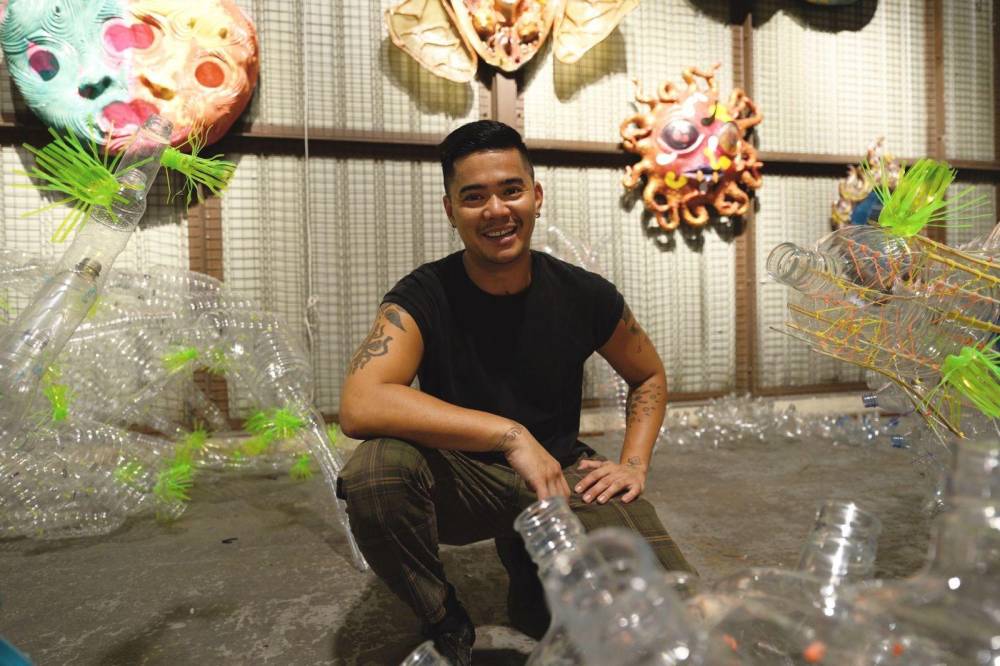
Leeroy New brings an ecological and speculative edge, using bamboo, recycled plastic, and found objects to transform waste into biomorphic shelters and floating vessels. Works like “Bird Nests” and “Flotilla” evoke the Philippines’ archipelagic condition and a culture of improvisation shaped by survival.
The body as archive
New’s material explorations extend into performance in “Aliens of Manila,” where discarded objects become wearable sculptures in collaboration with local performers.
Chang notes that Filipino contemporary art often carries “a strong sense of embodied memory, where history is felt through the body, material, and everyday life.” This also resonates in the performance and film aspect of the exhibition.
Eisa Jocson’s “Corponomy Online” examines labor, economies of movement, and Filipino entertainment cultures, drawing from research on pole and macho dancing, hostess work in Japan, and performances at Hong Kong Disneyland.

In “The Last Hapi,” Russ Ligtas shows a 90-minute hybrid video installation blending film, ritual, and performance. Referencing the 1972 declaration of Martial Law, the work evokes historical trauma, while scenes with stillness, silence, and breath invite viewers to reflect.
Painting as reflection
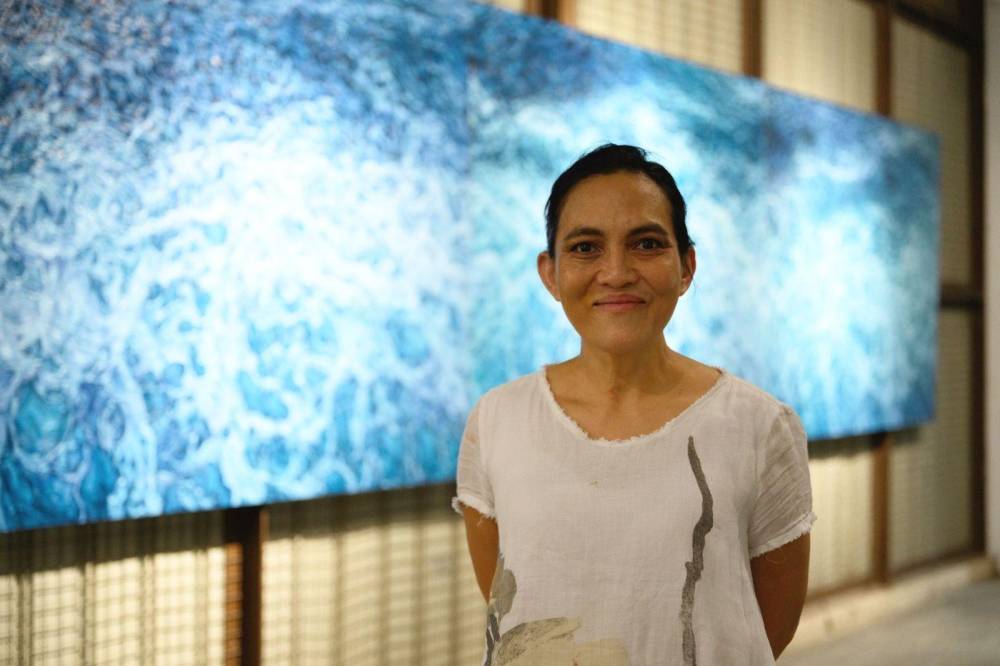
Painting, too, operates as a site of layered time. Elaine Navas presents a monumental triptych from her well-known series “Nothing Moves Itself,” inspired by Thomas Aquinas and in dialogue with photos by artist Ling Quisumbing Ramilo. The work shows the sea mid-motion, suggesting stillness, but with underlying currents of constant change.
In typical Manuel Ocampo fashion, with biting wit and conceptual sharpness, “The Critic (from The Worst Slave Is The One Who Defends The Master)” uses a duck as a migrant protagonist to critique Western ideals of high modernist art, questioning notions of authority and value while reflecting on migration experiences.
You might have also heard of “the Manong Generation,” Filipino migrant workers who shaped agricultural and maritime labor in the United States. Dominic Mangila draws from these histories and archival research in eye-catching paintings, some in acrylic, others mixing oil paint and pastel.
A constellation, not a conclusion
Under the soaring warehouse ceilings, the exhibition space itself becomes a metaphorical sky, “a dipang langit” beneath which these fragments coexist. There is no single path through the works nor prescribed reading.
That openness is deliberate. “I hope viewers come away with the understanding that contemporary Filipino art is not a single story, but a constellation of voices and experiences,” Chang says. “The exhibition does not offer definitive conclusions, but invites reflection on how personal memory connects with collective history.”
Like a sliver of light glimpsed between towering structures, “Isang Dipang Langit” offers just enough illumination to see contemporary Filipino art differently, and imagine what just might emerge, drifting under a shared sky.
“Isang Dipang Langit: Fragments of Memory, Fields of Now” curated by Dong Jo Chang runs from Jan. 20 to Feb. 1, 2026, at The Columns Gallery, 22 Lock Road #01-35, Gillman Barracks, Singapore 108939