



SC: Same-sex couples can co-own property

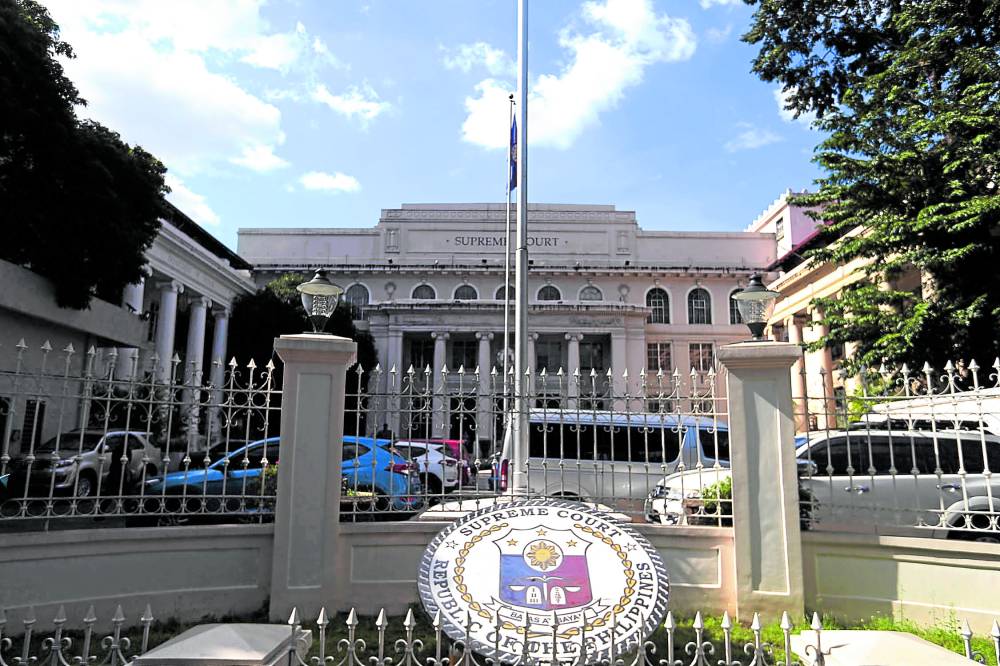
While there is no law recognizing their unions, same-sex couples scored a legal victory after the Supreme Court ruled that they may be recognized as co-owners of a property they acquired and jointly paid for while living together.
In a decision promulgated on Feb. 5, the high court’s Second Division said same-sex couples are covered by the Family Code, particularly Article 148, which governs the property relations of couples living together but cannot legally marry one another.
Article 148 acknowledges co-ownership based on each of the couple’s contributions to the property, according to the high court.
The decision, penned by Associate Justice Jhosep Lopez, granted the petition of Jennifer Josef seeking to reverse the earlier decisions by the Quezon City Regional Trial Court (RTC) and the Court of Appeals (CA) that did not recognize her as a co-owner of a property with her former partner, lawyer Evalyn Ursua.
(Ursua served as counsel for a Filipino woman who accused US Marine Lance Cpl. Daniel Smith of raping her at the former US naval base in Olongapo City in 2006. Smith was found guilty by a Makati City court a year later but was acquitted in 2009 by the Court of Appeals.)
‘Landmark jurisprudence’
The LGBT group Bahaghari welcomed the SC ruling, saying it will serve as “landmark jurisprudence” on the civil rights of the community “in a legal system that has historically made them voiceless and invisible.”
Bahaghari chair Reyna Valmores lauded the decision for recognizing unmarried same-sex couples under Article 148 of the Family Code.
“In the first place, LGBTQ+ couples should not have to be treated as individuals without [the] capacity to marry each other,” Valmores said in a statement. “Love has no gender. We deserve to be recognized to love another.”
According to the high court, Article 147 of the Family Code applies to unmarried couples who may legally marry, while Article 148 is applicable to unmarried couples who may not marry one another.
The court noted that both Josef and Ursua lived together as a couple in 2005 in an apartment “without the benefit of marriage,” pointing out that the property regime for void marriages is governed under the code’s Article 147 or 148.
“However, the applicability of these provisions became a nuanced question in the context of cohabitation between same-sex couples, considering that Philippine laws do not recognize same-sex marriage in our jurisdiction,” read the court’s decision.
Family Code’s Article 148
While the Code defines marriage as a union between a man and a woman, the court said that in the case of Josef and Ursua, both cohabitated but were “not capacitated to marry each other,” thus Article 148 can apply to their property relations.
The court said “common property” is something acquired during cohabitation and through the partners’ actual joint contribution of money, property or industry.
Senior Associate Justice Marvic Leonen said Article 148 applies to all forms of cohabitation and is not based on gender, stressing a same-sex relationship is a normal relationship that must be covered by the article.
“Otherwise, we render legally invisible some forms of legitimate intimate relationships,” Leonen said.
The former couple’s property was a house and lot in Quezon City. Both agreed to register the property in Ursua’s name “to easily facilitate bank transactions.” Upon their separation, both agreed to sell the house and lot, and to divide the proceeds equally.
Property dispute
Ursua executed an Acknowledgment of Third-Party Interest in Real Property in 2007, which acknowledged Josef’s co-ownership over the house and lot, recognizing that she “financed and paid” 50 percent of the expenses in the acquisition and renovation.

Three years later, Josef executed an Affidavit of Adverse Claim. By 2014, she sent a demand letter to Ursua for the partition of the subject property and for the portion of the proceeds to be transferred to her (Josef), “or that she be paid the fair market value of her corresponding share.”
A conflict arose between the former partners when Ursua argued that she had exclusive ownership of the property, emphasizing the acknowledgment she executed and that Josef’s interest over the property was “subject to the determination of the actual percentage of interest based on records and documents.”
After she found out that Josef executed an affidavit of adverse claim, Ursua executed an affidavit of repudiation of adverse claim and sought to recover damages from her former partner.
Signed acknowledgment
The Quezon City RTC Branch 87 dismissed the case for partition of real estate filed by Josef. The CA later affirmed the lower court’s decision but modified it by removing the damages sought by Ursua.
The high court granted Josef’s petition for the reversal of the lower courts’ decisions and upheld her complaint for partition against Ursua. It remanded the case to the Quezon City court for further proceedings and ordered the judge to hear the case with dispatch.
Going beyond the property dispute, the Supreme Court called on Congress and other government agencies to address the rights of same-sex couples in the absence of a law recognizing their unions.
“[T]his Court does not have the monopoly to assure the freedom and rights of homosexual couples. With the political, moral, and cultural questions that surround the issue concerning the rights of same-sex couples, political departments especially the Congress must be involved to quest for solutions, which balance interests while maintaining fealty to fundamental freedoms,” it said.
“The process of legislation exposes the experiences of homosexuals who have been oppressed, ensuring that they are understood by those who stand with the majority. Mostly, public reason needs to be first shaped through the crucible of campaigns and advocacies within our political forums before it is sharpened for judicial fiat,’’ it added. —WITH A REPORT FROM MARY JOY SALCEDO