







Art Fair PH 2026: A critique of a fair in flux

Brian O’Doherty wrote in “Inside the White Cube: Notes on the Gallery Space,” “A gallery is constructed along laws as rigorous as those for building a medieval church.”
The much-awaited annual Art Fair Philippines 2026 did not suffer from a lack of art. On the contrary, the works on view were strong and ambitious, often breathtaking, spanning across galleries, mediums, and regions. But what the fair wrestled with was the space itself—a converted office building with low ceilings, glass cubicles, and narrow corridors.
Since 2013, Art Fair PH has evolved from a thrilling, somewhat makeshift setup of booths and art presentations at The Link Carpark. It was these experimental early iterations where I first fell in love with contemporary art, visiting after classes in high school, returning later as a college intern, and eventually, facilitating sales as a gallery assistant.
More recently, in 2025, the fair moved to another location sprawling across the Ayala Triangle Gardens, which was praised for the high ceilings and spacious booths under towering white tents.
This year, the fair felt different. “Like a Hong Kong fair,” a gallerist told me, with “a little chaos.” They made the contrast to the “polish of Art SG,” which they instead likened to last year’s fair at Ayala Triangle Gardens.
It’s understandable that there is a push for Circuit Makati as a future hub for arts and culture, especially with developments underway for a 2,000-plus-square-meter Contemporary Art Museum in the area, set for completion by 2027.
But if, as O’Doherty argues, the construction of gallery spaces has laws as stringent “as those for building a medieval church,” then Art Fair PH 2026 demonstrated how deeply space can shape the way art is experienced—the good, the bad, and the ugly, all considered.
Perhaps as a fellow editor suggested, “this year’s Art Fair was more reminiscent of the temple in the Bible, cramped with vendors that so enraged our Christ.”
The strengths
If there was one place where the fair genuinely asked viewers to slow down, it was through the selection of art. This especially shone in the Projects section, curated by the fair organizers themselves, and arguably the most cohesive part of Art Fair PH 2026.
Spanish artist Ampparito’s durational work was conceptually strong and engaging. He committed to handwriting every day in a calendar from this year until 2099, giving a visual representation of a fairgoer’s human lifespan. But then again, the space could’ve been stronger if it had more streamlined walls that weren’t interrupted by glass barriers or a nearby staircase.
Other strong projects included Max Balatbat’s chapel installation. Both fearsome yet intimate, the presentation curated by Norman Crisologo was extremely unsettling yet very compelling. Meanwhile, Ged Merino’s kulambo-based work pulled you in with the way it accumulated time through its stitches, both hung from the ceiling and installed on the floor.
That said, expectations were higher for significant female artists at the Projects, particularly Imelda Cajipe Endaya and Brenda Fajardo, whose exhibited work felt less than expected for their stature. Perhaps it was because of the wide windows of the building. Although the open windows were decorated with sketches, the uncontrolled daylight seemed to pull attention away from the works, allowing the outside world to intrude, as cars passed by and people picnicked in the grass below.
This additional visual noise competed directly with the art. Gazing out the windows, it was also difficult not to think about how the underprivileged housing on the near horizon juxtaposed the expensive art and society people circling inside—an unintentional contrast between the outside world and the curated space inside.
As O’Doherty wrote on ideal conditions, “The outside world must not come in, so windows are usually sealed off. Walls are painted white. The ceiling becomes the source of light… The art is free… to take on its own life.”
Beyond Projects, there were several individual galleries that had standout works. Columns Gallery and Ames Yavuz brought strong international presentations. Newcomer 125 Projects delivered one of the fair’s most exciting booths, too. Meanwhile, Archivo 1984 impressed with ambitious large-scale works, and León Gallery International held its ground. Photography spaces like Tarzeer Pictures and Fotomoto PH also offered refreshing counterpoints, and crowds gathered around Carlo Tanseco at J Studio.
Performance art was one of the fair’s most engaging aspects, with Lilibeth Cuenca Rasmussen’s presence. Artist-run initiative Triangulum brought in durational intensity in the work “The Standard” by Pitchapa Wangprasertkul, performed inside a glass enclosure. While initiatives complementary to the fair (like 10 Days of Art) extended the fair beyond the Circuit Makati buildings, making the city itself a more accessible site for art.
Even small touches mattered, and one of the great things this year was the bathrooms, which were clean and air-conditioned, a far cry from the porta-potties in the previous years at the car park.
The bad
O’Doherty also describes the modern gallery as a place where the body is barely welcome. “The space offers the thought that while eyes and minds are welcome, space-occupying bodies are not—or are tolerated only as kinesthetic mannequins,” he writes. Ironically, in Art Fair PH 2026, the space did not erase the body. And due to the layout, the bodies often overwhelmed the art with it.
Crowds were dense. Standing in front of an artwork for more than a few moments was difficult without someone cutting in for a photo or closer look. The architecture did not allow for the pause that art often asks for. And while the frantic air of art fairs is common to this kind of setup, the narrow corridors and low ceilings of the converted office building made it more difficult.
Despite the high-speed elevators, there was vertical congestion, as waiting times were long and each elevator was crowded. More able-bodied people opted for staircases, and by the end of the fair, my editor and my feet were aching.
Spanning the 5th to 9th and 11th floors, with the afterparties across the street, there was a sense of unclear zoning and flow, too.
The ugly
O’Doherty writes that the white cube is “unshadowed, white, clean, artificial… Art exists in a kind of eternity of display… one has to have died already to be there.” Well, maybe the death bit is an exaggeration.

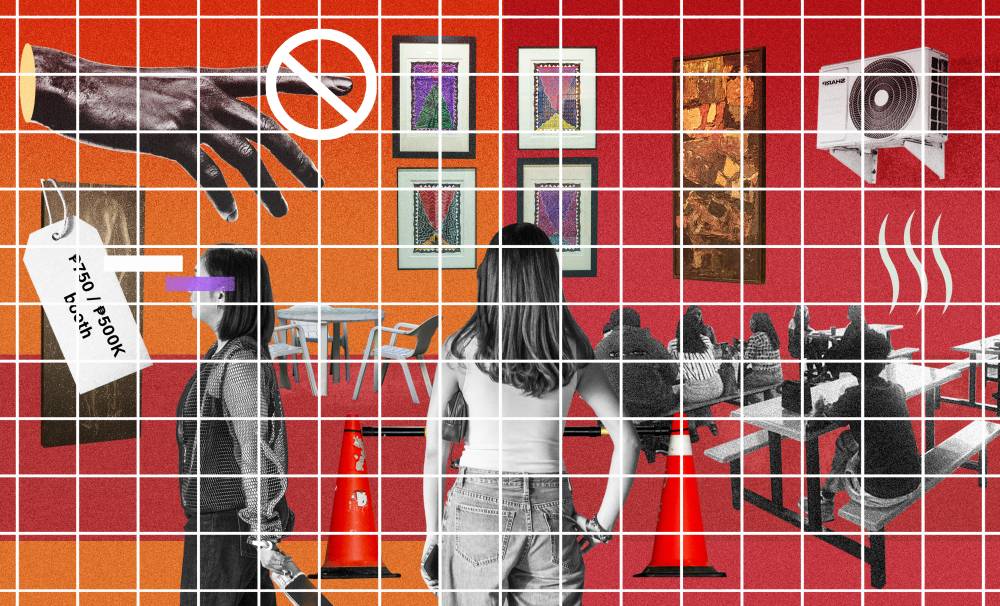
Perhaps one of the things most uncharacteristic of the fair was the setup for food and drinks. There was noticeably poor ventilation where food was cooked and served, with visible smoke at times, raising concerns for nearby artworks’ integrity and preservation.
Meanwhile, the eating areas were filled with plastic canteen-style tables and chairs. And while recently, Bad Bunny’s album art for “DeBÍ TiRAR MáS FOToS” has sparked discussion on the cultural symbolism and nostalgia of plastic chairs, in the context of the art fair, the canteen-style setup still seemed far removed from the sophistication of what fairs are known to be.
Not to mention, in the vernissage at least, there were no garbage cans in close proximity.
Conclusion: It was the space
For gallerists and gallery-goers alike, a certain standard of art-viewing experience is expected. At P750 per ticket, visitors reasonably anticipate comfort and ease as they explore. For gallerists, whose booths often cost around half a million pesos, the stakes demand that the venue reflects that investment, not just for exposure, but generous space.
And overall, the art deserved space to breathe, and so did the gallerists, staff, and fairgoers.
Art Fair PH 2026 was not short on ambition, talent, or effort. And organizing an event of this scale is understandably difficult. The dedication of the organizers was evident, and credit is due for their effort and coordination to have managed an event of this magnitude, despite the long hours and physical toll it takes on all involved.
Having grown up attending Art Fair PH and loving every moment of it, this year, I hope, is a temporary bump. And despite it all, I still enjoyed the fair and spent 10 hours wandering the floors. But I must admit, it was easier after a couple of glasses of wine and my Sidechick Burger.
Art Fair PH has taken leaps and bounds, and fairs around the world have also developed in such a manner over the years, evolving from less of a marketplace and more of a community that focuses on education, talks, and other innovations in art.
Maybe Doherty’s prescriptions for the installation of art that deliberately considers venue, flow, and audience care should have been given more careful consideration in both curatorial and logistical decisions. But for 2026 at least, Art Fair PH operated in a space that resisted stillness, as well as the sustained looking that art deserves.
Fairs evolve, and so will Art Fair PH. With the new Cultural Center underway, I am genuinely excited for the higher, exhibition-appropriate ceilings, greater circulation, and improved spatial design that will give the fair and the art the room it needs.
Looking forward, this is the configuration that will allow Art Fair PH to fully realize its ambitions, and I can’t wait to see it.