









Challenge: Turning ESG policies into real, lasting change

Many businesses nowadays are trying to promote sustainability and become more environmentally friendly in order to keep up with evolving market demands, as consumers become more and more conscious of the impacts of their choices.
But while the idea is there, not every sustainability initiative can translate into meaningful impacts for the environment and bring lasting change to the community.
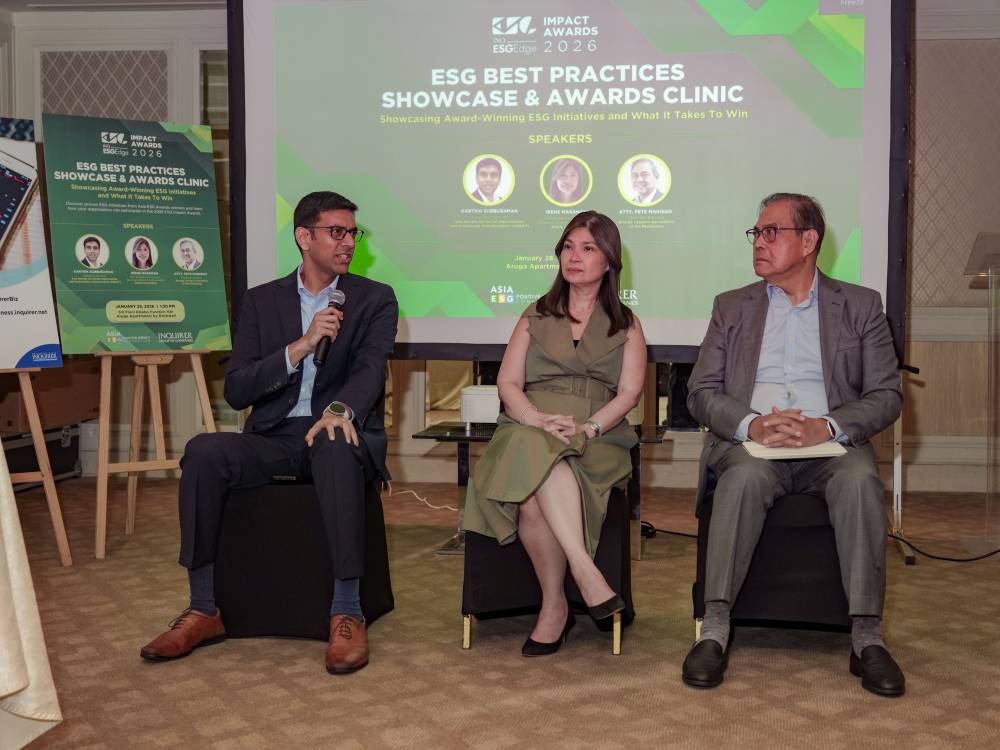
That’s why for lawyer Pete Maniego Jr., senior policy advisor at the Institute for Climate and Sustainable Cities, practicing environmental, social, and governance (ESG) principles should go beyond compliance. It should be tied to the company’s strategy and embedded in its culture.
“It should be something that you do because it’s inherent in your operation, and it will make your operation do better,” he said during the Inquirer ESG Winners Circle forum held in Makati City on Jan. 28.
Award winners
The forum brought together winners of the inaugural Asia ESG Positive Impact Awards last year, which recognized companies from across the Philippines, Malaysia, and Indonesia for implementing some of the best sustainability practices in the Southeast Asia region.
As one of the judges for the awards, Maniego shared that some of the questions he would often ask participants when they were presenting their projects were: “What have you done to the community? How do they benefit from it? Can you continue doing it and scale it up?”
“Can it be replicated by other organizations, by other companies?” he added. “Because if it can be replicated, that means it’s viable, and it will have a greater impact on the country [and to] the community.”
Local development
One example of a sustainability initiative in the Philippines that not only benefited the company but also brought development for the community is the SanMar Solar project by ACEN Corp., located in San Marcelino, Zambales.
The 585-megawatt solar farm is one of the largest in Southeast Asia, and it sits on what used to be unusable land that was buried in lahar after the eruption of Mount Pinatubo in 1991, said Irene Maranan, ACEN’s head of sustainability and communications, during the same forum.
“You can’t do anything in this area anymore, and this is where we chose to put our solar plants,” she said.
According to Maranan, the implementation of the SanMar project was anchored on the principles of transparent and continuous community engagement as well as development that focuses on fostering long-term resilience in the community.
“Engagement is, you assess [and] collaborate with the community and ask them what they need. But, when you are able to do all that already, what do you do with that information? You continue with community development and how they will become resilient,” she explained.
Among the benefits of the SanMar solar project was the creation of jobs for the local communities, many of them coming from the Aeta indigenous group, as well as the improved connectivity in the remote area with the construction of roads, bridges, and other infrastructure.
“This captures what ESG looks like when it moves beyond policies and agreements into real lives,” Maranan said.
Enterprise partnerships
For his part, Karthik Subburaman, executive director of Asia Society for Social Improvement and Sustainable Transformation (ASSIST), said one way to achieve success in implementing ESG practices is by forming partnerships with other enterprises.
“We will be the first ones to say we don’t know everything, we don’t have all the answers,” he said during the forum. “Whatever we know and whatever we are able to do as work is through partnerships.”
Monitoring and evaluating the impact of a project is also important in order to determine the next steps that need to be taken, Subburaman added.
“Cocreation and implementation is one thing, but making sure the impact is monitored and evaluated [is] imperative to continue initiatives moving forward,” he explained.
Subburaman shared that for ASSIST, having a positive impact means bringing about lasting change in the community.

As part of a firm offering development consulting, he said “a lot of our energy is spent in building or designing programs that bring about real change, not for the sake of compliance but for learning and progress.”
“Our interest is to be able to drive performance, whether it is at the individual or professional level, or at an entity or organization level, ultimately bringing about a change in the society level. That’s what we really are about,” he said.
Clean power
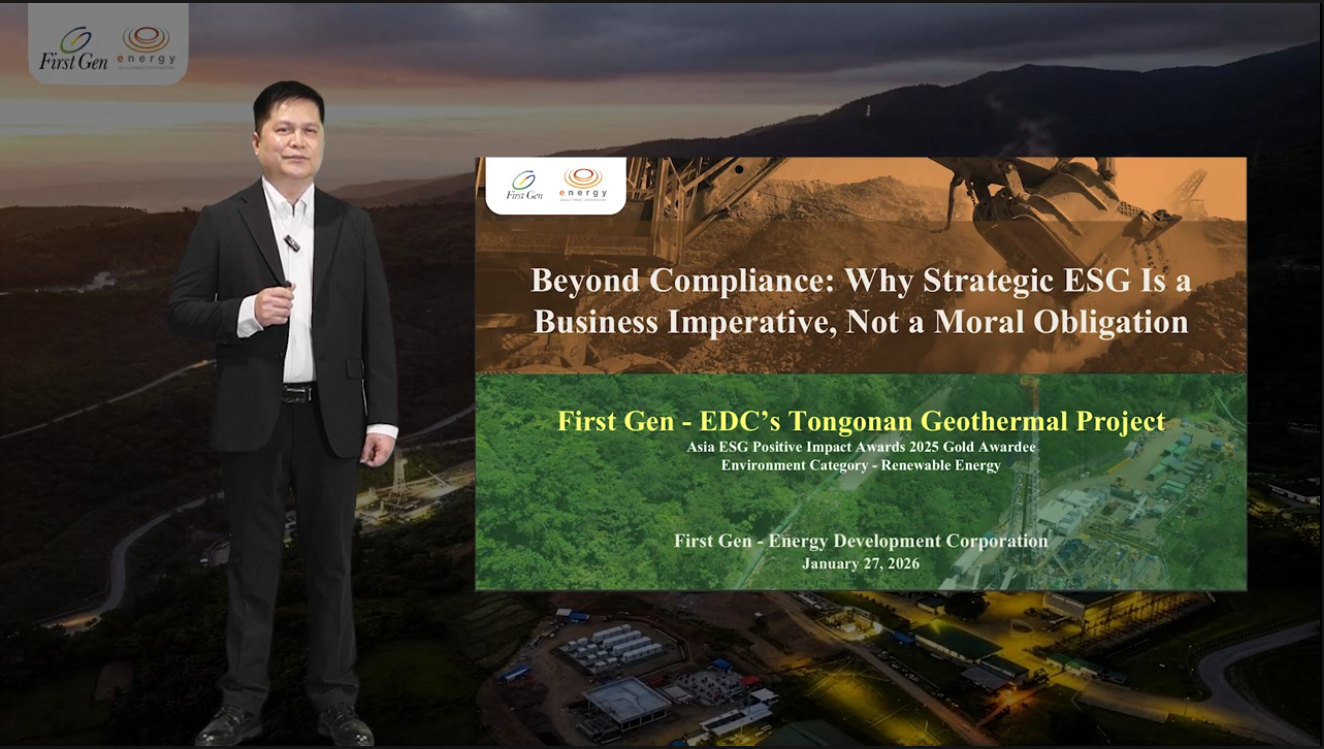
An example would be the Tongonan geothermal power plan of Energy Development Corp. (FirstGen-EDC) in Leyte, which has been delivering clean and reliable power 24/7 for over 40 years, supplying more than 25 terawatt hours of renewable energy to the national grid across the decades.
“That is not luck. That is strategy,” said Teodulfo Troyo, Tongonan facility head, in a video presentation. “Many companies see the environment as a limitation. At Tongonan, the environment is an operating asset.”
Troyo said that in Tongonan, community development, such as livelihood and education programs, was not just an “add-on” but was designed into the project. This reduces conflict, builds “shared ownership,” and helps the company secure a long-term license to operate.
He explained that FirstGen-EDC employs the help of local communities in managing the forests surrounding the geothermal site, which, in turn, ensures the continuous flow of thermal energy, resulting in a partnership that provides mutual benefits.
That is why for Troyo, helping the community is not just a moral obligation, but a part of business continuity and planning.
******
Get real-time news updates: inqnews.net/inqviber