Monumental failures

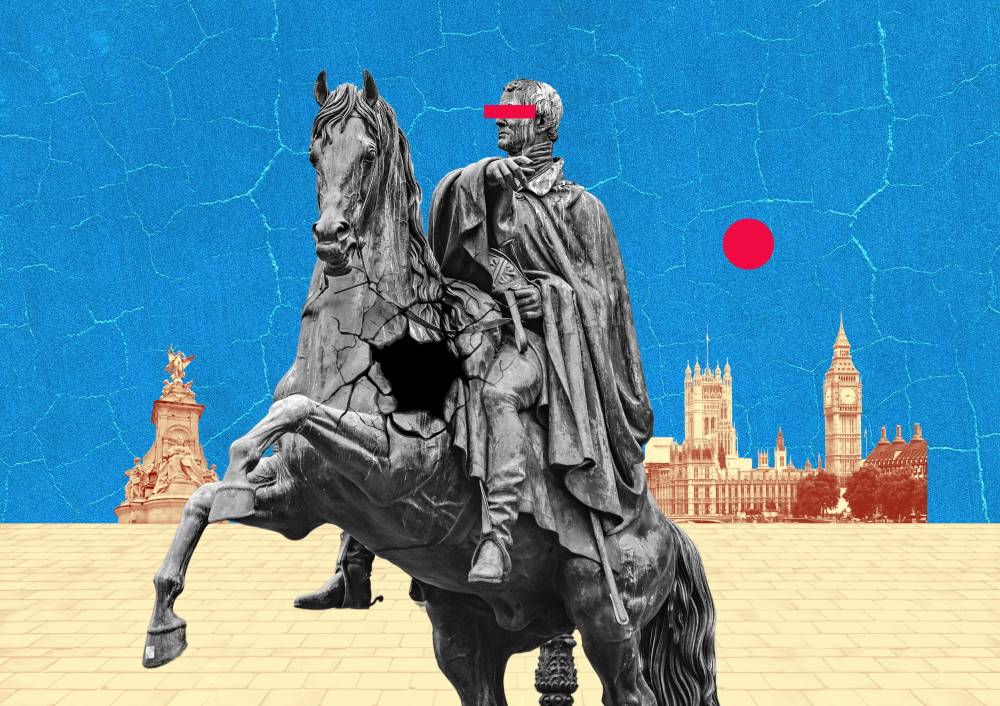
Sometimes, London feels like one big theme park inhabited by the ghosts of empire, both dead and living. The city is a tableau of royal palaces, graceful Victorian arcades, and stately monuments to conquest as well as to classicism, not to mention the purported supremacy of white civilization over the savagery of their subjects, past and present.
Erected as symbols of power, monuments pay homage to key persons, events, and narratives in a nation’s history. They tend to be imposing in scale, highlighting the significance of what is being literally and metaphorically elevated, as well as glorified and memorialized. Their purpose is rarely subtle, ostensibly historical, often blatantly political; sometimes obfuscated is their value as tourist attractions and revenue generators.
As regimes fall and reigns end, monuments lose their meaning, if not their bronze patina altogether. As erased truths unfold and accepted narratives unravel, monuments mutate. Once symbols of might intended to awe and intimidate, they become objects of ridicule, relics of greed, and testaments to collective delusion.
Of course, how one perceives a monument depends on how closely attached one is to colonial structures and past glories. Monarchists will marvel at the longevity of the institution, declare it the glue that holds the United Kingdom together, and feel nostalgia for an era of grace and grandeur that is slipping away. Those with a decolonized anti-monarchist mindset, on the other hand, will certainly walk past Buckingham Palace’s Georgian façade and understand that wealth was stolen, peoples enslaved, lands seized, and cultures destroyed so that inbred kings and queens could consolidate their power and live in splendor. Funded by the taxpayer.
If one allows oneself to believe in the divine right of kings, then one is giving carte blanche to a tiny family of titled and entitled people to behave and misbehave as they see fit, with little to no consequence. The former Prince Andrew is a nonce and has always been a nonce because Mummy let him be one, and then society let him be one. Mummy bailed him out to the tune of 12 million euros when a brave woman named Virginia Giuffre credibly accused him of sexual abuse. His brother Charles stripped him of his royal title and privileges in the wake of sordid revelations regarding his relationship to convicted sex trafficker Jeffrey Epstein, but Andrew still got to live on royal grounds in the Sandringham estate.
With the latest Epstein files drop, complete with incriminating pictures of the royal nonce nonce-ing about in a T-shirt over the body of a presumably young girl, the scandal became too big to ignore. Obviously something had to be done to placate the restive masses. A disgraced Andrew was sacrificed and thus arrested. On his 66th birthday. On charges of leaking classified documents while trade envoy, as allegedly revealed by Epstein’s emails. He was released after 12 hours of questioning.
But will he ever actually serve time for his crimes, pedophilia and sexual abuse arguably being more serious offenses than treason?
Andrew’s real crime, in the eyes of many, is that he got caught. On camera.
Because let’s face it. Rape, torture, sexual abuse, and the like—Andrew isn’t the first royal to allegedly participate in such criminal activities. When realms are won by violence and maintained by violence—and imperialism is a form of violence—is it any wonder that its rulers think nothing of sexual violence and condone those in their circle who behave violently? Charles himself, as I’ve said before, remained a friend to notorious sex offender Jimmy Saville as well as Peter Ball, the former bishop of Lewes, who sexually abused young men in the ’80s and ’90s, even after their convictions.
And Mummy knew. Her son wasn’t called Randy Andy for nothing. And yet the British public believes that whatever Meghan Markle supposedly did to the British royal family was a far greater transgression than Andrew’s own provable history of criminal behavior.

Strip away the royal façade and you get, for the most part, mediocrity. This was magnificently displayed in the British Nigerian artist Yinka Shonibare’s recent show at the Serpentine Gallery, “Suspended States.” In one exhibit, “Decolonised Structures,” he reimagined queens, lords, prime ministers, generals, and other erstwhile architects of British imperialism as less-than-life-size fiberglass sculptures in officious poses, painted over in floral waxed cloth patterns. Clearly a critique of imperial power rendered innocuous when finery is covered in frumpery—Queen Victoria could be an ordinary grandmother, Winston Churchill a benign, if pompous, uncle, Lord Napier a flamboyant drag queen—Shonibare turned once feared and respected personages into monuments of banality. “The authority of bronze and marble is gone,” remarked curator Hans Ulrich Obrist.
The use of wax cloth motifs is particularly significant. Shonibare said that the textile became a metaphor for authenticity as well as colonialism. “I went to a shop in Brixton selling batik, and they told me that these fabrics are Indonesian inspired, produced by the Dutch industrially and then sold back to West Africa. I always imagined the fabrics were ‘authentically’ African.” Today, the fabrics are manufactured in China. But of course.
Unsurprisingly, many among the British continue to embrace the mythology around their icons, and revere their royals. It wasn’t exactly shocking to hear Brits calling into a radio show on the London Broadcasting Corporation in defense of Andrew. “What’s he supposed to do for fun?” one male caller demanded.
Can’t he just play pickleball like every other 66-year-old?