





4 towns declare holiday on EDSA revolt anniv; classes, gov’t work suspended

Even as the national government had declared Feb. 25 as a “special working holiday” throughout the country, at least four local governments had declared the suspension of work and classes in their respective localities in order to give people enough time to reminisce the day 40 years ago when democracy was restored through the 1986 Edsa People Power Revolution.
These are the local governments of Taytay in Rizal province, Hinigaran and Isabela in Negros Occidental province, and Capas in Tarlac province.
Alongside this, many universities and colleges throughout the country, especially those under the Catholic Education Association of the Philippines, (CEAP) had declared academic holidays, freeing up their students, faculty and staff to participate in commemoration activities.
“The spirit of Edsa is not merely a memory of the past but a living legacy of courage and unyielding faith in democracy that continues to define our identity as Filipinos and our responsibilities as citizens of a free republic,” said Hinigaran Mayor Grace Arceo.
She said that the Edsa People Power of February 1986 was a “monumental chapter in the country’s story and a testament to the world that the collective pursuit of truth, justice and liberty can peacefully dismantle even the most formidable walls of oppression.”
Taytay Mayor Allan de Leon urged his constituents to “come together in remembering the spirit of unity and freedom.”
In suspending work in government offices, Isabela Mayor Miguel Angelo Yulo ordered that essential offices and agencies delivering basic and emergency services to remain operational to ensure the continuous safety and welfare of the people.
In Tarlac, Capas Mayor Roseller Rodriguez said only personnel from the public order and safety management office, disaster risk reduction and management office, health office, and municipal hospital are required to report for work today.
But he clarified that the suspension of work does not cover private businesses or national government offices, unless they voluntarily choose to observe the Edsa anniversary.
Understanding present
Rodriguez said the suspension allows residents to participate in commemorations and reflect on the bloodless revolution’s historical significance.
Among academic institutions, the University of St. La Salle (USLS) in Bacolod City said remembering Edsa is not only about honoring the past but also about understanding the present.
“The concerns that moved Filipinos to stand together 40 years ago remain pressing and relevant up to this day, particularly the pursuit of truth, justice, accountability and respect for human dignity,” USLS said.
“On Feb. 25, we pause—not just to mark a date on the calendar, but also to remember the courage, the unity and the peaceful call for freedom that rang through the streets,” it added.
In Oriental Mindoro province, the Divine Word College of Calapan declared Feb. 25 a nonworking day across all its campuses in observance of the 40th anniversary of the Edsa revolt.
The declaration follows the directive of the Catholic Bishops’ Conference of the Philippines, through its Episcopal Commission on Catholic Education and the CEAP, as well as the Apostolic Vicariate of Calapan.
In Albay province, the Diocese of Legazpi has ordered the suspension of classes in all Catholic schools in the province.

Bishop Joel Baylon said this would allow students, faculty, and staff to actively participate in the scheduled activities on Feb. 25, such as the “March of Heroes” which, he said, is “envisioned as a solemn expression of gratitude for the gift of freedom, democracy, and moral courage that marked the historic events of 1986.”
Baylon said the procession “seeks to pass on the younger generation the truth and enduring meaning of Edsa.”
In Cagayan de Oro City, Catholic-owned Lourdes College had called off classes for the Edsa commemoration rites. “The institution honors the power of peaceful change and the enduring spirit of democracy,” it said.
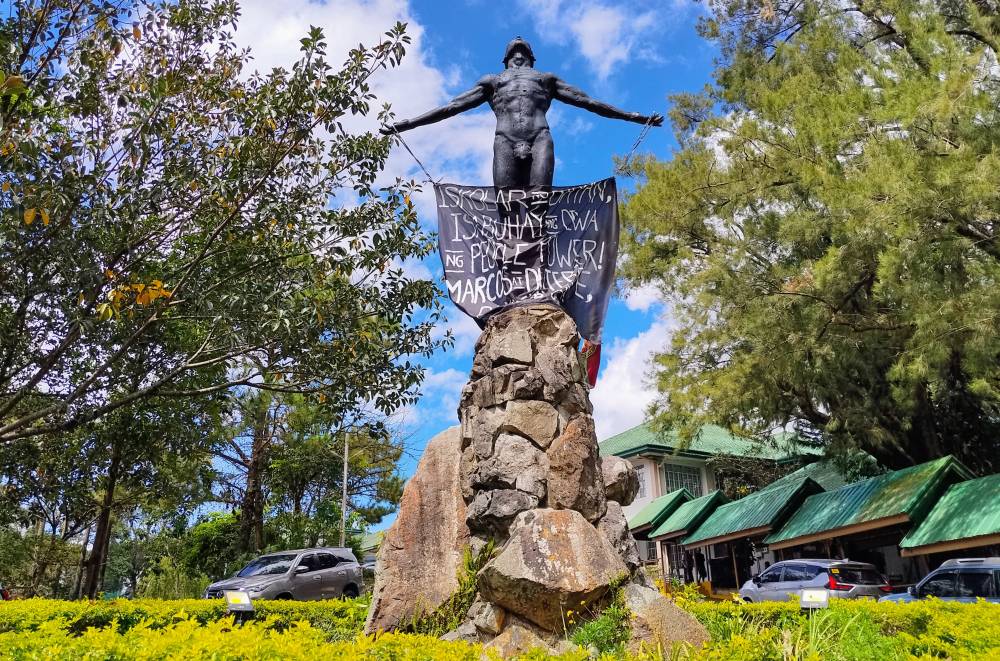
In Baguio City, activists lamented at how the spirit of Edsa seemed to have been lost in the younger generation.
Geraldine Cacho recalled how ordinary people shielded opposition figures and activists being hunted by the government when they occupied the Baguio Cathedral from Feb. 23 to Feb. 25 in 1986.
Forty years since that heroic ordeal at the cathedral, Cacho said many of its participants had been disappointed at the failure to protect “gains” made in fighting tyranny.
Activist Jeanette Ribaya, who was 26 when she joined the uprising in Metro Manila, said People Power was bloodless only because it was paved by the people killed or tortured during martial law.
In Baguio as in other parts of the country, the People Power anniversary will be commemorated by an anticorruption rally because issues of corruption during martial law are still being repeated today, Cacho said. —REPORTS FROM CARLA GOMEZ, CONG CORRALES, MADONNA VIROLA, JUN MALIG AND VINCENT CABREZA