


For Annie Cabigting, perspective is plural

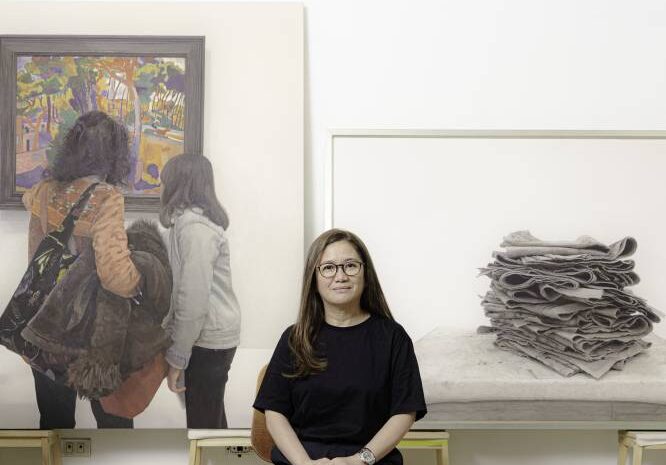
Looking at an artwork by Annie Cabigting demands a sense of stillness. Her realist, often self-reflexive work draws viewers to lower their voices, slow down, and look deeper. But behind the stillness in the artist’s creation is a creator whose mind is constantly in motion.
It’s tempting to frame Cabigting as simply one of the country’s most conceptually rigorous painters (which she is). But she is also an avid gamer with an enviable rig—so avid that she met her husband on a MMORPG (massive multiplayer online role-playing game). At the same time, she is a disciplined student of Kyūdō, the meditative Japanese martial art of archery, a practice rooted in samurai culture.
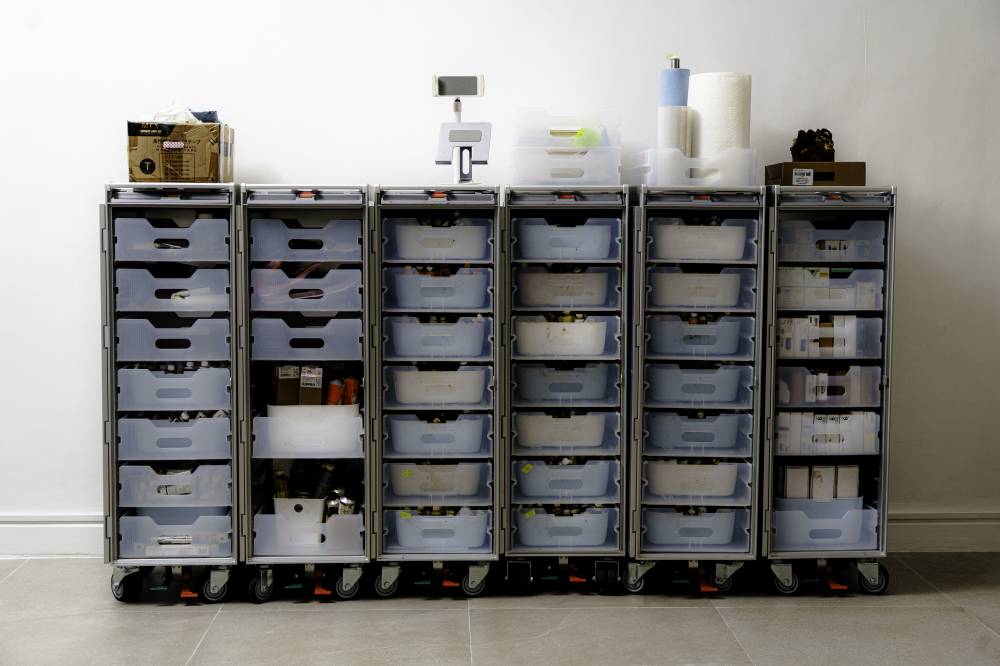
As an artist, Cabigting’s studio is clean and meticulously organized, with paint stored in identical airline trolleys. While I expect her to listen to cerebral culture podcasts or art theoretical lectures, she reveals she prefers to listen to horror and true crime when she’s at work.
Without a doubt, Cabigting’s multiplicity is astounding. And if her way of life shows anything, it reveals how her practice always revolves around manifold perspectives.
Rigor with play
If you were to just skim Cabigting’s portfolio of past exhibitions, she appears to be intensely cerebral. In the 1990s, she studied painting at the University of the Philippines College of Fine Arts, where her drawing habits were, as she recalls, “smacked out” of her by mentor Roberto Chabet, the father of Philippine conceptual art.
Cabigting became an artist later in life, after teaching and working in advertising. She was already in her 30s when she mounted her first exhibit, although she entered the art world well-equipped with the conceptual clarity possessed by all Chabet babies.
The artist’s most instantly recognizable works are meta and self-reflexive paintings based on photos of people looking closely at art historical masterpieces—from renditions of geometric Picassos to clean Rothkos, poetic Vermeers, and grand Rubens. From these photos, she breaks the images into grids and reconstructs them pixel by pixel through paint.
Yet her intellectual rigor coexists with play, as she shares how she moves fluidly between PC, PS5, Switch, and Xbox. She shows off an ergonomic mouse with interchangeable panels, fashioned like a glove. At one point, she raves about Final Fantasy as not just an entertaining game, but a test of ethical gray areas and moral inquiry, waxing poetic about how one character may be a savior from one perspective, while evil and destructive from another.
Across her home are Maine coons, rescue cats, and little tortoises. They weave through Lego flowers arranged across shelves and vinyl records stacked neatly nearby.
Constructing the gaze
From Cabigting’s artistic oeuvre, you would think she’s all seriousness, and while her conceptual foundation is, as a person, she is delightfully light. And if her life and hobbies reveal a tendency toward multiple perspectives, her exhibitions make that inquiry physical.
In 2018, she staged “Museum Watching” at Finale Art File, working with Migs Rosales to transform the white cube into a manufactured museum environment, complete with architectural interventions and ornate furniture. There were behavioral effects, as she recalls, “I want to see if people would change their behavior… Even in a manufactured space, people behave differently,” she says.
“Like outside, they’re gulo. Then the minute they enter the museum, their tones are hushed,” she adds.
Cabigting positioned herself in a corner. “The audience became the participant because they’re entering the space. They became part of the work.” Without that presence, she insists, “it’s just an object on the wall.”
This interest in what surrounds the artwork, and not just the artwork itself, was evident long before, such as in her 2006 exhibition “Hanging Pictures,” also at Finale. Here, Cabigting froze the act of installation. White-gloved hands delicately handled works by Lucian Freud or Francis Bacon at auction, a small Vermeer, and a grand Rubens. In contrast, the bare hands of local installers in the Philippines steadied frames with a leveler perched on top.
These gestures were subtle but asked incisive questions like who touches art, and who assigns value, as well as what invisible labor sustains the spectacle of display.
To see or not to see
In 2012, Cabigting continued to push logic with “Under Wraps,” conceptually echoing the strategies of Christo and Jeanne-Claude, known for wrapping large-scale environmental works from entire islands to the Reichstag in Berlin. Cabigting created small paintings that were completely concealed in white fabric and laid on pedestals like stone tablets, never meant to be opened, exercising the restraint of collectors.
Through “Under Wraps,” she also commented on a toxic trend in the market, where people were buying paintings they had never seen, prioritizing value rather than appreciation of the art itself.
“If they could buy paintings without seeing, then they can live with a painting that they’ll never see,” she explains with relish. “I’m not giving you a visual work. It’s more mental… You always wonder.”
Inevitably, collectors asked when they could unwrap the pieces, to which she replied, “You can’t open it. The point of the work is wonder what is inside.” The moment of revelation, she argues, would collapse the experience. “You’re gratified if you see it. After that, wala na ’yung experience.” If they had opened it, Cabigting swore she’d disown the work. But no collector did such thing. Five years later, she painted the wrapped canvases themselves to give to the collectors, perhaps as a sort of recompense.

This investigation into visibility and access expanded later on in exhibitions like “In Storage” (2022), when she turned the main gallery of Finale into a warehouse, which is what the gallery originally was. Sealed crates filled the space, with only rough sketches and squiggles hinting at their contents inside, pushing collectors to choose blindly.
Through this, Cabigting made a commentary on artworks that were put in storage, moving through freeports, without taxes, ultimately disappearing from public view. “After the show, it disappears into the boxes or homes of collectors,” she says. “And us, the public, will never see it again.”
Most recently, her 2025 exhibition “Five Formed From Two” followed a new method of inquiry. Cabigting painted sides of a wooden block, thickly layered with pigment, blurring the line between painting and sculpture.
“It’s the same object, but perspective-wise it also changes. We have a different perspective on the same object. We all have our own prejudices. So that’s why I made three versions of the same object.”
How we see things is all informed by our subjective experience. Be it because of our age, gender, nationality, class, or personal histories, our gazes are never neutral, but shaped by who we are. Cabigting’s practice maps this spectrum.
Stillness and multiplicity
In Cabigting’s exhibitions, figures stand before masterpieces, caught mid-gaze. As you stand in front of one of these paintings in real life, you might ask yourself: Is Cabigting’s work a masterpiece in itself as well?
From 2023 to 2024, she exhibited “When We Look at Art” at the Metropolitan Museum of Manila, documenting the decades of her practice thus far. And more recently, she exhibited a piece at ALT Art 2026 last February, creating a painting of two women studying a small painting by Matisse.
With more works in progress in the year to come, Cabigting continues to create layered conversations in her work, from discussions on value, labor, and access to imagination and the politics of seeing.
For Women’s Month, Cabigting shows a person who is expansive, not reducible to a single dimension or role as an artist. She is disciplined and playful, analytical and intuitive, conceptual and domestic, an archer and a gamer, meticulous and mischievous.
Through all this, Cabigting exemplifies how perspective is plural, both in art and life itself.