

ICC prosecutor: Duterte’s defense a near ‘admission’

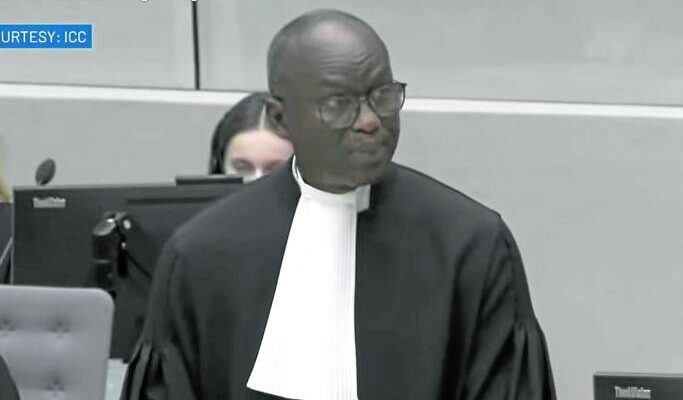
THE HAGUE, the Netherlands—Deputy Prosecutor Mame Mandiaye Niang of the International Criminal Court (ICC) described the strategy adopted by the defense of Rodrigo Duterte—highlighting continued extrajudicial killings after he stepped down from Malacañang—as “nearly close to an admission” of the crime.
Such a defense strategy is called tu quoque—Latin for “you too”—which intends to divert responsibility for the crime from the accused to another person or party while also acknowledging it, Niang noted.
“When you are called upon in a court of law to respond to your crime, to allege that it’s not only (you), [and say], ‘look at others, they’re also doing it,’ I think it’s not a defense,’” he said in an exclusive interview with the Inquirer shortly after the fourth and final day of the confirmation of charges hearing.
A sense of irony
In his submission on the merits of the case on the third day of the hearing, lead defense Nicholas Kaufman dragged President Marcos to the case, saying that his client’s successor “did not frustrate the incidence of murder at the hands of state agents or vigilantes.”
What made Niang “almost smile” was the irony in Kaufman telling the Pre-Trial Chamber (PTC) I not to seriously take the “incendiary” words of Duterte ordering and encouraging the drug-related killings, and in the same breath, challenging the victims’ lawyers to look into the post-Duterte extrajudicial killings.
“For someone who denied that, ‘No, no, no, you shouldn’t take us seriously, none of these crimes were state crimes,’ but in the end, allege that, ‘Oh, the state crimes continued, the state crimes are even amplified and you should look into it,’ is nearly close to admission,” he said.
This tu quoque strategy, however, is “not permissible” in the ICC, and therefore, not a well-grounded defense, according to the deputy prosecutor.
“We no longer retain jurisdiction of what may happen to the Philippines. But the bottom line is, that’s not a good line of defense,” Niang said.
In 2018, Duterte ordered Manila’s withdrawal from the Rome Statute—the treaty that established the ICC—after learning that a “preliminary examination” of thousands of extrajudicial killings was being conducted by then ICC Chief Prosecutor Fatou Bensouda. The withdrawal took effect in 2019.
‘Plausible deniability’
Niang, a Senegalese prosecutor, also rebuked the defense for trying to apply “plausible deniability” to absolve the former president of accountability when it cited faulty police reports and other documents to cast doubts on even the existence of slain drug war victims and their identities.
“They will put something [in official records] to protect themselves from future investigations. But bottom line is, you have to read evidence in context,” he said.
Asked which of the defense’s arguments he finds the most illogical, Niang refused to say, but expressed confidence that the Office of the Prosecutor (OTP) had “a very strong case” before the pretrial chamber.
“I think that when we presented images [and] videos … that was a case, in my view, that speaks for itself because it’s not (often) that you have a self-confessed crime [as a case],” said Niang, who was elected to his position in 2021. He began his nine-year term the following year.
“It’s not always that you have a self-confessed crime, so to speak,” he said. “Someone who at one point in time believed that the lengths of justice will never reach out to him and who spoke confidently about what he was doing. I think that’s a major part of our case.”
‘Oblique’ defense attack
Kaufman closed his presentation on the final day of hearing by launching a two-pronged attack against the prosecution’s “narrative manipulation,” accusing it of cherry-picking evidence to control public perception while burying the “real meat” that the defense can only attack during closed sessions.
“The prosecution controls the narrative by arbitrarily lifting redactions so that it can make its narrative of a grand scheme … known to the public in open court,” Kaufman told the bench.
He said the prosecution’s action has forced the defense to attack the substance of the charges “obliquely,” depriving the public of a transparent view of the weaknesses of the case against Duterte.
“Be persuaded by your own innate sense of justice and by your own collective years of experience, but most importantly, be guided by coherent evidence and by common sense,” Kaufman told the PTC I.

“I beg you not to confirm any of the charges. I ask you to let Rodrigo Duterte return to the Philippines, not to govern. but simply to let him live out the rest of his days in peace, in his humble dwelling in Davao,” he concluded.
Given a voice
One relative of a drug war victim, Sheerah Escudero, said she and the families of other victims were deeply grateful at how their common legal representatives—Joel Butuyan, Gilbert Andres and Nicole Arcaina—have echoed their voices and retold their stories before the PTC I.
Her younger brother, Ephraim Escudero, 18, had been missing for five days in 2017 when his body was found dumped in an open field in Angeles City, Pampanga. He was shot three times in the head, which was wrapped with packaging tape as were his arms and legs—similar to how thousands of drug war victims’ bodies were mercilessly disposed.
According to police investigators, her brother was “collateral damage” as he had a clean barangay and police record and was never involved in drug peddling in their community in San Pedro City, Laguna, Escudero said.
“We have waited for so many years … and finally our calls were amplified,” she told reporters after the pretrial hearing was concluded on Friday. “We trust the (ICC) on how it will handle the proceedings and we are confident that the evidence from the prosecution is strong.”
The confirmation of charges hearing, held from Feb. 23 to Feb. 24 and from Feb. 26 to Feb. 27, is intended to determine whether there is sufficient evidence to bring Duterte to a full trial on charges of crimes against humanity of murder and attempted murder. The PTC I has 60 days to decide on it. —WITH A REPORT FROM TETCH TORRES-TUPAS
******
Get real-time news updates: inqnews.net/inqviber