





Motorists: Better road conditions to help prevent accidents

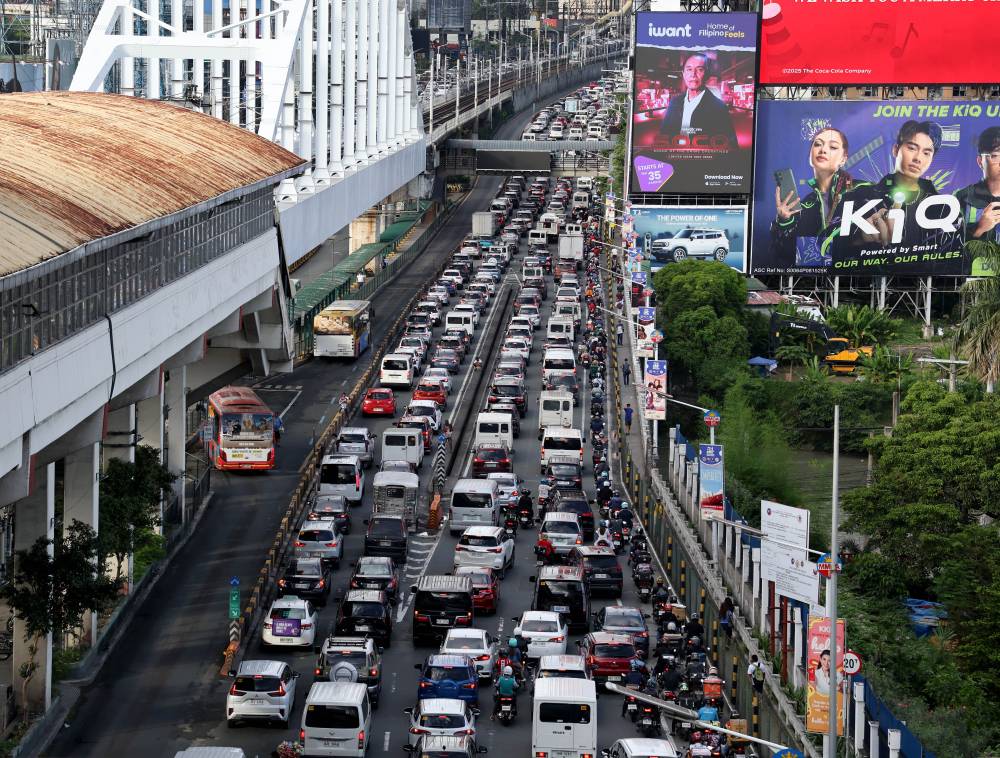
Kirk James Gonzales, a food delivery and motorcycle taxi rider, recalled a time when he was flagged down and issued a ticket by a traffic enforcer for failing to follow a traffic sign.
He noted that some road signs are not visible to motorcycle riders like him because of their placement or size, apart from such factors or circumstances as trees and other obstructions.
A “No Left Turn” sign, for example, should be visible to drivers before they reach the intersection, Gonzales said. But “sometimes, there’s only one [road sign], and you can’t even read it because it’s covered by leaves, by a tree,” he told the Inquirer.
Based on the latest data from the Metropolitan Manila Development Authority (MMDA), the primary cause of fatal road accidents in Metro Manila is human error, with authorities citing instances of negligence, inattentiveness, loss of control or poor sight.
But for motorists like Gonzales, preventing road accidents should not just be about penalizing drivers who violate traffic rules.
Structural problems such as obstructed road signs should be addressed, and labor conditions of public utility vehicle drivers must also be considered.
Review of traffic signs
Mark Larson Vallejo, also a motorcycle taxi rider, said he hopes that transport network companies (TNCs) would provide additional training on understanding various road signs.
“What we call road and safety training, for food delivery riders,…there is no such training happening,” he said in the same interview.
Vallejo said a review of traffic signs is important because many motorcycle riders have already forgotten some of these rules.
Gonzales also acknowledged that some motorcycle riders disregard such traffic signs as “one way” street.
“The pinned location of [your] customer…is right there, but the road is one way. If you were to turn around, it would be very far, and you’re chasing passengers because you have a target [number in a certain time frame],” he said.
Motorcycle accidents
One mistaken notion that most Filipino motorists believe is that motorcycle drivers are spared culpability in any accident they are involved in.
But no Philippine traffic law grants such accommodation to motorists operating motorcycles.
According to the MMDA’s latest Metro Manila Accident Recording and Analysis System report, there were a total of 88,101 road crash incidents in 2024 within Metro Manila, 2.5 percent higher than the previous 85,954 incidents recorded in 2023.
Most of the cases involved cars, which accounted for 54 percent of all road crashes, followed by motorcycles that accounted for 23.5 percent.
But when it comes to fatal road crashes, the MMDA pointed out that such cases mostly involved motorcycles—with 349 recorded deaths in 2024, followed by cars with 135 and trucks with 101.
Blind spot
Arthur Magalinan, corporate lecturer at A1 driving school, said one of the things aspiring drivers need to learn is that vehicles have a blind spot, which is why they should not expect other road users to always see and avoid them.
He said this is one of the topics they teach students who wish to learn how to drive a motorcycle before letting them transition from driving in a training facility to an actual road.
Learning a vehicle’s blind spot is especially important for motorcycle riders because many of them, Magalinan observed, do not stay in just one lane.
“Motorcycles, they don’t line up at the back [of a vehicle.] We may notice, if they are not at the rightmost [side], they are on the center line,” he told the Inquirer.
“What they don’t know, and this is what we teach them, vehicles have a blind spot. You’re right beside them, but they don’t see you in their side mirror.”
By traversing the center line that marks the separation of lanes on a road, Magalinan said motorcycle riders are “really putting their lives at risk,” noting that there are undisciplined drivers of cars and other four-wheel vehicles who would turn without giving a signal.

Discipline, patience
Based on Magalinan’s observation, the reason for road accidents is usually not lack of skill but lack of discipline among drivers.
“If you have discipline when it comes to yourself and your driving, you will be far away from accidents. And you will know how to handle your vehicle, how to follow the traffic rules and regulations,” he said.
Magalinan also stressed the need for patience, saying that drivers who are in a rush are more prone to accidents because they would often take shortcuts or risky maneuvers on the road.
Such is the case among motorcycle taxi riders, particularly those in food delivery, Vallejo said, pointing out that they need to reach a delivery quota to get their monetary incentives.
“For example, in peak hours, around 10 a.m. to 1 p.m., [TNCs] will give an incentive request in which you need to have this amount of booking,” he said. “The tendency of delivery riders, in order to hit the target of the incentive request, [is that] they will drive faster.”
Risk of bad roads
Vallejo said drivers also face various road obstacles that could lead to accidents. This can be difficult especially for food delivery riders because they have to traverse unfamiliar places as part of their job.
“We go to many different places [where] we are not aware of the various cracks on the ground,” he said. “Of course, you’re driving fast. You don’t know that the road isn’t flat. There’s suddenly a hole in the ground that can cause an accident for delivery riders.”
He said road humps can also be dangerous for motorcycle riders, especially if they do not have the proper yellow markings that would make them visible at night.
“Humps nowadays are the same color as the road, so sometimes, while you’re driving, you’re surprised that there’s a hump there,” Gonzales said.
Magalinan advised those travelling to unfamiliar areas, especially new drivers, to plan their routes. He also said traffic signs that are more like obstructions should be fixed.
“Our enforcers should also be well-oriented and well-trained, because we have enforcers who do not know their duties,” he said. “In my opinion, an enforcer should have been a driver for five years, so that they understand the feeling of being a motorist.”