










Higher tax, ‘scarier’ packs make smokers quit–study

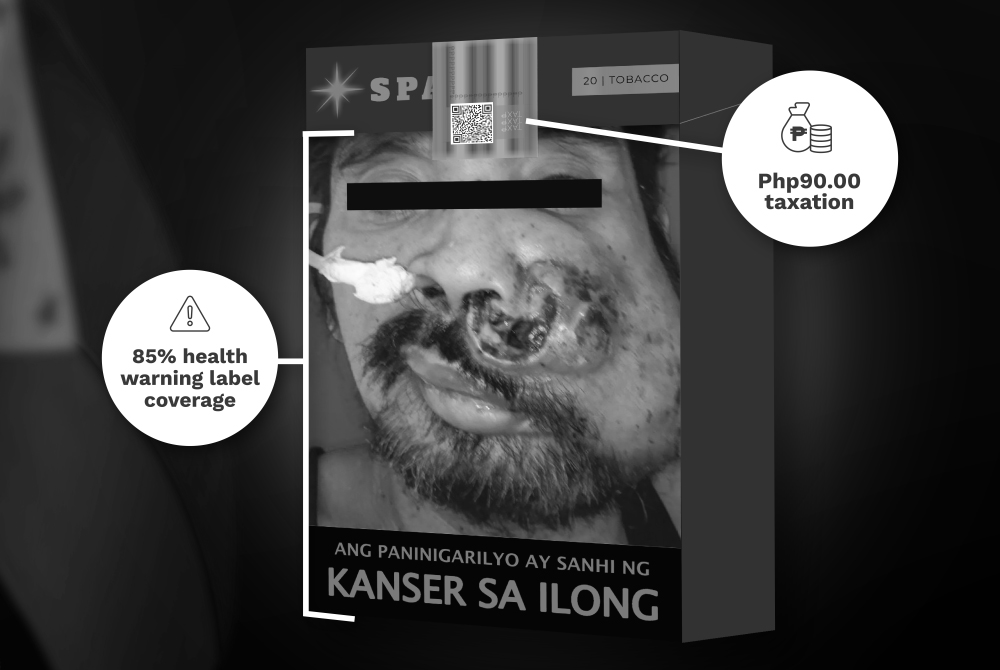
Health experts are calling for higher taxes on cigarettes and larger warning labels on the packaging, taking their cue from a new study that found that such measures help motivate Filipino smokers to quit.
“If the excise tax on cigarettes were increased to P90 per pack—a 23-percent increase from its current rate—roughly 5.5 million more Filipinos who smoke might consider quitting,” Lauren Czaplicki, an associate scientist at the Institute for Global Tobacco Control (IGTC) of the Johns Hopkins Bloomberg School of Public Health.
In a statement on Wednesday, Czaplicki said people tend to base their purchasing decisions on how much a pack of cigarettes costs as well as what it looks like, which is why higher taxes and larger graphic warnings serve as effective deterrents.
Czaplicki was speaking as the lead author of a new study by IGTC, which found that the Philippines, where more than 13 million Filipinos smoke cigarettes, can still improve its regulations when it comes to taxes and packaging.
Graphic images
In the study, researchers surveyed 886 Filipino adults who smoke. They were shown images of cigarette packs with varying prices and sizes of warning labels, before being asked to choose which one would make them think about quitting the most.
Most of the participants chose the cigarette packs that were priced higher because of an additional P80 to P90 in cost due to excise taxes and featured warning labels with graphic images that covered at least 85 percent of the pack.
On the other hand, when asked to choose which ones do they think would be the least harmful, most of them pointed to the lower-priced cigarette packs that only had P60 in excise and the ones which had no health warning label on the packaging.
The researchers noted that raising the tax from P60 to P80 or P90 can help deter people from buying a cigarette pack. Increasing the size of the health warning label from 50 percent to 85 percent can also encourage those who smoke to consider quitting.
According to the IGTC, taxes currently represent 51 percent of the price of a pack of cigarettes in the Philippines. As for graphic warning labels, IGTC noted that the images have to cover 50 percent of the front and back of a cigarette pack and 30 percent of the sides.
Room for improvement
For the researchers, however, there is still an opportunity to advance packaging regulations in the country.

They also saw a need to further strengthen programs that can prevent the illicit trade of foreign cigarette packs that do not have the proper warning labels.
“The Filipinos surveyed are essentially saying, ‘Taxes should be raised to help me stop smoking,’ and ‘Larger health warnings will discourage me from smoking,’” Dr. Ulysses Dorotheo, executive director of the Southeast Asia Tobacco Control Alliance, said in the same statement.
“Tobacco consumers themselves are telling Philippine policymakers how to help them quit smoking,” he added.
******
Get real-time news updates: inqnews.net/inqviber