










Research suggests women stand to benefit from increased strength training

Despite hesitation from the elders in my family (“baka mahulog matres mo!” “kababae mong tao, nag-ga-ganyan ka?”), it was my sister who developed a solid weightlifting practice which she eventually taught to me.
It wasn’t really in defiance. As an active member of her university track and field team during her undergrad and postgrad years, weekly gym sessions focused around weightlifting were part and parcel of team training.
She shares that these “push days” contributed much to her performance on the track as did her actual runs.
Science and society: A game of catch-up
Our little domestic anecdote reflects a larger trend in fitness that developed over the closing decades of the last century and has been increasingly embraced in the 21st century: More women are strength training.
A landmark position paper by the US National Strength and Conditioning Association published in 1989 argued that women across sports—not just competitive weightlifting—stand to benefit from increased strength training.
This came around a time when more gyms, including women’s gyms, began including weights equipment, all as Arnold Schwarzenegger (yes!) actively championed women’s participation in weight training.
One notable advocate is physiologist and nutritionist Stacy Sims, who holds research positions in the US and New Zealand, and whose body of work has long addressed gender gaps in sports science, criticizing fundamental assumptions about the human body based on studies on male bodies, arguing instead that women’s bodies have different needs.
It seems very obvious, and yet actual medical literature largely assumes that what works for men works for women, that the markers of disease in men also apply to women when interestingly, they can be a sign of a healthier woman.
Sims has also recommended that more women participate in strength training, noting that on top of the already-documented holistic benefits of this form of exercise, “women especially need to stay on top of their skeletal health, since we can lose up to 20 percent of our bone mass in certain sites in the years leading to and around menopause, and 35 percent to 50 percent of women have low bone mass by age 50. Resistance training is essential for supporting strong bone density.”
Other researchers note the following benefits: Strength training helps during childbearing, labor, and delivery, with lessened chances of a C-section, preeclampsia, and post-partum depression. Girls undergoing puberty, who are more prone to body-image issues and eating disorders, can also benefit mentally.
Benefits often manifest two weeks in, while long-term changes set around six months to two years. There was even a case of a 71 year-old who started her strength journey in her 60s.
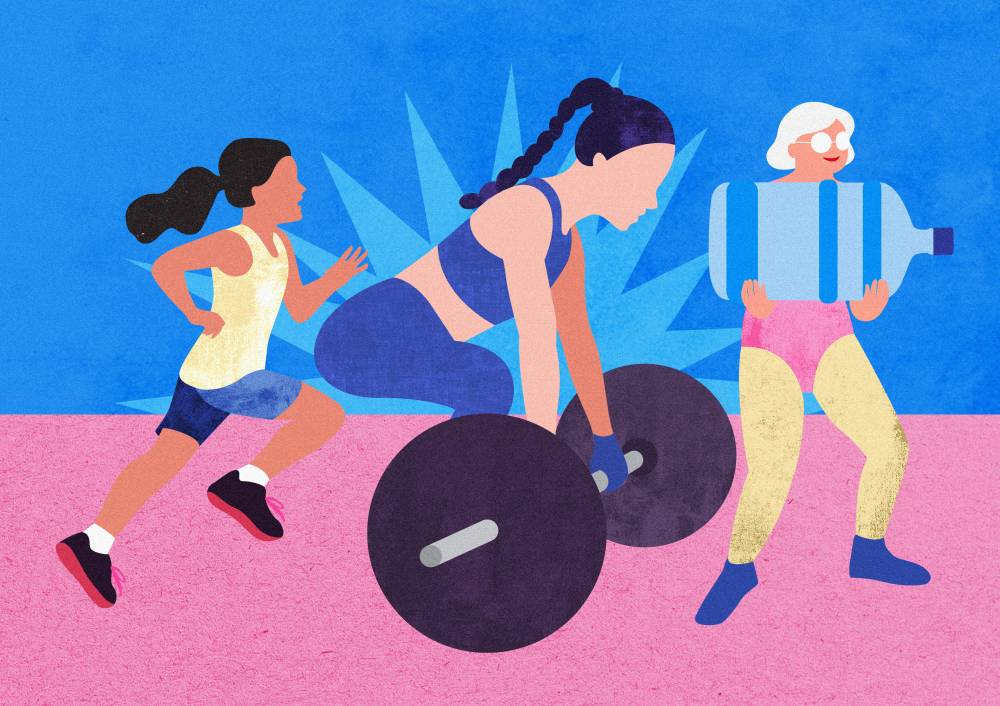
When I think about a woman’s independence, I don’t just think about property or voting rights, moving freely around in a city or countryside, to go flaneuring without the fear of harassment, I think about the day-to-day: As a lola, will she still be able to lift gallons of water, open a stubborn bottle of sardines, or carry a storage box from above, like a lolo still working around the house, refusing to be infantilized? I believe this is where strength training can come into play.
Feminist thinker and icon Gloria Steinem, who later in her life took up strength training, had this to say: “For women to enjoy physical strength is a collective revolution. I’ve gradually come to believe that society’s acceptance of muscular women may be one of the most intimate, visceral measures of change. Yes, we need progress everywhere, but an increase in our physical strength could have more impact on the everyday lives of most women than the occasional role model in the boardroom or in the White House.”
And yes, to look good, too!
I’ll be real, I don’t just lift for quality of life (less achy shoulders after commuting with a laptop), sustained independence (I feel extra strong when I open the door for men, especially when it’s a heavy door), and the #LolaGoals mentioned earlier. I also lift for aesthetic.
It’s okay to want to look good especially as an expression of selfhood versus for an external validation of self.
It’s all right to want that dress to fall nicely over one’s shoulders, for bling to not just accentuate each other but one’s toned arms too, and for race day photos to immortalize shapely calves striding mid-air like a Nike ad.
Even then, women may still hesitate to take on weight training due to negative perceptions around “muscle mommies.”
Social media content creator and health and medical educator Doc Alvin Francisco challenged that view on TikTok, hopefully resting the case that women will “bulk up” like men if they lift more. He says this is impossible as women don’t possess the necessary hormones to bulk up the way men do even with the same lifting volume.
The 1989 NSCA position paper mentioned earlier echoes this, collating several reports observing that while women developed power output from lifting, they didn’t necessarily bulk up (or undergo muscle hypertrophy, to use the scientific term). The authors, meanwhile, observed that it was in a competition setting with steroid use where women were more likely to gain significant muscle mass.
The literature seems unanimous: A toned, athletic female body still looks vastly different from a toned, athletic male body.

Here’s a caveat: I want to circle back on who we’re looking good for, given how historically, the fitness industry (it’s an industry for a reason, sad to say) has also preyed on human insecurities, and even notions of “strong is beautiful” have been twisted to sell products. One can take pride in one’s gains without the pressure to perform getting gains.
Meanwhile, men should incorporate more yoga
“Ka-lalake mong tao, nag-yo-yoga ka? Manyak ka, ano?”
Just as women should do more strength training, men should incorporate more flexibility training as well. A quick search will list the unisex benefits and even the male-body benefits.
Men who do a lot of competitive, high-impact, injury-prone sports stand to benefit a lot from stretching overworked muscles while also strengthening muscles their chosen sport often overlooks. Yoga, Pilates, and other flexibility exercises precisely fill these gaps. Cross-training is the key, and even the NBA has a yoga program.
Historically, too, “feminine” activities like yoga and Pilates were practiced by and even created by men.
Reasons for men’s hesitance range from valid (if you’re the only man in a women-dominated fitness class, I suggest taking a spot at the front) to absurd (“fellas, is it gay to care for our pelvic floor?”).
There’s a meme-stereotype about a gym bro with a buff upper body and chicken legs with weak hips, and I think, like art, there’s definitely some imitation of life going on here. It seems once again, toxic masculinity strikes, harming *gasp* men.
Overall, there are persistent, if dated, notions that certain fitness activities are only for a specific gender. And while each sex responds differently to training and nutrition with different biomarkers for illness and, conversely, wellness, both sexes—and all genders—stand to benefit from a holistic, de-gendered approach to fitness.
Medically reviewed by Alex Vergara, MD