








Brent crude trades near $105; Iran strikes more Gulf targets

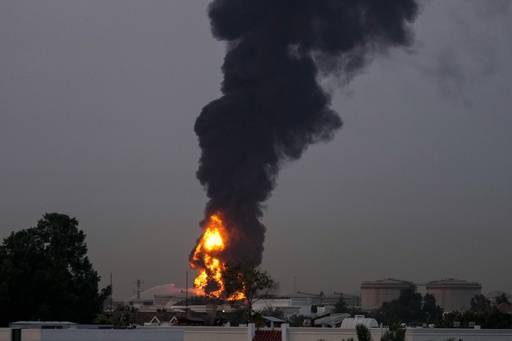
BANGKOK—Brent crude oil traded near $105 per barrel on Monday as Gulf countries reported more attacks by Iran, with the war entering its third week, while share prices were mixed.
A barrel of Brent, the international standard, was up 1.6 percent at $104.73, dipping slightly after opening above $106 per barrel. It’s up more than 40 percent since the war began.
US benchmark crude gained 1 percent to $99.68 per barrel. It’s up nearly 50 percent since the war began.
In share trading, Tokyo’s Nikkei 225 fell 0.4 percent to 53,609.49, while the Kospi in South Korea climbed 0.6 percent to 5,521.17.
Hong Kong’s Hang Seng rose 1.1 percent to 25,755.53 and the Shanghai Composite shed 0.7 percent to 4,066.40.
In Australia, the S&P/ASX 200 gave up 0.4 percent to 8,583.50.
Taiwan’s Taiex edged 0.1 percent higher, while India’s Sensex was down 0.1 percent.
Inflationary pressure
US futures climbed, with the contract for the S&P 500 up 0.5 percent while that for the Dow Jones Industrial Average rose 0.4 percent.
On Friday, Wall Street’s losses deepened as the war again pushed prices above $100 per barrel, ratcheting up inflationary pressure on the global economy.
The S&P 500 fell 0.6 percent to 6,632.19. The benchmark index is now down 3.1 percent so far this year.
The Dow Jones Industrial Average lost 0.3 percent to 46,558.47. The Nasdaq composite finished 0.9 percent lower, at 22,105.36. Those indexes also ended the week with their third straight weekly loss.
Strait of Hormuz closure
Iran has retaliated against attacks by Israel and the United States by effectively stopping cargo traffic through the narrow Strait of Hormuz, where a fifth of the world’s oil typically sails. That has oil producers cutting production because their crude has nowhere to go.

In just over a week since the closure of the Strait of Hormuz, more than 12 million barrels of oil equivalent per day have been taken offline, according to independent research firm Rystad Energy.
However, a handful of tankers have reportedly passed through the strait, adding to uncertainty.
“The truth is that at this point, much of the market is operating in the fog,” Stephen Innes of SPI Asset Management said in a commentary. “For context, the strait normally handles roughly 25 oil and LNG tankers every single day.”
Emergency reserves
If the war continues to hamper the production and transportation of oil from the Persian Gulf, it could cause a damaging surge in inflation.
Members of the International Energy Agency are making a record 400 million barrels of oil available from emergency reserves, though it appears to have done little to reassure markets.