







New record low: Peso slides beyond 60 vs $1

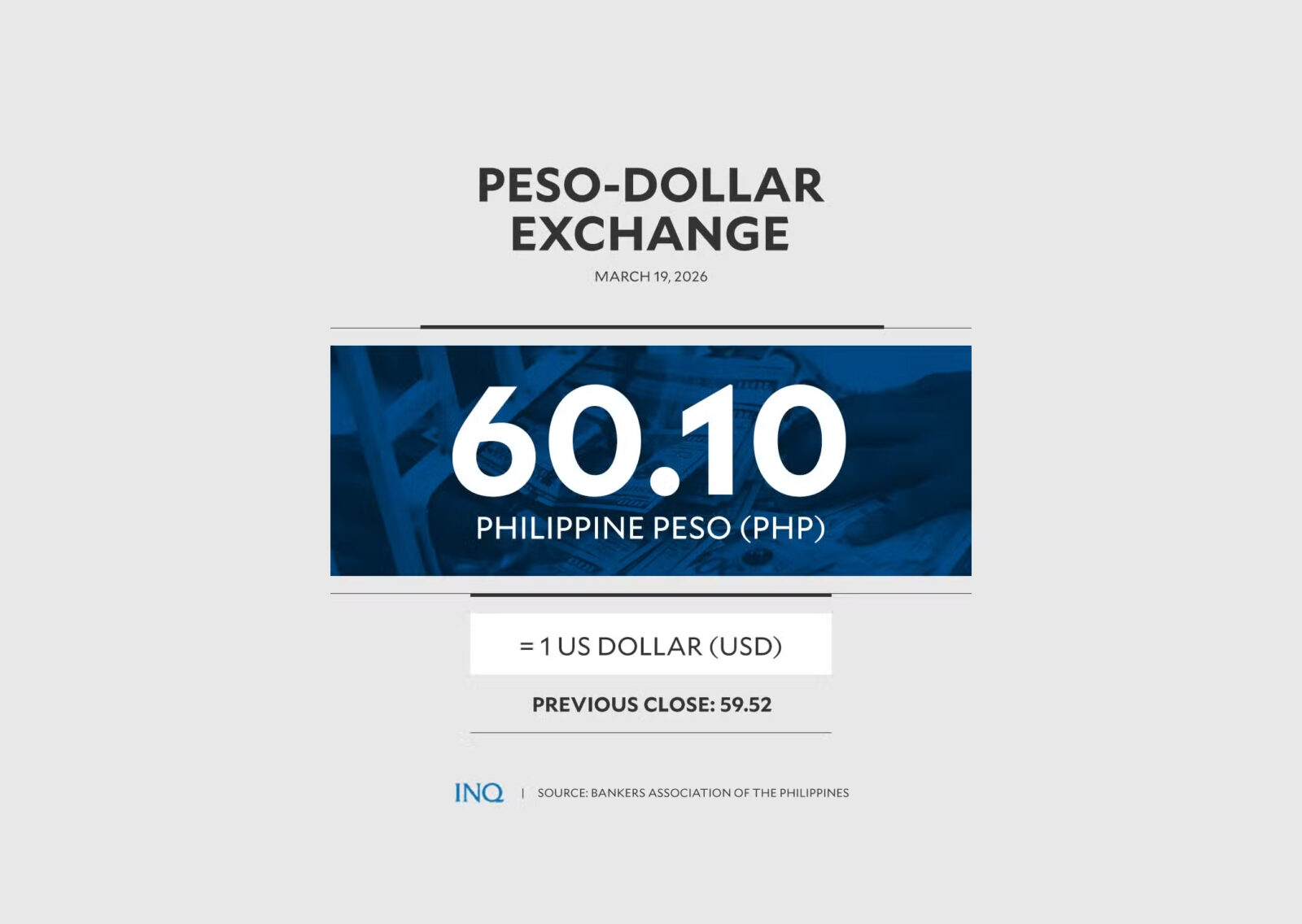
The Philippine peso slid to a record low on Thursday, breaching the 60-per-dollar mark for the first time, as a surging greenback gained more strength after the US Federal Reserve held interest rates steady, citing uncertainty surrounding the war in the oil-rich Middle East.
The local currency closed at 60.1 per dollar, weakening by 58 centavos from its previous finish and setting a new all-time low, surpassing the prior record of 59.87 reached on March 16.
During the session, the peso fell as far as 60.4 before trimming some losses, eclipsing its previous intraday low record of 59.95.
Trading was heavy, with total volume rising to $2.4 billion from $1.8 billion before.
While much of Asia slept, the US central bank left its benchmark rate unchanged at its March 18 meeting.
Fed Chair Jerome Powell said policymakers would have to “wait and see” amid heightened inflation risks tied to the conflict in the Middle East.
Powell remarks
Markets read Powell’s remarks as a signal that US rate cuts may not come soon, reinforcing the dollar’s appeal against other currencies as investors sought the safety of haven assets while the war drags on.
At home, the Bangko Sentral ng Pilipinas (BSP) has lowered its policy rate to 4.25 percent—a move aimed at supporting an economy reeling from the fallout of a corruption scandal, but one that could also make local yields less attractive to investors.“Even with the Fed on hold, the signal remains higher-for-longer, keeping US yields elevated and the dollar firm,” the trader said.
This raises the possibility that the peso will further weaken.
“Combined with high oil prices and geopolitical risks, this continues to pressure the peso, with any recovery likely gradual and dependent on a clearer shift in US policy and softer oil,” it added.
A weaker peso carries mixed consequences for the Philippines.
It boosts the domestic value of remittances sent home by millions of overseas workers and could help make Filipino exports more competitive.
But the weakness also risks driving up import costs and reigniting inflation. Prolonged depreciation could likewise inflate the peso value of foreign debt held by the government and private firms.
Violence in the Middle East escalated after the United States and Israel struck Iran, which retaliated by targeting neighbors in the Persian Gulf that host American troops and disrupting traffic through the Strait of Hormuz, a critical artery for about one-fifth of global oil exports.
Already, BSP Gov. Eli Remolona Jr. has warned that the central bank could raise interest rates if oil prices stay above $100 for an extended period and the US dollar continues to strengthen. Such a move, aimed at containing inflation, could tighten financial conditions and complicate the economy’s recovery from the graft fallout.

“Across Asia, economies, such as Thailand, India, and the Philippines, where food carries a relatively high weight in CPI baskets, are also particularly vulnerable to second-round inflation pressures, as higher energy costs are likely to spill over into food prices,” Lloyd Chan, senior currency analyst at MUFG Global Markets Research, said in a note to clients.
As the conflict in the Middle East drags on, the BSP said on Wednesday it was closely monitoring the impact of the conflict on Philippine inflation and the economy ahead of its next policy meeting on April 23.
The central bank said it was also watching effects on the country’s current account, including remittances and trade, as well as financial markets. It added that its intervention in the foreign-exchange market was “limited to tempering large swings that could affect inflation rather than defending any specific level.”
One trader said the central bank may have viewed the peso’s slide past 60 as broadly in line with external pressures stemming from Powell’s hawkish tone.
“However, if fundamental factors will drive the peso back below the 60-level, the BSP can be expected to intervene anew to prevent the FX rate beyond 60,” the trader added.
******
Get real-time news updates: inqnews.net/inqviber