






The Holy Week table

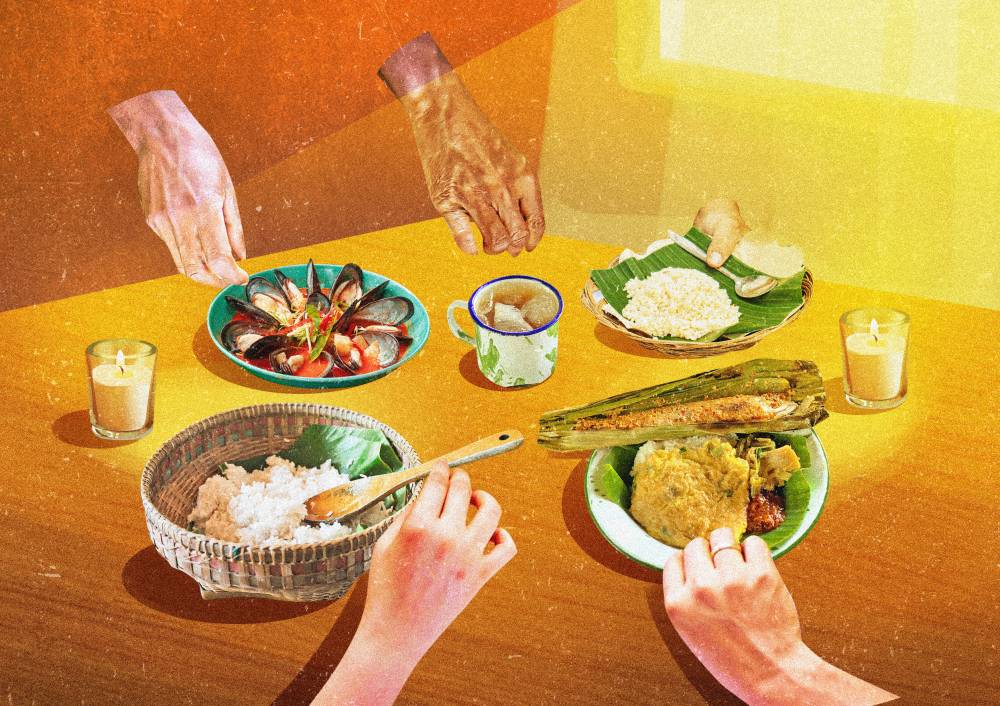
Holy Week in the Philippines is many things: a solemn religious observance, a national pause from ordinary life, a migration of Manila families to the provinces. But for those who grew up spending it in a vacation home—or invited to join the family of good friends—it is perhaps most vividly remembered through food.
From as far back as I can remember, we were invited to my parents’ good friends’ home in Matuod. Here, every year, we would be with the same families—invited to join our hosts. As we grew older, we noticed the ever-changing cast of characters that joined as special guests (outside the usual suspects) and looked forward to the stories that would unfold over the course of the week.
There was the year when my sister and some other kids got stranded out on kayaks and were dramatically rescued by a jetski by some very cute neighbors. There was the year when other guests stepped on sea urchins, and we had to watch our parents pick out the thorns. There was the year when I met and bonded with my two best friends in the whole world, and stayed up till 6 a.m. every day, telling stories.
Alongside the excitement of Holy Week at the beach was the food that was presented every day. As guests, we would bring food to share—the menus coordinated by the adults before leaving Manila. We are blessed to have friends who still invite us to join their families every Holy Week, and the week centered around food and bonding with friends is still the most special part.
Simple meals that honor the solemnity of Holy Week
Filipino Holy Week food exists in a productive tension between penance and pleasure. Catholic tradition calls for fasting and abstinence—no meat on Good Friday, reduced meals, and a general atmosphere of restraint.
And yet the Filipino kitchen does not easily surrender. What emerges is a cuisine of creative constraint: dishes that honor the prohibition, while still managing to be deeply satisfying. There are no grand feasts. Simple home-cooked everyday fare is usually served. Thanks to the proximity to the sea and the surrounding farms, fresh produce make up these staples.
What comes back from the palengke shapes what’s eaten during the day. A good day yields fresh tahong to be steamed with ginger and served in their shells, shrimp small enough to fry whole and eat with your fingers. Or a large piece of tanguigue that will be sliced for kinilaw—raw fish cured in calamansi and vinegar, mixed with ginger, onion, and chili, and eaten before it fully sets, still tender and cold.
Fish, shellfish, and vegetables become the stars. I remember the fishermen who would come to the shore of the beach house in Matuod to show our moms the catch of the day, freshly caught that morning. There would be the biko from the nearby bayan that would be brought out at merienda.
From simple to solemn to sinfully good
During Holy Week, the kitchen is the busiest place in the home. These are not kitchens stocked like Manila apartments. The cook—usually a tita, a lola, or an aunt who has appointed herself to the role—works with what was brought in the car and what the nearby palengke has available.
This scarcity produces some of the most flavorful meals of the year. Paksiw and monggo have been staples every Holy Week. The simplicity of the meal honors the solemnity of the week. Garlic rice, or in the case of our friends’ home, tinapa fried rice, is one of the week’s specialties.
The table is never formally set during Holy Week. Meals accumulate through the day—bowls left out, pots moved to the center of the table, someone always adding a dish of patis or a plate of cut tomatoes alongside whatever is already there.
Eating happens in shifts, in passing, standing up, or in the middle of other things. Ask any Filipino who spent Holy Week as a child in a vacation home or a provincial house, and the food memories that surface are almost always the same in their specificity. Like the bibingka from the woman who sells it near the church on Holy Thursday, still warm inside banana leaves.
The Good Friday meal is always more solemn, whatever was cooked, eaten in near silence at a table where someone has folded a cloth and placed a small candle. No meat, no loud conversation. The food tastes different when it is offered quietly.

On Black Saturday, the fast is technically not yet broken, but the kitchen is already moving toward it. The smell of something with meat beginning, the energy in the house shifting. On Easter morning, the table is finally full—with lechon, kare-kare, or a whole roasted fish arriving, the week’s restraint releasing itself in a meal that tastes almost sinfully good.
Back to basics, back to our roots
The vacation home itself contributes to the food. There is a different quality to cooking in a provincial kitchen—the wood or charcoal fire some older homes still use, the clay pot that imparts its own earthy note to whatever is cooked in it, the outdoor dining area where you eat exposed to the air and can hear the neighbors’ roosters and the church bells calling for the Tres Horas.
Food eaten in those conditions, in that company, carries the place inside it.
What is remarkable about Holy Week food in a Filipino vacation home is not any single dish but the accumulation—the way meals blur into each other, the way cooking is continuous and unhurried, the way the table functions less as a formal site of eating and more as a living surface that is always in some state of being set, being used, or being cleared. The week moves slowly, punctuated by Mass and the afternoon silence and the occasional downpour, and the kitchen keeps pace with it.
There is a theology in this, if one wants to find it. The discipline of eating simply, eating what is available, eating with the people you were given—these are not small things. They make a kind of meaning that does not need to be articulated.
The children who ate paksiw and monggo in a Batangas beach house 30 years ago do not remember it as deprivation. They remember it as one of the best tables of their lives.