











Iran-backed Houthis enter Mideast conflict

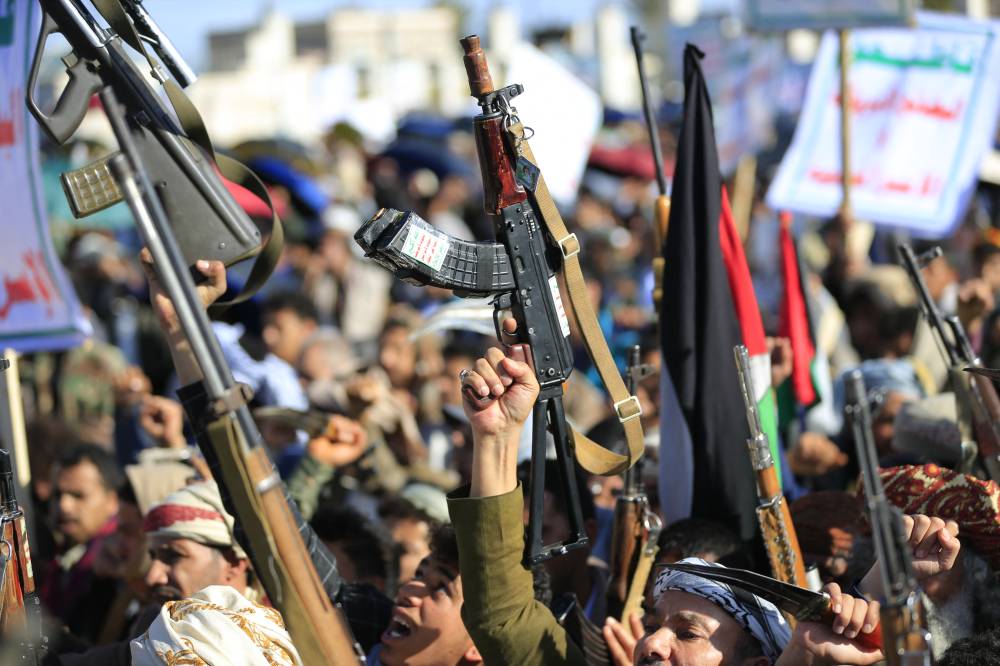
Tehran, IRAN—Yemen’s Iran-backed Houthi rebels have joined the month-old Middle East conflict, as they claimed Sunday’s missile attacks on Israel that raised concern about the war spreading from the Persian Gulf to the Red Sea on the other side of Saudi Arabia, and disrupting overall shipping and trade in that region.
Fears of a widening conflict came as the Washington Post also reported that the Pentagon had been preparing plans of US ground operations in Iran—though it said President Donald Trump had yet to approve any deployment.
The involvement of Houthi rebels has added a new complexity to a conflict that has already impacted a wide swathe of the Middle East.
The war has threatened global supplies of oil and natural gas, sparked fertilizer shortages and disrupted air travel, with Iran’s grip on the strategic Strait of Hormuz shaking markets and prices.
But the Houthis’ entry could further hurt global shipping if they target vessels in the Bab el-Mandeb (“Gate of Tears”) Strait off Yemen’s coast in the Red Sea, through which about 12 percent of the world’s trade typically passes.
Since the launch of hostilities, Saudi Arabia has rerouted much of its oil exports via the Red Sea to avoid the Strait of Hormuz.
Many Gulf shipments have been rerouted through Oman’s Salalah port on the Arabian Sea, way past the critical straits.
But Danish shipping giant Maersk said operations there were temporarily suspended after a drone attack.
Meanwhile in Abu Dhabi, fire broke out after Iranian missiles and drones struck the Khalifa Economic Zone on Saturday, injuring six people. Emirates Global Aluminium reported significant damage.
Air travel has also been disrupted, with authorities in Kuwait and Erbil in Iraqi Kurdistan reporting airport facilities hit in strikes by Iran.
Shipping disrupted
During the Israel-Hamas war, the Houthis, claiming solidarity with Palestinians, had disrupted shipping in the Red Sea and Gulf of Aden, forcing companies to take costly detours.
Seafarers have become familiar with harassment by Houthis. In September last year, Dutch-flagged cargo vessel MV Minervagracht was attacked by the rebels at the Gulf of Aden. Of the 12 Filipino out of 19 crew members, 10 returned to their home country in October. The other two were injured, with one eventually succumbing to critical injuries sustained during the attack.
Earlier, in July 2025, the 22-member crew of Eternity C, all Filipinos except for one Russian, were caught in an attack from the rebels, who also sank the bulk carrier. Most of them were eventually released that year except for three Filipinos who died and one who remained missing.
That month, the Houthis attacked another ship, the MV Magic Seas, which had 17 Filipino and two other foreign crew members. But all 17 Filipinos were eventually repatriated.
Two years earlier, Houthi rebels hijacked cargo vessel Galaxy Leader and held hostage its 25-member crew, including 17 Filipinos. But they were all freed after more than a year, with the Filipinos repatriated through the intercession of Middle East officials.
The Houthis, named after the family of their founder Hussein al-Houthi, are Shia Muslims, like their allies in Iran, who had been fighting Yemen’s Sunni-led government for more than two decades.
First strike from Yemen
Until Saturday, the Houthis had sat out the latest conflict, even as the Red Sea grew more vital.
Then a spokesperson said on Saturday the group fired at Israel “a barrage of cruise missiles and drones targeting several vital and military sites.”
But Israel said it stopped a missile fired from Yemen, the first time it had faced fire from that country since the Iran war broke out on Feb. 28.
Concerns rose about the Houthis’ entry into the fighting, since before the attack from Yemen, there appeared to be a breakthrough after Tehran agreed to allow humanitarian aid and agricultural shipments through the Strait of Hormuz.
Meanwhile the attacks on Iran continued, as Israel’s military said it struck the headquarters of Tehran’s Marine Industries Organisation, saying the facility developed “a wide range of naval weaponry.”
On Saturday evening, a wave of blasts rang out in the capital for several minutes, with no immediate word on what was targeted.
An Israeli military spokesman said attacks on the Iranian military industry had intensified and “within a few days, we will complete attacks on all critical components.”
“I miss a peaceful night’s sleep,” an artist in Tehran told Agence France-Presse (AFP), saying the previous night’s strikes were “so intense it felt like all of Tehran was shaking.”
Iran’s Revolutionary Guard on Sunday threatened to strike US university campuses in the Middle East unless Washington officially condemned US-Israeli attacks on two Iranian universities.
Several American institutions operate campuses across the Gulf region, including Texas A&M in Qatar and New York University in the United Arab Emirates.
US casualties
The number of American service members wounded has grown beyond 300, with more than two dozen troops injured this week from attacks on a Saudi air base.
Iran fired six ballistic missiles and 29 drones at Saudi Arabia’s Prince Sultan air base in an attack on Friday that injured at least 15 troops, including five seriously, according to two people briefed on the matter. US officials initially reported at least 10 American troops injured, including two seriously wounded, and later the figures were updated, according to an unofficial tally.

But more American forces are reaching the Middle East, with a Navy ship carrying about 2,500 Marines having now arrived in the region, the US Central Command announced on Saturday.
The USS Tripoli, an amphibious assault ship, as well as elements from the 31st Marine Expeditionary Unit that are aboard, are based in Japan. They were conducting exercises in the area around Taiwan when the order came for their deployment to the Middle East almost two weeks ago.
Attacks continued in Lebanon, which was drawn into the conflict when Tehran-backed Hezbollah fired rockets at Israel on March 2.
On Saturday, the Israeli military killed three journalists in the south, including Al Manar correspondent Ali Shoeib, one of the network’s most prominent war correspondents, who had covered Israeli attacks on Lebanon for decades.
The Israeli military accused him of operating within Hezbollah “under the guise of a journalist.”
Lebanese authorities, including President Joseph Aoun and Prime Minister Nawaf Salam, condemned the killings as war crimes.
Israel also carried out raids in southern Lebanon that killed nine paramedics, according to the health ministry.
Peace talks
Pakistan, acting as a go-between for Washington and Tehran, will host foreign ministers from Saudi Arabia, Turkiye and Egypt in Islamabad on Monday for talks on the crisis.
Iran’s President Masoud Pezeshkian thanked Islamabad “for its mediation efforts to stop the aggression,” while Germany’s Foreign Minister Johann Wadephul said on Friday he expected a direct US-Iran meeting in Pakistan “very soon.”
Trump’s special envoy Steve Witkoff said such a meeting could take place this week, as he promoted a 15-point plan that Washington says “could solve it all.” —WITH A REPORT FROM INQUIRER RESEARCH
Sources: Inquirer archives, pna.gov.ph
******
Get real-time news updates: inqnews.net/inqviber