





As PH, China resume talks, AFP notes who’s ‘not reliable’

The Armed Forces of the Philippines on Tuesday warned that China cannot be considered a reliable partner in the West Philippine Sea (WPS), even as the Department of Foreign Affairs (DFA) reengaged Beijing in talks on possible joint oil and gas explorations and coast guard cooperation.
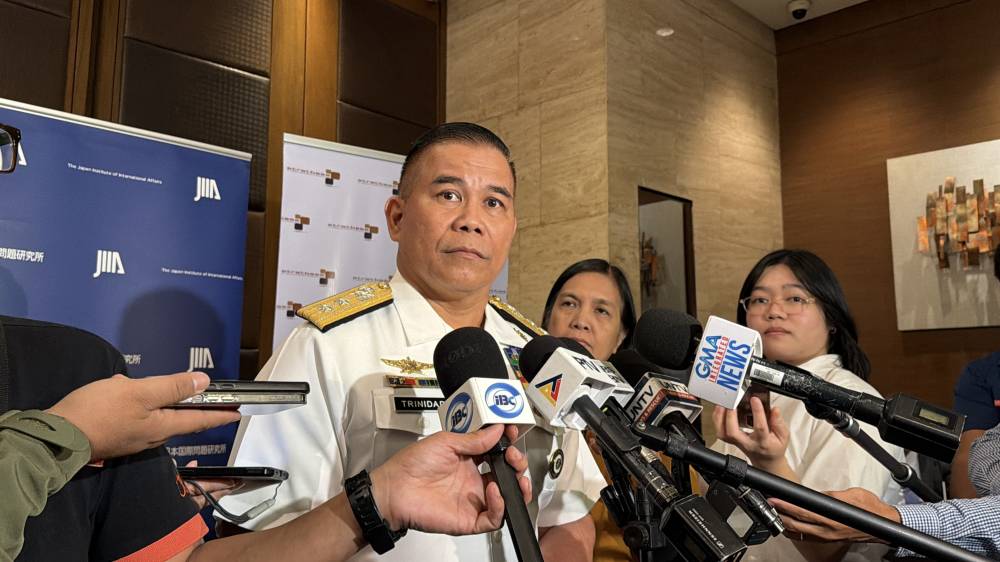
Rear Adm. Roy Vincent Trinidad, Philippine Navy spokesperson on the West Philippine Sea, called for caution, saying history had shown a “difference between talk and action” when dealing with China.
“The Chinese Communist Party is not a reliable partner on the negotiating table,” Trinidad said during a briefing at Camp Aguinaldo on Tuesday. “We will continue performing our mandate of patrolling our seas and securing our sovereignty and sovereign rights.”
Trinidad stressed that while the DFA leads diplomatic efforts, the AFP—including the Navy, Air Force, and Army—will maintain vigilance over Philippine maritime territories.
“Trust and confidence will always be based on transparency or truthfulness,” he said.
The AFP’s remarks follow last week’s back-to-back diplomatic talks between Manila and Beijing, which resumed formal consultations on maritime tensions in the South China Sea. Also discussed was a possible gas and oil exploration in the West Philippine Sea.
Illegal presence
Just as talks concluded, Trinidad warned of a deliberate increase in Chinese maritime activity in the West Philippine Sea, citing the presence of nearly 90 Chinese vessels this month as Manila continues to assert its maritime rights.
The increase in Chinese activity, he said, coincides with global attention on tensions in the Middle East.
“These are deliberate. They are trying to normalize their illegal presence and take advantage of the focus of the international community in the Middle East,” Trinidad said.
China’s approach, he said, follows a strategic doctrine of projecting strength while avoiding direct confrontation.
“The acme of skill is to win without firing a single shot,” he said, adding that Beijing seeks to “legalize” its illegal presence and influence narratives in disputed waters.
For March 2026, the AFP monitored 22,755 vessels navigating Philippine maritime zones. Of these, 19,328 were foreign-flagged and 3,428 domestic. Nearly 8,000 vessels failed to respond to radio challenges, the AFP said.
Specific to the West Philippine Sea, the Navy recorded persistent and unauthorized activity by the People’s Liberation Army Navy (PLAN) and China Coast Guard (CCG).
Near Panatag (Scarborough) Shoal, 49 vessels were monitored, 17 from the PLAN and 32 from the CCG. The shoal lies about 220 kilometers from Luzon, well within the Philippines’ exclusive economic zone (EEZ). It has remained under Beijing’s control since a 2012 standoff with the Philippine Navy.
The Navy also tracked 15 vessels near Pag-asa Island, four PLAN and 11 CCG ships. The island is located about 528 km west of Palawan province.
Near Ayungin Shoal, 14 vessels were recorded—four from the PLAN and 10 from CCG. The low-tide elevation lies about 194 km off Palawan.
Twelve vessels—seven PLAN and five CCG—were monitored near Escoda Shoal, which is about 195 km west of Palawan.
Continuous monitoring
Assistant Director General Cornelio Valencia Jr. of the National Security Council (NSC) on Tuesday said the Philippines continues to monitor Chinese naval and air activities in the waters within the country’s EEZ.
He said the recent patrols of PLAN over Panatag were “standard operations” and not viewed as an escalation.
“It has been monitored. No untoward incident has occurred. Our actions are always on the legal side. We follow rules of engagement at sea,” Valencia told reporters on the sidelines of the National Symposium on the Law of the Sea and the West Philippine Sea in Pasig City.
The AFP, he said, remains “on top of that situation.”

But a Philippine Coast Guard officer described these activities differently.
In a post on X, Rear Adm. Jay Tarriela, PCG spokesperson for the West Philippine Sea, said that naval and air units of China’s People’s Liberation Army Southern Theater Command carried out “illegal and escalatory patrols” in the waters and airspace around the shoal, also known as Panatag or Bajo de Masinloc.
Valencia described last week’s near-collision between a PLAN warship and the Philippine Navy’s BRP Benguet as “something new but expected.”
He emphasized that the Philippines would avoid responding with force and escalation.
“We maintain our principled position that we act according to rules of engagement. We try to avoid escalating the situation of the West Philippine Sea,” he said. “We avoid responding to dangerous maneuvers like we have seen before.”
Trinidad rejected Chinese claims of conducting coordinated exercises, noting that the presence of PLAN, CCG, and air assets near Bajo de Masinloc was dispersed and not part of a formal maneuver.
“This is part of their false narrative to project control over Bajo de Masinloc,” he said.
‘Adult in this game’
Trinidad also addressed recent confrontations at sea, including incidents on March 7 and March 25 when PLAN warships targeted Philippine Navy vessels.
“Amid all the illegal, coercive, and aggressive actions, the AFP will not be provoked to escalate the situation. All our actions will remain professional and within the bounds of international law,” he said.
“The AFP is the adult in this game. Tayo po ang matanda rito. Sila po yung bata. Ang matanda hindi po pumapatol sa bata (We are the adults here. They are the children. The adults don’t strike back at children),” Trinidad said, as he stressed that all military actions remain within the bounds of international law and rules of engagement.