


Where priests train for battles of ‘Liberation’

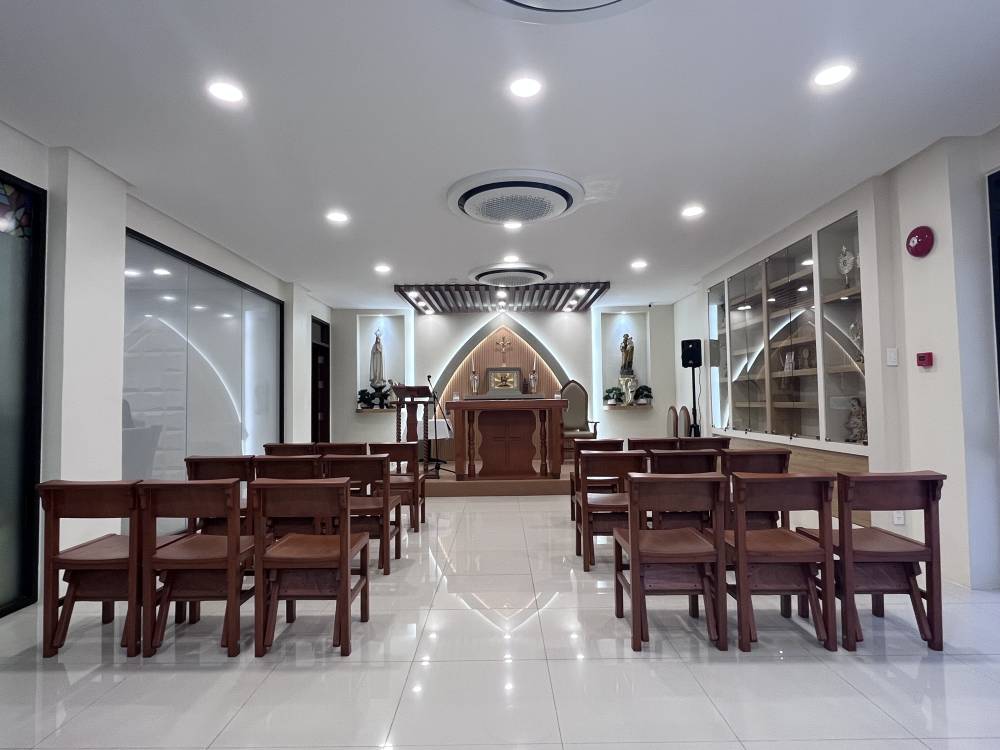
At first glance, the white three-story structure along St. Bernardino Street at Barangay Guadalupe Viejo, Makati City, looks just like any other modern office building, with its large windows and glass doors that open to a spacious lobby.
But within its walls is a training ground for a spiritual battle that has raged for ages.
Known as the first exorcism center in Asia, the Saint Michael Center for Spiritual Liberation and Exorcism is where Catholic priests train to deal with individuals the Church believes may have been possessed by evil spirits.
Completed thanks to donations, the center was inaugurated last Feb. 23 and currently serves as the headquarters of the Philippine Association of Catholic Exorcists (PACE), a group under the Catholic Bishops’ Conference of the Philippines and headed by Manila Archbishop Jose Cardinal Advincula.
According to Fr. Jose Francisco Syquia, PACE secretary general and chief exorcist of the Manila Archdiocese, an increasing number of Filipinos are seeking the help of the Church as they face “all kinds of moral challenges,” usually arising from financial hardship.
“Whenever people are getting poor, they will look for other powers. First of all, they will try to enter the occult, witchcraft, Satanism,” he told the Inquirer. “They will try to look for powers outside of the Catholic faith.”
“Secondly, because of poverty and all these problems, they fall into all kinds of moral challenges. It’s more tempting to sin now,” he added. “Because of that, [they] fall into moral problems, which are actually spiritual problems.”
Inquiries from youth
As more and more Filipinos yearn for spiritual healing, Syquia stressed the importance of training more exorcists through the center.
There are currently around 200 exorcists in the various dioceses across the country, still a “small” number compared to the number of people experiencing “diabolical attacks,” he said.
Before the center’s establishment, the exorcists would gather for training conferences every year. Now they have a dedicated facility complete with classrooms, viewing areas and prayer rooms.
They generally learn from each other by sharing their experiences. Training involves not just readings and conferences, but also exposure to many different cases of possession.
Becoming an exorcist is in itself a process not without traps and pitfalls. Training takes almost two years, and along the way the devil can react and attack the trainee in ways that cannot be controlled, he said.
Since its opening, the St. Michael Center for Spiritual Liberation has been receiving an average of 10 inquiries through its official Facebook page every day, most of them from young people seeking succor from the crushing weight of negative emotions, such as anger or sadness.
Many Filipinos have also turned to occult practices, believing in amulets, talismans, crystals or statues of pagan deities as a source of “luck,” Syquia noted.
“You have to understand that Filipinos are religious in nature. There’s a good side and a bad side to that. The good side is that God becomes central in their life. But the bad side is that they tend to go to occult practitioners or do occult practices without thinking that this is not of God,” he added.
Modes of attack
“Filipinos, when they get sick for example or feel they have a problem, medically they go to the ‘albularyos,’ ‘magtatawas,’ the occult practitioners. Or they go to fortune tellers, faith healers, ‘espiritista.’ So you see, there are many ways by which a devil is invited to a person’s life,” said Syquia.
In extreme cases of possession, the devil may take over the body, “desecreting” it, making the person act in ways not human or tempting the mind with negativity, a state called “diabolical obsession,” said Syquia.
In other cases, the devil can cause illnesses that doctors cannot heal, or manipulate the emotions to keep a person fearful or depressed.
“It’s a spiritual affliction because it comes from a spiritual source which is diabolical, the devil, who is an evil spirit,” he said. “He comes in and attacks, we may say, spiritually. His weapons are spiritual, but you will see the effects physically.”

It is not easy to discern this, Syquia said, but trained exorcists should know how to look for signs of whether an evil spirit is causing a person’s condition.
“Usually, one of the signs is that there’s really no cause… ‘Why do I have these fears? Where do they come from?’ And there is no natural cause,” Syquia explained. “Or maybe you did something wrong, but the effect is much worse than what it should be.”
Before performing an exorcism, Syquia said, a trained exorcist will first interview the subject individual to understand his or her history—the person’s spiritual or moral life, or the lack thereof.
For exorcism to work, the person must have a strong faith in God, for “only Jesus who has the power because He is God. He has the power to expel the demons, and in His name we expel the demon.”
Beyond Lenten ‘obligations’
The success of an exorcism requires a return to the Church, a rekindled relationship with God. It is also important to learn forgiveness, to let go of resentments and other negative emotions, so that the devil cannot come back, he added.
“The devil came in because the person lived a life that invited the demon in, and it could have taken years. So, he has to also change his life to drive away the demon,” he said. “Once that is fixed, the devil has no more right to stay in that person’s life.”
During Lent, Syquia said, it is thus important to undergo moral conversion and not just “fulfill our holy obligations.’’
“[Because] after Holy Week, we go back to our old ways. Stealing, cheating, lying; that’s why we have so much corruption,” he said. “When there is an immoral environment, the demon thrives there.”
“The most important thing is we allow God to change us and become more and more like Jesus. That’s the essence of Holy Week. It reminds us to carry our crosses, to forgive people who hurt us, to really live a life that is like Jesus,” he added.