



Quality education remains elusive

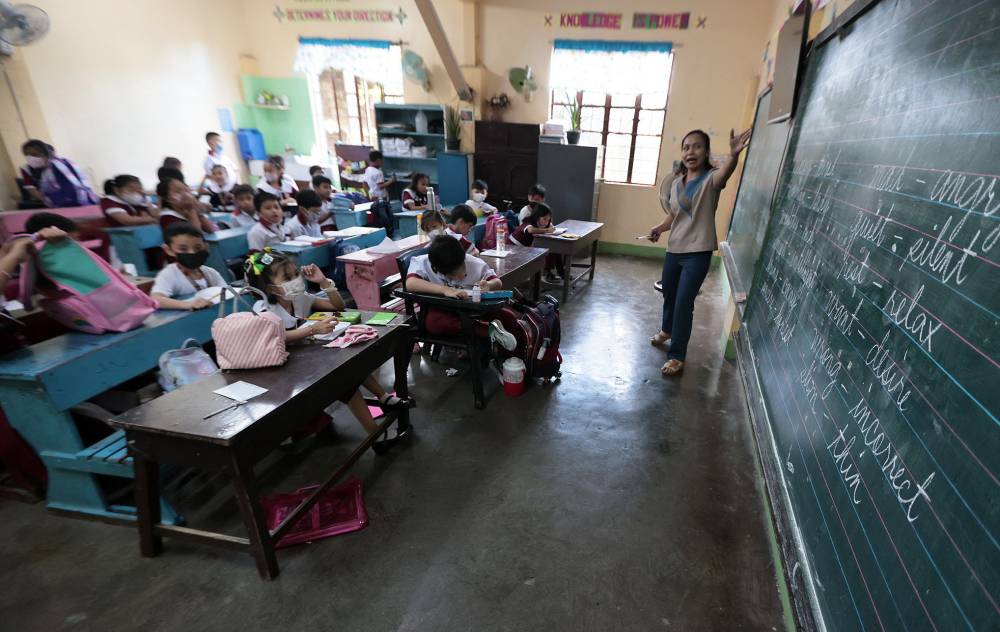
While the biggest slice of the country’s annual budget continues to be allocated to education, as mandated in the Constitution, there seems to be no breakthrough in lifting Filipino students out of their dismal proficiency levels.
In its final report, “Turning Point: A Decade of Necessary Reform (2026–2035),” the Second Congressional Commission on Education (Edcom 2), which conducted three years of studies to diagnose the ills afflicting Philippine education and recommend reforms, showed even more depressing findings.
Based on standardized assessment data of the Department of Education (DepEd) from 2023 to 2025, Edcom 2 said that language and numerical proficiency of Filipino students sharply decline as they move through the school system, “becoming negligible” as they reach high school.
The 2024 findings in Early Language, Literacy, and Numeracy Assessment showed that at least 30.52 percent of Grade 3 learners were considered “proficient” or “highly proficient,” meaning they were able to recognize letters and sounds, read common words, understand short phrases, count on their own, or do simple numerical problem-solving. But almost 70 percent of these Grade 3 learners struggled with these skills.
‘Proficiency collapse’
By the time they reach Grade 6, proficiency drops by 11 percentage points to 19.56 percent, meaning that only one in five students was considered proficient. These rates plummet in high school, with only 1.36 percent or 14 out of 1,000 students in Grade 10 and 0.4 percent or 4 in every 1,000 Grade 12 students found proficient in basic problem-solving, managing and communicating information, and analyzing and evaluating data to create ideas.
Simply put, the majority of high school graduates don’t have the basic literacy skills they need to succeed in college or even hold simple first jobs for K-12 graduates.
These findings show that no progress has been achieved since the Philippines was included in the Programme for International Student Assessment in 2018 and 2022, which found that Filipino students were among those with the lowest rankings in reading, math, science, and creative thinking globally. Per Edcom 2, our highest-achieving students were comparable to the average students in most of our Asian neighbors, and the weakest students in Singapore.
The Edcom 2 report said the root causes of this systemic “proficiency collapse” include childhood stunting that affects 23.6 percent of learners, widespread mass promotion of students despite a lack of required proficiency, and fragmented governance.
Another drastic experiment
A key finding in the report pointed to many learning days lost due to high heat, typhoons, local holidays, students’ cocurricular activities, and nonteaching tasks that took teachers away from the classrooms.
“In (school year) 2023 to 2024, we counted 53 teaching days lost—this is equivalent to at least one full quarter lost,” Edcom 2 Executive Director Dr. Karol Mark Yee said, noting that public schools ended up with an average of 191 actual class days per year instead of the mandated 205 days.
In response, DepEd announced the implementation of a three-term academic calendar at the start of the new school year in order to address the long-standing inefficiencies and focus attention on teaching.
Instead of the current four grading periods, the academic calendar will be divided into three terms, each with longer, continuous days of teaching, while other activities and celebrations will be limited to a two-week “end-of-term block.”

“Ultimately, this reform is about making the school year work better for both learners and teachers, so that every day in school leads to deliberate and deep learning,” DepEd said.
The new school calendar is yet another drastic experiment on top of the revised high school curriculum that will be in full swing at the opening of classes in June.
Lack of consultations
But crucial to its success is ensuring that teachers are on board and properly trained to adjust to the new calendar. While DepEd’s surprise move was approved by President Marcos, the agency must still address concerns expressed by a teachers’ group about the lack of consultations on the new system.
“We already called for consultations, but in the end, (the changes) were imposed in a rush,” Alliance of Concerned Teachers chair Ruby Bernardo said in a statement. She noted that the trimester calendar does not address the acute shortage of classrooms, low wages and excessive workloads of teachers, and the lack of learning materials for students. To be fair, these problems have been decades in the making.
With limited time to put the new system in place, DepEd should bear in mind that crucial reforms must address the unanimous verdict on our public school system: the failure to equip students with the foundational skills they need to succeed in life.
For many young Filipinos, education is the key out of generational poverty. But that dream remains elusive if they can’t even get the quality education that they deserve.