


SC told: Budget items for parking ‘pork’ have reached ‘obscene scale’

The national budget in the last three years saw an increase in unprogrammed appropriations (UA), or standby funds, that was beyond what was proposed by President Marcos, and which lawmakers used to “park” their supposed pork barrel in the form of “budget insertions.”
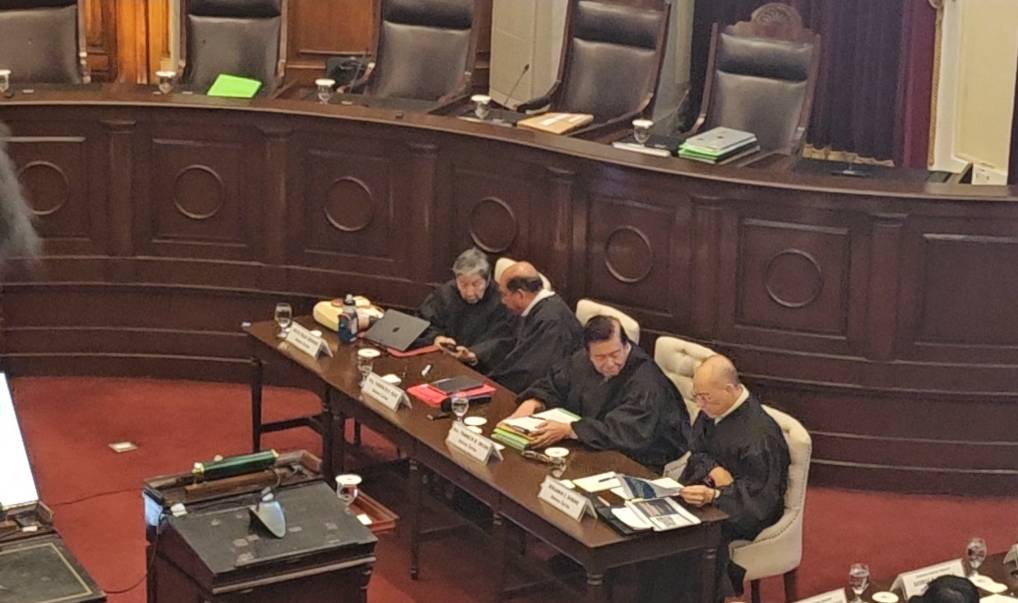
It was one of the major observations made before the Supreme Court on Tuesday, the first day of the oral arguments on the four consolidated petitions questioning the legality of UA in the 2024, 2025 and 2026 General Appropriations Act (GAA).
Appearing as amici curiae or friends of the court, economists who served as former budget officials and economic managers during previous administrations shared their expert opinion as to why the controversial budget item, a subject of much deliberation and tinkering by lawmakers, should be declared unconstitutional.
The petitions were filed separately between January 2024 and January 2026 by the late former Albay Rep. Edcel Lagman; former Camarines Sur Rep. Gabriel Bordado Jr. (now Naga City vice mayor); former Basilan Rep. Mujiv Hataman (now provincial governor); former Sen. Aquilino “Koko” Pimentel III, former Speaker Pantaleon Alvarez; the group Filipinos for Peace, Justice, and Progress Movement Inc.; Caloocan Rep. Edgar Erice; and Mamamayang Liberal Rep. Leila de Lima.
According to Benjamin Diokno, currently a Monetary Board member at Bangko Sentral ng Pilipinas and a former budget secretary, Congress had exceeded the UA proposed by a Philippine president only five times after the 1986 Edsa People Power Revolution.
These were in 2010 under the administration of Gloria Macapagal-Arroyo, in 2022 under the administration of Rodrigo Duterte, and in 2023, 2024 and 2025 under the administration of President Marcos, Diokno said.
“The increases in the last three years have been particularly large,” Diokno noted.
Citing Article VI, Sec. 25 (1) of the 1987 Constitution, petitioners argued that lawmakers may not increase the funding proposed by the executive branch in the National Expenditure Program (NEP) for government operations. “The form, content, and manner of preparation of the budget shall be prescribed by law,” read the Charter’s provision.
Practice since 1986
The Department of Budget and Management (DBM) defines UA as funding for priority programs or projects that could only be released when there are excess revenues or additional foreign grants. Programmed appropriations, on the other hand, are those already identified and itemized during the preparation stage of the budget process.
The practice dates back to 1986, or under the post-Edsa “Freedom Constitution,” when Diokno, then a DBM undersecretary, already used UA in preparing the 1987 national budget.
“It has been used ever since,” he told Senior Associate Justice Marvic Leonen, the first and only interpellator on Tuesday. At the time, he said, UAs were mainly meant for foreign-assisted projects.
Asked by Leonen on whether UAs are still relevant to this day, Diokno said “definitely,” adding that any delay caused by lack of funding for government projects add more pressure on public coffers.
He cited the case of the Metro Manila Subway Project and the North-South Commuter Railway project, whose construction had been delayed due to payment issues on right-of-way (ROW) acquisitions after the initial funding was realigned to UA.
‘Obscene scale’
Economist Solita “Winnie” Monsod, a former socioeconomic planning secretary, cited the “obscene scale” of the increase in UAs and how they had become the “repository” of budget insertions made during the bicameral conference on the GAA.
Monsod said that despite a 2013 Supreme Court decision declaring the Priority Development Assistance Fund or “pork barrel” unconstitutional, policymakers “took the low road” by creating a new form of pork instead of instituting much-needed reforms in the public financial management system.
“From 2016 to 2022, President Duterte also ran on an anticorruption platform. But the pork barrel came back with a vengeance,” she stressed.
“There was a standoff in 2019. The budget had to be reenacted because [then President Duterte] took off P95 billion from the budget. But in 2020, the Congress recalled the budget because they wanted to put the P95 billion back in. And that is the time when the contractors became part of the scene,” Monsod also recalled.
Since 2022, under the current administration, the budgeting process has evolved into a “more sophisticated system [that]… where the pork barrel has become a part of the budget preparation and embedded in the [NEP],” she said, adding:
“The so-called ‘baseline balance management’ formula or BBM, was adopted by the DPWH (Department of Public Works and Highways), and the entire DPWH infrastructure budget became a pork barrel.”
Monsod noted that lawmakers may now make a pitch for projects outside their districts as long as they pay a “parking fee” or standard operating procedure (SOP, a euphemism for kickback or commission) of 6 percent to the district representative.
Speaking also as amicus curiae, former Senate President Franklin Drilon noted that while UAs had been a “consistent feature” in the budget law, in recent years they had included regular agency operations and personnel benefits.
“The unprogrammed appropriation has remained largely unexamined. Complete clarity, however, after all, is a privilege afforded only by hindsight,” Drilon told the high tribunal.

Also a former justice secretary, Drilon noted that the existence of the UA as a “special appropriation” in the GAA becomes consistent with the Constitution only when its purpose is specified and its release is certified by the Bureau of the Treasury upon availability of funds.
“In its standard formulation, assuming the conditions are strictly and fully observed, unprogrammed appropriation does not increase the President’s recommended budget ceiling,” he stressed.
In response to these views, Solicitor General Darlene Marie Berberabe, who represents the respondents in the four consolidated petitions, argued that the UA is “not part of the budget where the prohibition on increasing the ceiling is applicable.”
Not a blank check
Berberabe, a former dean of the University of Philippines’ College of Law, also dismissed the petitioners’ description of UA as “blank checks and shadow budgets.”
“[They] are politically agitating. However, they are incorrect,” she said, adding that UAs are “neither a blank check nor unconditional.”
“They are among the most conditioned and controlled spending authorizations in the entire government system. [UAs] give the government fiscal flexibility. They ensure that a windfall does not go undeployed while public needs go unmet, without requiring anew a full deliberative cycle of a special appropriations bill, which duplicates effort and takes time to pass,” said the government counsel.
However, former Budget Secretary Florencio “Butch” Abad, also appearing as an amicus curiae, said it’s the Constitution, not the UA, that provides “flexibility” in the government budget.
When public funds rely on “discretionary activation,” the practice gives rise to “opaque” instruments of spending that weaken transparency and undermine constitutional safeguards, Abad said.
“The Constitution allows flexibility but it requires that decisions on how public funds are spent remain within the legislative appropriation process and do not migrate into the execution stage of the budget,’’ he said.
“To allow otherwise is not merely to relax a rule, it is to reconfigure the allocation of power over the public purse and that… is a constitutional question of the highest order,” Abad added.
The oral arguments on the petitions will resume on April 21.