





Lessons on impunity

What the Philippines failed to do, the International Criminal Court (ICC) has made possible: a trial at last for former President Rodrigo Roa Duterte for crimes against humanity.
In landmark decisions last week, two chambers of the ICC rejected challenges to the court’s jurisdiction, unanimously confirmed the charges against Duterte, and committed him to a full-blown trial before the court in The Hague, Netherlands.
The first ruling, issued by the ICC’s Appeals Chamber on Thursday, affirmed the ICC’s jurisdiction over alleged crimes committed while the Philippines was a state party to the Rome Statute that established the international court.
It rejected the Duterte defense team’s challenge to the ICC’s jurisdiction and paved the way for his case to proceed, as well as continue to hold him in detention. More significantly, this ruling set a precedent for other countries—and perpetrators of crimes against humanity—that they cannot easily escape accountability by simply withdrawing their membership from the Rome Statute as Duterte did when he was president.
The following day, the much-awaited decision of the ICC Pre-Trial Chamber I was issued: it found “substantial grounds to believe that Mr. Duterte is responsible for the crimes against humanity of murder and attempted murder” over killings committed in Davao and during the war on drugs.
‘First big step’
It said the crimes were “committed as part of a widespread and systematic attack against a civilian population” in the Philippines between Nov. 1, 2011, and March 16, 2019, when the Philippines was a state party to the Rome Statute.
Human rights lawyers Joel Butuyan and Gilbert Andres, who were appointed as common legal representatives for victims, hailed the ICC’s ruling as the “first big step” in attaining justice for the victims.
Just as well, it is a lesson for a nation so immobilized by the climate of impunity that its institutions and justice system were rendered “unwilling or unable” to prosecute the cases against its own citizens.
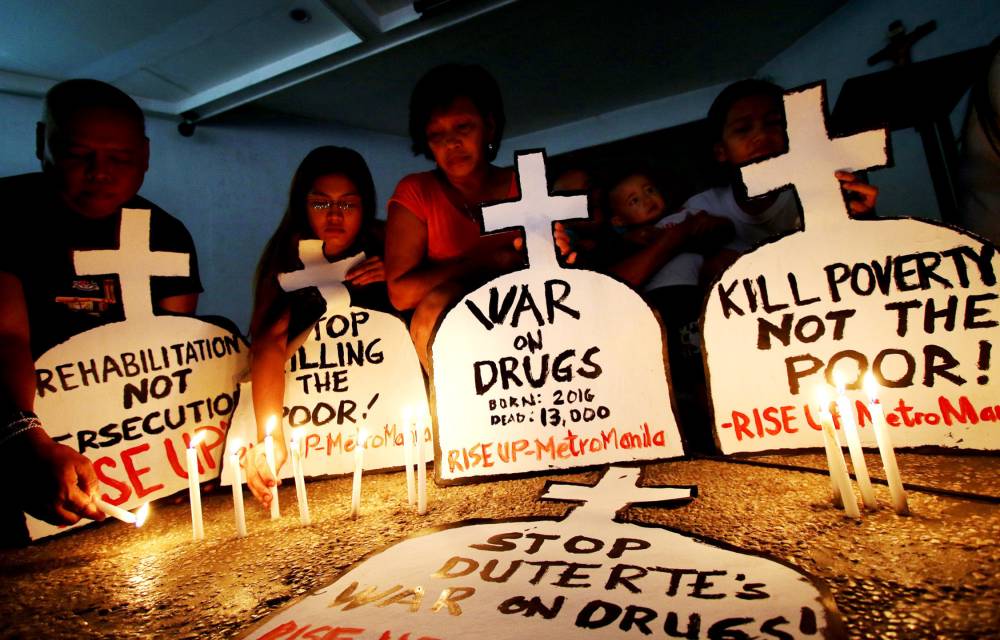
During his reign as longtime mayor of Davao City, Duterte nurtured an image as the “Punisher” who went after criminality with an iron fist. In his 2016 presidential campaign, Duterte promised to end the problem of illegal drugs in the country within six months and threatened to “fatten the fish” in Manila Bay by dumping bodies of drug users there.
True enough, the killings unfurled in horrific numbers. As soon as Duterte became president, police swooped down on poor communities to flush out small drug users. Dead bodies in dark alleys and dank sidewalks soon became a daily occurrence. In the deadliest police operation in August 2017, 32 drug suspects were killed by police in one day alone—during the “One Time Big Time” operation in Bulacan.
‘Nanlaban’ modus
In Caloocan City, described by then archbishop and now Cardinal Pablo Virgilio David as the “ground zero” of extrajudicial killings (EJKs), 373 drug suspects were reported killed as of 2018. They included Kian delos Santos, a 17-year-old student who was killed by police as he was on his knees begging for his life, and who has become the face of EJK victims of the Duterte drug war.
By the end of Duterte’s six-year term in 2022, the death toll was numbing: over 6,000 people killed in police operations, according to the Philippine National Police. Human rights groups estimated the dead were closer to 30,000, including EJKs committed by vigilantes and members of the infamous Davao Death Squad killing machine.
Duterte’s “kill, kill, kill” mantra and directive to the cops to deliberately provoke drug suspects to fight back so they can be killed in self-defense gave rise to the “nanlaban” modus police used to justify the murders. His repeated avowals to take responsibility for the killings further fostered the climate of impunity that silenced dissent and calls for justice. To date, only eight police officers have been convicted for five drug war killings, including Delos Santos’.

Coperpetrators
It must be pointed out, however, that the succeeding government did its part. President Marcos, regardless of his reason, will be remembered for the political will to allow the arrest of his predecessor and his swift rendition to the ICC. Without this singular act, the ICC trial would not be possible.
And now, the pursuit of accountability will get a chance to run its full course before an impartial court. This will also give Duterte his right to present his defense and face his accusers, which he had cowardly avoided by waiving his right to appear in person in the pre-trial hearings despite all his bluster against the court.
The expectation is that, in due time, Duterte’s other coperpetrators—including incumbent senators and former high officials—will similarly be brought to the ICC to account for their roles in the killings.
It’s still a long way to go, and the outcome of the trial remains to be seen. But having Duterte finally tried for the killings is a major turning point in a nation’s search for justice and closure for this dark and bloody chapter.
******
Get real-time news updates: inqnews.net/inqviber