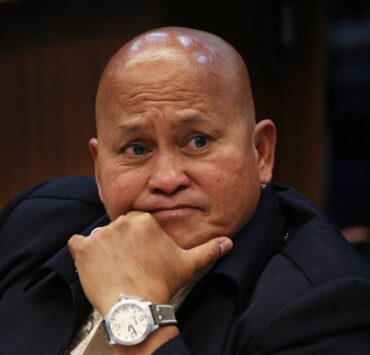


Alan says only PH court warrant can get Bato


Newly installed Senate President Alan Peter Cayetano said Sen. Ronald “Bato” dela Rosa, who is under the chamber’s “protective custody,” may only be turned over to authorities on a warrant issued by a Philippine court.
Cayetano laid down this position a day after the International Criminal Court (ICC) confirmed its issuance of an arrest order on Dela Rosa, which a group composed of ex-Sen. Antonio Trillanes IV and agents of the National Bureau of Investigation tried to serve at the Senate premises on Monday.
According to international law and human rights experts, however, the Senate does not have the power to protect a fugitive and neither does Dela Rosa enjoy parliamentary immunity under the Constitution.

Dela Rosa, who evaded the NBI arresting team on Monday, said he was not leaving the Senate anytime soon to exhaust his legal options.
“There’s no problem with serving the warrants. We are lawmakers, we are not lawbreakers. So they can bring the warrants and we’ll receive [them]. What we’re saying is, the warrant of arrest should be from a Philippine court,” Cayetano told reporters on Tuesday.
The Senate on Monday agreed to take Dela Rosa under its custody after the senator emerged at the plenary session after a six-month absence to participate in the ouster of Sen. Vicente “Tito” Sotto III as Senate president.
“We’re also saying that in the past, any senator who sought refuge in the Senate was accorded all due process … they exhausted all legal remedies before they voluntarily surrendered,” said Cayetano. “So all we’re asking for Senator Bato is reason, logic, get rid of emotions. It’s hard for victims to get rid of emotions.”
“But we’re a nation of laws, not of men. So it needs to go through the court, that’s it. When it goes through the court, and all legal remedies have been exhausted … we ourselves would authorize it. And that’s what he also told me even when he was still hiding—that when (it’s from the) local court and (legal remedies are) exhausted, he will follow. He’s a police officer, he’s a senator,” he added.
Reasonable grounds
The ICC’s Pre-Trial Chamber I said it found reasonable grounds to believe that Dela Rosa, a former Philippine National Police chief during the Duterte administration, is “criminally responsible” for being an indirect co-perpetrator in the drug war killings and that “all elements (were) met” in accusing him of murder.
The chamber’s arrest warrant was dated Nov. 6, 2025, but reclassified as public only on Monday.
“The Chamber finds that, due to Mr. Dela Rosa’s role and positions held during the time of the alleged attack pursuant to article 7(1) of the Statute, including as chief of the Davao Police and subsequently as chief of the [PNP], he necessarily knew about the operations and their scope,” read part of the 16-page arrest warrant.
The ICC’s Office of the Prosecutor (OTP) described the warrant as an “important step in [its] ongoing pursuit of accountability for alleged crimes committed in the context of the so-called ‘war on drugs’ campaign in the Philippines.”
‘Not leaving’
It said it would continue to work with the ICC Registry so the warrant could be finally executed against Dela Rosa, who had appealed to the Supreme Court for the issuance of a temporary restraining order or writ of preliminary injunction.
“We will exhaust all available means, legal means that we need to do so they can’t take us to The Hague,” Dela Rosa said. “Which Filipino would want to be tried abroad?”
“I’ll stay here. I’m not leaving,” said the senator, who was clad in a T-shirt, shorts and slippers when he was chanced upon by reporters on Tuesday morning.
Dela Rosa has also filed an urgent manifestation with omnibus motion for guidance on the legal effect of the arrest warrant from the ICC before the Supreme Court.
While seeking refuge at the chamber and awaiting the high court rulings on his petitions, he intends to attend the plenary sessions. Should a lower court issue an arrest warrant against him, he said they will appeal before the Supreme Court.
Not a ‘bouncer’
The Senate, as an institution, however, “cannot act like a bouncer” and block the arrest of one of its members “just because it wants to,” said human rights lawyer Dino de Leon, an alumnus of The Hague Academy of International Law.
“It has to abide by the law. It is a state institution. It has to respect the prerogatives of the Executive (branch) to serve the warrants of arrest, especially since under (Republic Act No.) 9851, the Executive can directly surrender Bato to the International Criminal Court,” he said in a phone interview.

De Leon was referring to Section 17 of the 2009 law, the Philippine Act on Crimes Against International Humanitarian Law, Genocide, and Other Crimes Against Humanity, which states that the Philippine government may surrender or extradite an accused person to the requesting international court that is already investigating or prosecuting the crimes covered by the law.
He noted that the constitutional provision being invoked by the Senate does not apply to Dela Rosa because the Charter protects those who are accused of crimes with a maximum penalty of six-year imprisonment.
Human rights lawyer Neri Colmenares made a similar point, saying that the crimes against humanity of murder being thrown at Dela Rosa are punishable by at least 14 years under RA 9851, while the same crimes are punishable for a maximum of 30 years in the ICC.
“Clearly, therefore, (Dela Rosa) does not fall within the immunity privilege provided in the Constitution even if the Senate is in session,” he said in a statement.
“A warrant of arrest may therefore be served against him even inside the Senate just like the warrant that was served to then Sen. Leila de Lima and Sonny Trillanes who were both arrested in the Senate premises,” Colmenares added.
Trillanes was arrested for rebellion while inside the Senate premises in 2018, while De Lima was held in the Senate for one night before eventually surrendering to authorities the next day in 2017.
Colmenares pressed the Senate to adhere to the legal processes as it is not mandated to decide on the legality of Dela Rosa’s arrest and block the implementation of an arrest warrant.
******
Get real-time news updates: inqnews.net/inqviber