





Gov’t budget surplus shrank to P31.4B in April

The national government reverted to a budget surplus in April, although the figure was sharply lower than a year ago as expenditures rose faster than revenues amid the extension of the annual income tax filing deadline.
Data released on Tuesday by the Bureau of the Treasury (BTr) showed a budget surplus of P31.4 billion in April, down 53.29 percent from the P67.3 billion recorded in the same month last year.
April’s budget position reversed the P349.7-billion deficit posted in March.
The surplus meant that the Marcos administration collected more revenues than it spent during the month. However, the figure was significantly smaller than last year’s as revenue growth lagged behind the pace of expenditures.
Broken down, revenues inched up 2.83 percent to P536.8 billion.
Both of the country’s main tax collection agencies posted higher revenues during the month.
The Bureau of Internal Revenue (BIR) collected P422.2 billion, though growth was limited to 0.41 percent after the deadline for filing Annual Income Tax Return (AITR) was moved to May 15 from the original April 15 schedule following the declaration of a state of national energy emergency.
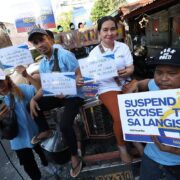
Meanwhile, the Bureau of Customs (BOC) raised P86.3 billion in revenues, up 15.52 percent from a year ago. The double-digit growth came despite the suspension of excise on kerosene and cooking gas, supported by strengthened valuation and monitoring systems as well as the continued digitalization of customs processes.
Nontax revenues also increased 7.32 percent to P25.8 billion. According to the BTr, this was driven by P160 million in restitution funds recovered from flood control projects and P623.9 million in privatization proceeds.
Still, overall revenue growth was outpaced by an 11.14-percent increase in public spending to P505.4 billion.
Higher expenditures were attributed to increased disbursements to local government units through bigger National Tax Allotment shares, the Annual Block Grant for the Bangsamoro Autonomous Region in Muslim Mindanao, and releases under the Local Government Support Fund.
PhilHealth
Also contributing to the rise in spending was the return of P60 billion in excess funds to the Philippine Health Insurance Corp. (PhilHealth) following a Supreme Court ruling declaring the earlier transfer of the funds to the national treasury unconstitutional.

The government also made payments to suppliers and contractors involved in various foreign-assisted railway projects of the Department of Transportation.
From January to April, the Marcos administration posted a budget deficit of P324.1 billion, narrower by 14.44 percent than the P378.7-billion shortfall recorded in the same period a year earlier.
Year-to-date revenues climbed nearly 10 percent to P1.67 trillion, while expenditures rose 5.12 percent to P2 trillion.
For 2026, the government is projecting a P1.6-trillion budget deficit, equivalent to 5.3 percent of gross domestic product. To bridge the fiscal gap, the borrowing program has been set at P2.68 trillion.
However, the Marcos administration’s fiscal position has come under pressure as the lingering fallout from the graft scandal compounds the ongoing energy shock triggered by the war in the Middle East.
As a result, the Philippines’ bid to secure its first-ever “A” credit rating has weakened after S&P Global Ratings downgraded the country’s sovereign outlook to “stable,” while Fitch Ratings revised its outlook to “negative.”