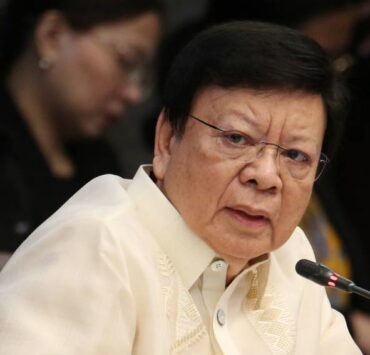



Drilon: ‘On Senate records, nothing happened’


A hearing on the flood control scandal called by former majority members of the Senate will amount to nothing as they had no authority to open the inquiry in the first place, former four-time Senate President Franklin Drilon said on Thursday.
“On the Senate records, nothing happened,” he said of Thursday’s hearing.
Newly elected Senate President Pro Tempore Sherwin “Win” Gatchalian, who is also the acting Senate President, said the new blue ribbon committee chair, Sen. Erwin Tulfo, had rescheduled the hearing for next week and no resource persons were allowed entry into the Senate building.
There was some pushing and shoving between Sen. Robinhood Padilla, who was leading “resource persons” into the Senate session hall, and Interior Secretary Jonvic Remulla, who was requested by Gatchalian to provide additional security.
‘Rump session’
The hearing called on Thursday by former committee chair Sen. Pia Cayetano, is in question as it did not have the necessary secretariat assistance, which should include official recording of the proceedings.
Drilon said that Gatchalian characterized the hearing as a “rump session” led by ousted Senate President Alan Peter Cayetano’s sister and presided by Sen. Rodante Marcoleta.
“He (Gatchalian) said that it was not authorized, that’s why it was a rump session,” he said. “If this is not part of Senate session, if not considered official activity, then the resource persons are not protected from immunity from lawsuit for lying.”
“Even if it is recognized, you still cannot lie. You’ll be liable for perjury,” he said. “If the Senate hearing is not authorized, the same principle applies. If you libeled a person in that so-called hearing, the person you libeled has the right to file charges against you.”
Shake-up was legitimate
This week’s Senate leadership shake-up stands as a legitimate exercise of the senators’ right to choose their new officers, unless reversed by the Supreme Court, Drilon and the Integrated Bar of the Philippines (IBP) said on Thursday.
With no Senate sessions for two days, the 11-member minority declared themselves the new majority and gained a quorum with the addition of Sen. Francis Escudero, who showed up on Wednesday. This allowed the senators to conduct official business beginning with the election of a new set of officers and committee chairs.
According to Drilon, the senators’ actions carried the “presumption of regularity” in the performance of public functions.
“This means that you cannot immediately say that this was wrong … but it can be questioned before the Supreme Court,” the veteran lawmaker told the Inquirer.
He added that whatever the Supreme Court decides would prevail.
“But in the meantime, what happened yesterday is valid, until it is reversed by the Supreme Court,” he said.
The IBP, the professional association of all of the country’s lawyers, also cited the 1949 ruling—when one of the 24 members of the Senate was abroad at the time and could not participate in Senate sessions—to support the actions taken by the Gatchalian majority.
It clarified how a quorum could be constituted whenever the Senate or the House of Representatives does not have full attendance.
‘Practical approach’
“This Avelino ruling emphasizes a practical approach: the Constitution should be interpreted in a way that allows the Senate to function, and not be blocked by the absence of members who cannot realistically be made to attend,” the IBP said in a statement on Thursday.
It cited parts of the decision, which said: “When the Constitution declares that a majority of ‘each House’ shall constitute a quorum, ‘the House’ does not mean ‘all’ the members.”
The court added: “There is a difference between a majority of ‘all the members of the House’ and a majority of ‘the House,’ the latter requiring less members than the first. Therefore, an absolute majority (12) of all the members of the Senate less one (23) constitutes constitutional majority of the Senate for the purpose of quorum.”
Applying the Avelino doctrine, the IBP said that the June 3 session constituted a quorum for the chamber to conduct official business because both Estrada and Dela Rosa were deemed “beyond the reach of the Senate.”
All acts, including any resolution or decision, made by the Senate during the session are also deemed official “following the presumption of regularity in the discharge of official functions,” the IBP said.
12-member quorum
During the June 3 session, Sen. Vicente “Tito” Sotto III moved to declare all seats vacant and nominated Gatchalian as Senate President Pro Tempore, replacing Sen. Loren Legarda. The senators also chose Gatchalian to be the acting Senate President.
The new Senate leader defended the 12-member quorum, based on a total of 22 senators left behind following the arrest of Sen. Jinggoy Estrada on Monday on plunder and graft charges and the fugitive status of Sen. Ronald “Bato” dela Rosa since evading an arrest warrant from the International Criminal Court.
Speaking to fellow senators and the public, Gatchalian cited the 1949 ruling which stated “that an absolute majority of 12 out of [the then] 23 members can constitute a constitutional majority of the Senate for quorum purposes.”
Gatchalian also cited the May 15, 2025, Senate session where the quorum was only based on 17 available senators as seven others were beyond the Senate’s “coercive jurisdiction”—four were traveling abroad and three were in detention. Estrada was one of those detained, also on plunder charges.
But Cayetano and Legarda insisted on holding their positions and called the actions taken by Gatchalian and the other senators illegal and unconstitutional.
‘Available’ senators
They argued that Senate rules require a “majority of all” 24 members, or 13 senators, to elect their officers.
Drilon, who was the Senate President in 2015, emphasized that the 1949 decision applied to both the 2015 and the current cases.

“The SC said that when you determine the quorum of a Senate session, you count the Senators who are available subject to the control and supervision of the Senate, excluding those outside or beyond the Senate’s coercive powers,” he explained.
He said there were arguments that if there were not enough senators for a quorum, you could haul in other senators to attend a session. “But if they are outside the country or they are under arrest, the Senate would have no control over these colleagues of ours,” he said.
Drilon dared Dela Rosa, who is facing charges of crimes against humanity in the drug war of ex-President Rodrigo Duterte, to come out of hiding and rejoin the Cayetano group.
“But if no one knows where he is, how can you count him?” Drilon said.
He acknowledged that there might be some confusion between the wording of the Senate Rules and the Supreme Court decision. However, he pointed out that the burden of proof lies on the ousted faction.
“The best thing to do is to return this to the Supreme Court and ask it to state what really is the right move,” he said.
Both Malacañang and the House of Representatives recognized the new Senate leadership under Gatchalian.
On special session
Malacañang said on Thursday that it would grant a request for a special congressional session from the Senate to pass priority legislation only through Gatchalian as its representative.
“Therefore, whatever message he conveys to the executive branch, that is what we will recognize,” Palace press officer Claire Castro said.
It urged the Senate to resolve its internal conflict before President Marcos delivers his fifth State of the Nation Address (Sona) and formally opens the second regular session of the 20th Congress on July 27.
She said President Marcos would be “inclined” to call a special session once an official request based on “valid grounds” reaches his office.
Mr. Marcos earlier said the Senate needed to get back to work as the executive branch planned to seek congressional approval for a supplemental budget and pass legislation to be able to provide help to Filipinos amid the persistent price shocks brought by the Middle East crisis.
He also wanted Congress to enact a number of the administration’s priority legislation before his fifth Sona on July 27, including bills to fully abolish the travel tax and to ban political dynasties. —WITH A REPORT FROM DEXTER CABALZA AND ZACARIAN SARAO