
More pushback urged vs China sanctions on Gibo


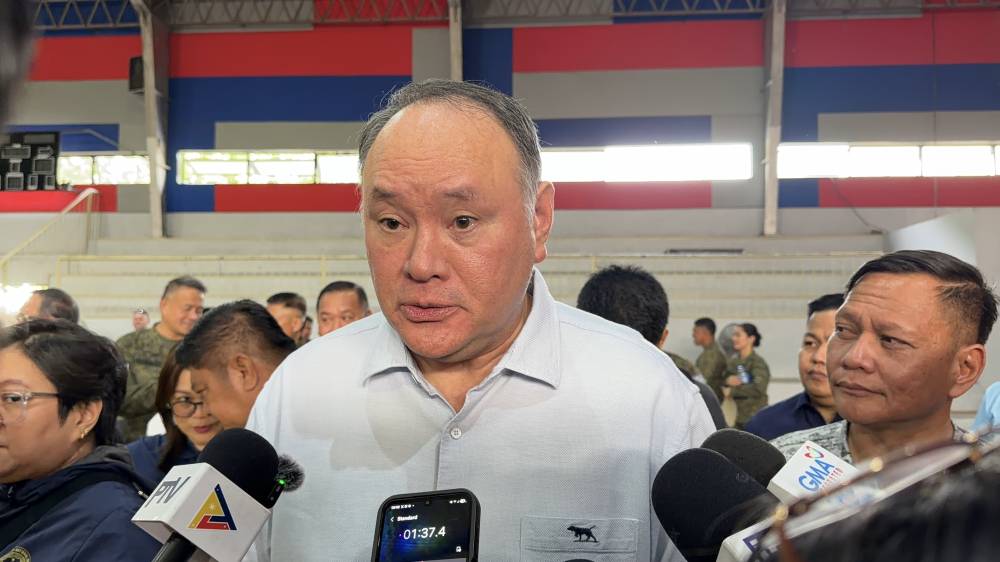
The government should stand behind Defense Secretary Gilberto ”Gibo” Teodoro Jr. against China’s sanctions imposed on him and his family, which Sen. Francis “Kiko” Pangilinan said on Saturday directly attack Philippine sovereignty.
In an unprecedented move against a Cabinet member since bilateral ties were established 51 years ago, Beijing announced last Thursday that it was barring Teodoro and his family from entering mainland China, Hong Kong and Macao for unspecified, allegedly “irresponsible” remarks made by the defense chief.
Pangilinan said the sanctions target the “sovereign decisions” of the Philippines and Teodoro’s role as the implementer of national defense and security policies.

“Punishing him and his family for doing so is a direct affront not only to him, but to the President, the Philippine state and our constitutional order,” Pangilinan said in a statement.
Teodoro is one of the most outspoken Filipino officials who criticize Chinese intrusions and aggressive actions in the West Philippine Sea, waters within the country’s exclusive economic zone (EEZ).
Pangilinan said that “in solidarity” with Teodoro, he was calling on the Department of Foreign Affairs (DFA) to formally protest against the sanctions, likening China to a bully.
“As a child, I learned that bullies prey on those they perceive to be weak. I also learned that kowtowing to a bully does not stop the bullying,” he said.
The DFA on Friday described the sanctions as an “unfriendly act that further complicates bilateral relations.”
Pangilinan pointed out that Beijing’s actions were a “clear escalation” of a pattern of Chinese coercion and intimidation of the Philippines.
Undeterred
“By sanctioning a sitting Cabinet member for defending an arbitral ruling and asserting rights guaranteed under international law, China diminishes its own standing in the community of nations,” the senator said.
“Such actions undermine its claim to be a responsible major power and only strengthen the resolve of democracies—big and small—to stand together against coercion,” Pangilinan added.
While shrugging off the sanctions, Teodoro said that he would continue performing his duty “and uphold our nation in the face of the wickedness they are committing here and even in our seas.”
On July 12, 2016, an arbitral tribunal ruled in favor of the Philippines’ sovereign rights over the West Philippine Sea under the United Nations Convention on the Law of the Sea (Unclos). It rejected China’s nine-dash-line claims to nearly the entire South China Sea, including the West Philippine Sea. China continues to ignore the landmark decision.
Irked again by Tarriela
The maritime dispute between the two countries escalated further on Saturday after the Chinese Embassy accused the Philippines of “stirring up trouble” and alleged that the Philippine military and the Philippine Coast Guard (PCG) had made calls to “retake” Panatag (Scarborough) Shoal, which is also called Bajo de Masinloc.
In 2012, China took control of the shoal, a Filipino fishing ground for generations well within the Philippines’ EEZ. Chinese coast guard and maritime militias have since prevented Filipino fishing boats as well as other Philippine vessels from approaching Panatag.
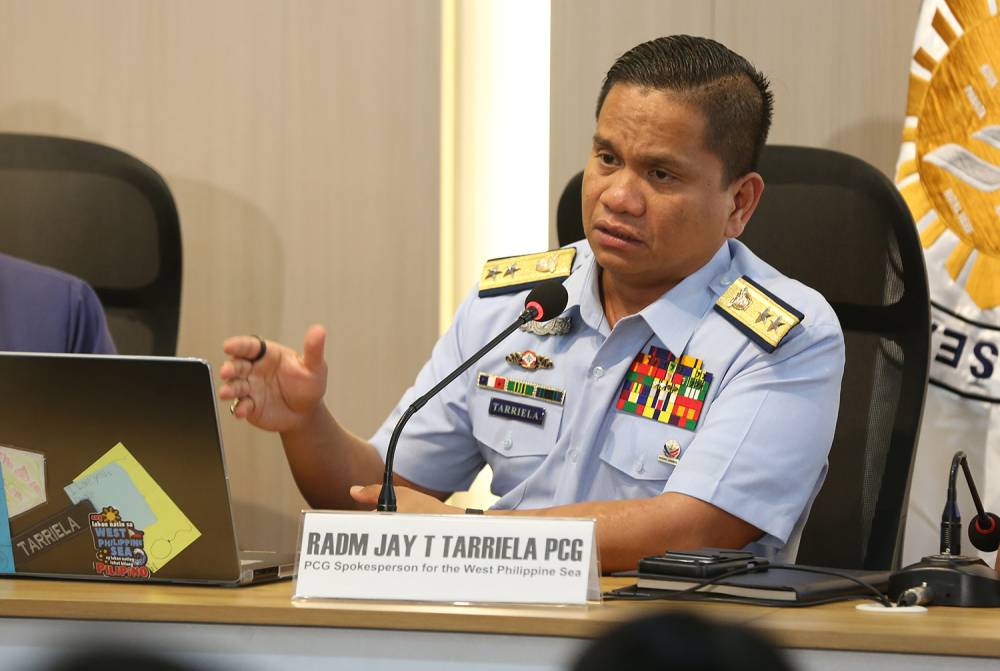
The embassy was reacting to a statement by Coast Guard Rear Adm. Jay Tarriela, the PCG spokesperson for the West Philippine Sea in a Facebook post on Friday where he pushed against Chinese criticisms that he was trying to hype the discovery by Philippine authorities of a Chinese-manned platform at the shoal.
Tarriela said he made the disclosure in the interest of transparency, for the Filipinos and the rest of the world to see China’s activities at the shoal.
“If ‘transparency’ is what Mr. Tarriela truly wants, then every time he goes on an attack, he should post the full facts that China has laid out,” the embassy said.
It added that Beijing remained open to dialogue but rejected what it called “megaphone diplomacy.” It maintained, however, sovereignty over the shoal, which it calls Huangyan Dao, and defended “routine” activities in the area, including lawful exercises of jurisdiction.
‘That is not hype’
In his statement on Friday, Tarriela defended the public release of an aerial photograph of the floating structure.
“We observed a structure inside Bajo de Masinloc. We documented it, dated it, geolocated it, and released the aerial imagery to the public. That is not hype—that is transparency,” he said.
He said the purpose of publishing the image was to allow the public, including the international community, to independently assess developments in the West Philippine Sea rather than rely solely on competing official narratives of the two countries.

Tarriela added that China’s response to documentation reflected a broader pattern of dismissing scrutiny, and cautioned against accepting Beijing’s descriptions of maritime activities at face value.
He cited past Chinese activities in the South China Sea, including at Panganiban (Mischief) Reef just west of Palawan where in 1995, the Philippine military found Chinese-built cement structures on stilts above the reef. China at that time tried to downplay the significance of the structures, saying they were intended only as shelters for fishermen.
Years later, the area occupied by the shelters expanded into one of the biggest artificial islands built by the Chinese in the South China Sea which it turned into missile-capable military outposts with runways, barracks and radars. In all, China built seven artificial islands, three of them within the Philippines’ EEZ.
Shots from Powell, too
Former US Air Force Col. Ray Powell, a maritime security expert and director of SeaLight at Stanford University’s Gordian Knot Center, on Saturday commented on the dispute over the Chinese platform at Panatag, which China claimed was taking part in a “scientific expedition” in the waters of the shoal.
“Most marine scientists don’t arrive with a large paramilitary cordon and a stack of talking points,” he said in a post on X.
Powell said China has maintained a sustained coast guard and maritime militia presence around the shoal in recent years, which effectively limited access to waters where Filipinos had traditionally fished.
He also questioned Beijing’s environmental justification for its activities, citing past reports of destructive resource extraction, including giant clams, in the area and saying that claims of scientific or conservation work are difficult to independently verify given restricted access.
“What we have here is a classic case of gray-zone gaslighting: seize your neighbor’s fishing ground, blockade it … and then scold your neighbor for being ‘provocative’ when it has the temerity to point out what you’ve done,” Powell said.
“Wrapping a maritime occupation in the language of ‘science’ and ‘conservation’ doesn’t make it any less of an occupation,” he added.
Get real-time news updates: inqnews.net/inqviber