










Add action to anger for agriculture


Farmers, fisherfolk and agriculture stakeholders are angry. They are not stopping there and are taking decisive action. With the full support of Agriculture Secretary Francisco Tiu Laurel Jr., they are getting results.
They have been joining the street protests against corruption. But their significant start in taking action started much earlier. It happened when the Senate was voting for the ratification of the Regional Comprehensive Economic Partnership (RCEP) free trade agreement as early as 2022.
How could we open our doors to agricultural imports so freely when our farmers and fisherfolk were not yet prepared to compete against them? Our agricultural budget for our preparation was 2 percent of total as compared to Vietnam’s 6 percent and Thailand’s 4 percent. In addition, we needed other requirements before we agreed to freer trade.
The AgriFisheries Alliance (AFA) took this stand in the Senate. The AFA is composed of farmers and fisherfolk represented by Alyansa Agrikultura (AA), with president Arsenio Tanchuling), agribusiness represented by the Philippine Chamber of Agriculture and Food Inc. (PCAFI), with president Danilo Fausto and science and academe represented by the Coalition of Agriculture Modernization in the Philippines (CAMP) with Chair Emil Javier.
With agriculture’s 2-percent budget share and this small amount depleted by 30 percent due to corruption and waste, this had to be fixed first. AFA cited three independent studies that documented this 30 percent.
RCEP conditionalities
AFA argued that RCEP should be ratified only if there were documented conditionalities in the RCEP agreement that would enable us to compete globally. This was an adequate information system that would facilitate good planning, proper consolidation of small farms to achieve economies of scale, effective anti-smuggling measures for fair competition and, very importantly, private-sector monitoring and proper implementation of the Department of Agriculture’s (DA) budget. Thankfully, after much deliberation, the Senate included these conditionalities in the RCEP.
However, the actual success is that the private sector budget monitoring and implementation did not happen until Tiu Laurel took over on Nov. 3, 2023. At a PCAFI meeting early in 2025, an Alyansa Agrikultura representative angrily complained about the 30 percent corruption and waste in the regions and asked for DA action. Tiu Laurel then asked him to co-lead with a DA official an investigation into this and recommend a solution.
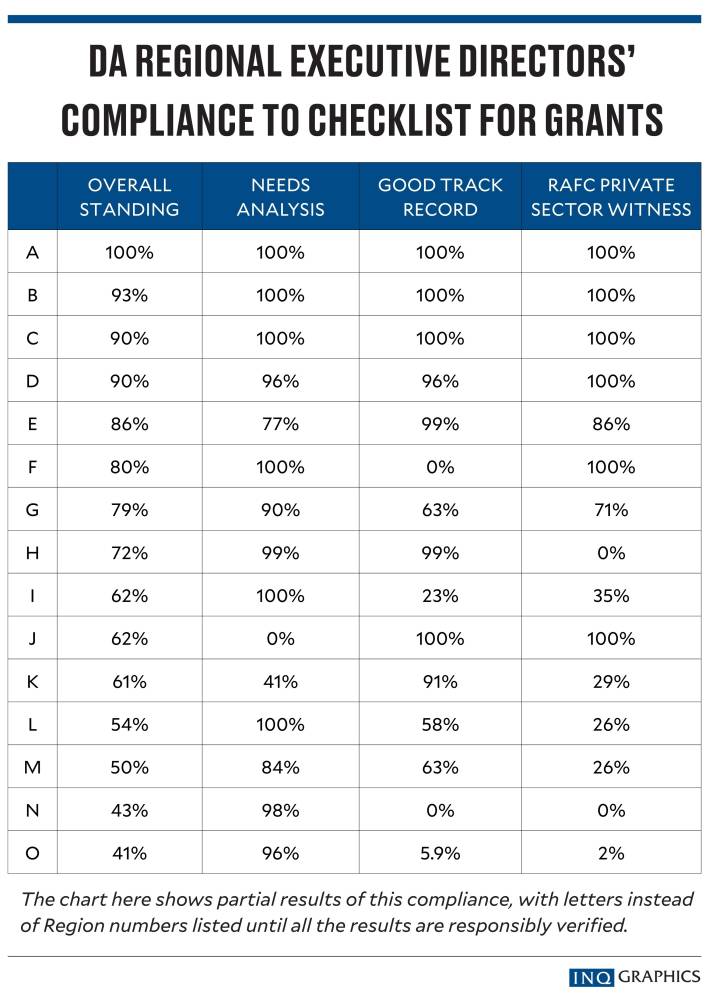
The main investigation finding was that DA grants were being given without proper processes. The obvious solution was a required checklist (done by banks but not done by the DA) that had to be followed before any grant was given. There are six requirements. The three most important ones are identified here.
Three reasons
First, since grants were given even when farmers did not need them, a needs analysis was required. Second, since they were given to beneficiaries without the proper preparedness, a track record had to be shown.
And third, because no independent private sector person could monitor what was being given out, the elected private sector chair of the Regional Agriculture and Fisheries Council should be a witness for transparency and accountability.

The DA regional executive directors who did not comply with these requirements would be severely penalized. So far, three regional executive directors have already been relieved of their posts. This is noteworthy, since no one has been penalized for this gross misuse of funds for the past many years.
The chart here shows partial results of this compliance, with letters instead of Region numbers listed until all the results are responsibly verified. This Table is updated monthly.
There can be no satisfactory delivery without the corresponding discipline. Tiu Laurel has shown his commitment against corruption and waste. He has ordered investigations and the corresponding disciplinary action on one undersecretary, three assistant secretaries, 10 directors, and 33 staff members. He identified a large previously approved project and called it a scam in a Senate hearing.
With Tiu Laurel’s commitment to fighting waste and corruption, the farmers, fisherfolk and agriculture stakeholders look forward to the action and results Tiu Laurel will soon be delivering.
The author is Agriwatch chair, former secretary of presidential flagship programs and projects, and former undersecretary of the Department of Agriculture and the Department of Trade and Industry. Contact is agriwatch_phil@yahoo.com