










‘Gene-edited’ rice variety eyed to boost food security

The government is harnessing science and technology to significantly enhance the disease resistance of a widely cultivated Indica rice variety.
Researchers from the Crop Biotechnology Center of the Department of Agriculture (DA) have utilized a floral dip-based gene-editing technique to boost the resistance of NSIC Rc 402 (Tubigan 36) against tungro, which could significantly reduce crop yield if left untreated.
Tubigan 36 is an an inbred rice variety developed by the Philippine Rice Research Institute (PhilRice) for irrigated lowland conditions. This rice variety is known for its medium-sized grains and moderately soft eating quality.
Project leader Reynante Ordonio says conventional tissue culture methods for genetic transformation are often ineffective for Indica rice varieties due to their limited responsiveness.
“Floral dip offers a simpler, faster and more practical alternative,” Ordonio says.
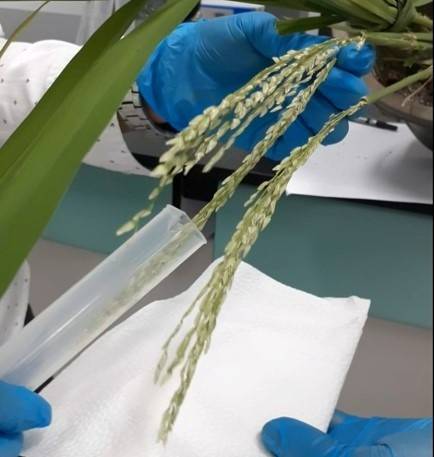
PhilRice says during the “pre-anthesis” stage or the period before flowering, DA researchers immersed rice flowers in a solution with Agrobacterium tumefaciens. It is a soilborne bacterium carrying a CRISPR-Cas9 construct, a gene-editing tool designed to disable the eIF4g gene that makes the plant susceptible to the rice tungro spherical virus.
“The solution also contains a hygromycin resistance gene, allowing researchers to easily identify successful transformations,” PhilRice says.
Favorable results
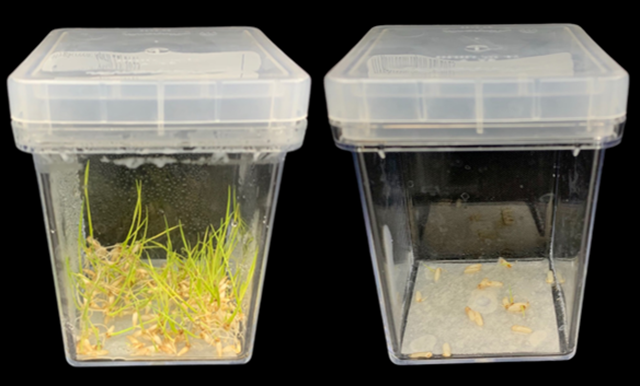
Among 512 harvested seeds from the floral-dipped rice variety, more than 400 developed into healthy plants that passed antibiotic screening.
Likewise, seven lines maintained tungro resistance for three successive generations, indicating their strong potential for stable resistance inheritance.
Tungro is one of the country’s most persistent rice diseases, causing up to 30-percent crop loss annually, equivalent to 456,000 tons of rough rice.
“These results demonstrate that the floral dip method can effectively enhance disease resistance not only in NSIC Rc 402 but also in other Indica rice varieties,” Ordonio says.
According to the International Rice Research Institute (IRRI), the disease is caused by a combination of two viruses is transmitted by leafhoppers. In turn, it causes leaf discoloration, stunts growth, reduces tiller numbers and produces sterile or partly filled grains.
“Tungro infects cultivated rice, some wild rice relatives and other grassy weeds commonly found in rice paddies,” the IRRI says.
Better yield, stress tolerance
Ordonio says this technology provides opportunities to swiftly develop improved rice varieties, especially those with better yield, quality and stress tolerance.
PhilRice says the approach could significantly accelerate rice breeding programs and enhance food security in the Philippines.

“With continued funding support from the DA-Biotechnology Program Office, we aim to further refine and adapt this protocol for more local varieties and even other crops,” Ordonio adds.
DA researchers made a breakthrough amid a series of storms that had battered farmlands across the archipelago.
Based on the DA’s bulletin dated Nov. 28, the Tropical Cyclone “Verbena” and shear line damaged P57.53 million worth of agricultural produce. Of these, rice accounted for 88.99 percent or P51.20 million of the overall losses.
Before this, the farm sector incurred P4.19 billion in damage due to Tropical Cyclone “Uwan.” Majority of losses were in high-value crops, equivalent to 63.46 percent or P2.66 billion.
Following the recent typhoons, the DA no longer expects another record-high palay (unmilled rice) output, as it slashed its forecast to 19.61 million metric tons (MT) to 19.89 million MT for this year.
The new projections were lower than its previous estimate of 20.2 million MT to 20.5 million MT and the initial target of 20.46 million MT.
The Philippines produced 19.09 million MT of palay in 2024, down 4.8 percent from 20.06 million MT in 2023, the highest local palay production recorded, according to the Philippine Statistics Authority.