











Peso crosses 60.5 vs $1; hits new low

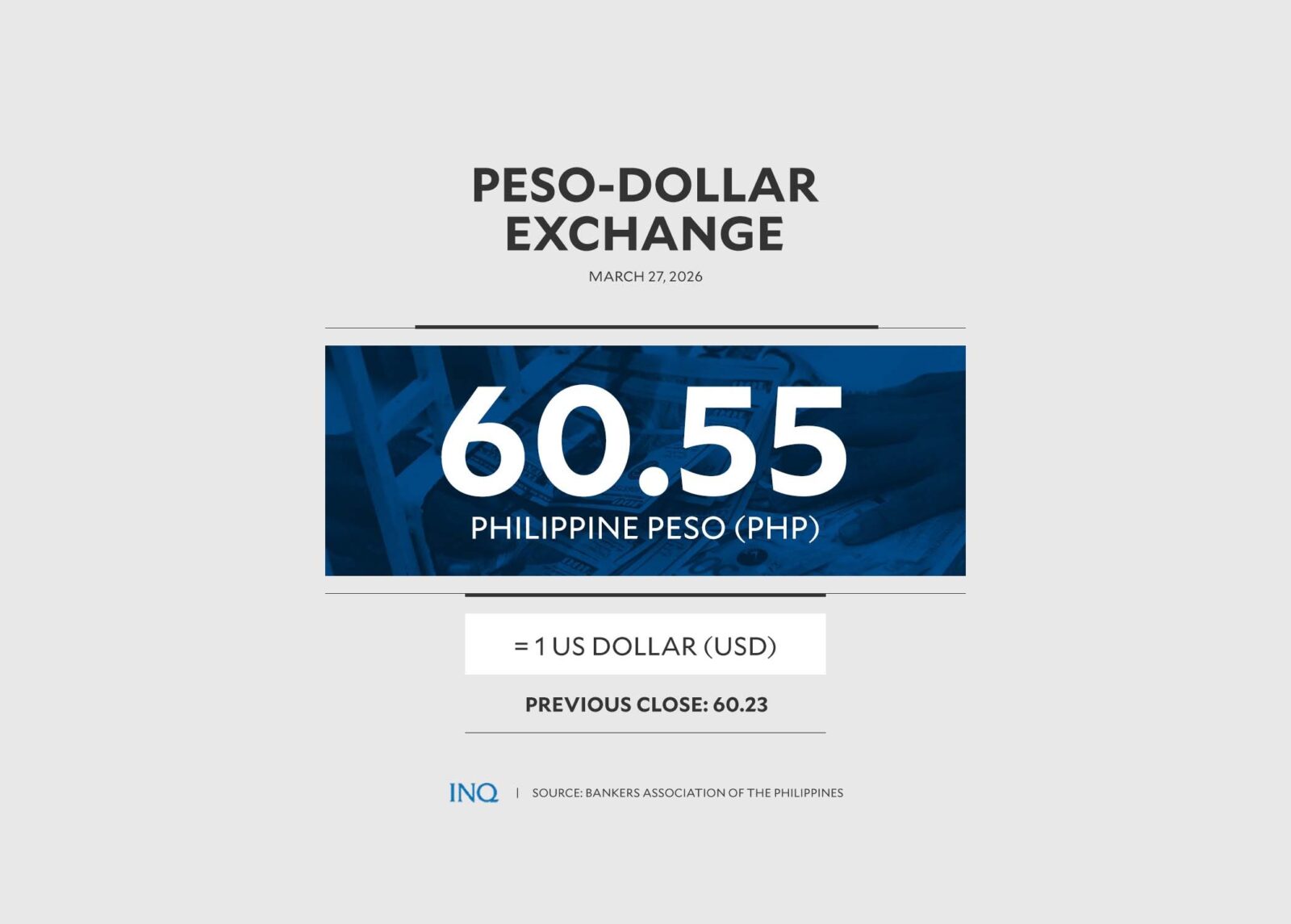
The Philippine peso tumbled to a fresh record low on Friday, capping a volatile week after the central bank’s surprise decision to hold off interest rate hikes left the currency vulnerable to a surging US dollar amid fears of a prolonged war in the Middle East.
The peso closed at 60.55, losing 32 centavos from its previous finish and surpassing the prior record-low close of 60.30 set on March 23.
It hit an intraday low of 60.57 before trimming some losses. Trading was heavy, with $1.3 billion changing hands, up from $1.2 billion in the previous session.
A trader said the peso remains under pressure as the US-Iran discussions fail to produce meaningful signs of de-escalation.
President Donald Trump said the United States would hold off on targeting Iranian energy plants for another 10 days as “talks are ongoing” with Tehran.
So far, both sides have given different accounts of diplomatic progress, contributing to safe‑haven demand for the US dollar as markets digest conflicting signals about how far negotiations have advanced.
At home, the Bangko Sentral ng Pilipinas (BSP) left its benchmark interest rate unchanged at 4.25 percent at an off-cycle meeting on Thursday, holding off on tightening despite rising inflation pressures from the Middle East conflict to avoid disrupting the economy’s fragile recovery from a recent graft scandal.
The Monetary Board had not been scheduled to decide on interest rates until April 23.
But amid uncertainty stemming from the war in the Middle East, BSP Gov. Eli Remolona Jr. said the surprise meeting—and the decision it produced—was meant to reassure markets “that we are assessing the situation constantly.”
“Any off-cycle adjustment is definitely expected to cause safe-haven demand for the dollar,” the trader said.
“Despite the BSP potentially leaning against a rate cut in their regular April meeting, it emphasized heavily on uncertainty in the briefing,” the trader added. “That somehow trimmed further the appeal for the local currency.”
The BSP said inflation may breach its 2 to 4 percent target range this year, with price growth now seen averaging 5.1 percent.
But Remolona said raising rates to fight inflation would risk delaying the economy’s rebound from the confidence shock triggered by a major corruption scandal.
He also acknowledged that higher borrowing costs—typically used to curb demand-driven inflation—would do little to counter supply-side price shocks from the Iran conflict.
In a note to clients, ANZ Research said it expects the BSP to stay on hold at its next meeting in April and to “emphasize continued monitoring of second‑round price effects.”

But research analysts at Nomura are seeing “a rising probability” that the BSP would deliver an outright hike next month as inflation may now be tracking well above the central bank’s target range.
“This is still contingent on the Iran conflict remaining unresolved and oil prices remaining elevated,” Nomura said.
“But the BSP’s reiteration that its primary mandate remains price stability suggests to us that the inflation outlook will be BSP’s main policy consideration near-term despite growth momentum likely remaining weak,” it added.
Jonathan Ravelas, senior adviser at Reyes Tacandong & Co., said trading at the spot foreign exchange market “remains constraint‑driven, with flows reflecting caution rather than panic.”
“Expect range‑bound trading at 60.25–60.75, as uncertainty around energy persists,” Ravelas said.
******
Get real-time news updates: inqnews.net/inqviber