







Roots and routes: Tourism and agriculture go hand in hand

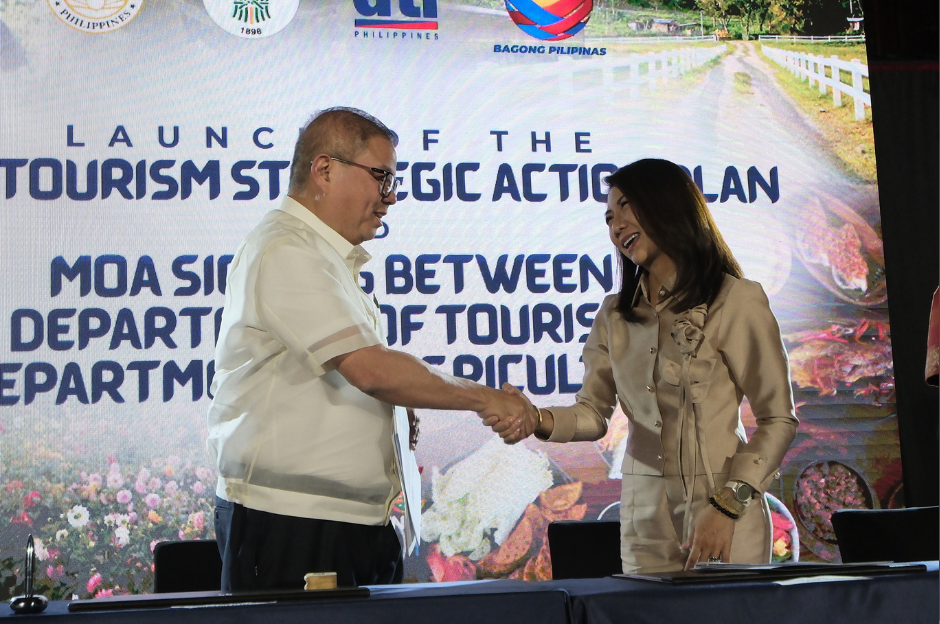
The Department of Agriculture (DA) and the Department of Tourism (DOT) have teamed up not only to boost food production nationwide but also to raise the Philippine flag in global tourism.
To formalize the partnership, the DA and the DOT signed a memorandum of agreement to align their respective programs, infrastructure and promotions to elevate the Philippines as a leading food and gastronomy destination in Asia.
Agriculture Secretary Francisco Tiu Laurel Jr. says the partnership provides a structural intervention for the agriculture sector.
“This is not simply about adding tourist stops to farms, a visit that could even spur greater investment the farm sector. It is about creating stable institutional demand for local produce, encouraging value adding and integrating agriculture into the broader services economy,” Tiu Laurel says.
“When hotels and restaurants source consistently from Filipino farmers, we stimulate rural investments, generate employment and expand economic activity beyond primary production,” the agriculture chief adds.
Tourism Secretary Christina Frasco says the collaboration will support infrastructure development, including farm-to-market roads (FMRs), irrigation systems, postharvest and cold chain facilities.
“When tourism demand for food and culinary experiences is intentionally linked to Filipino farmers and rural enterprises, visitor spending strengthens local economies,” the tourism chief says.
Frasco also says tourists are spending more on experiences that go beyond sightseeing, such as culinary journeys, farm visits and immersive rural experiences, among the growing segments of the market.
Tiu Laurel says connecting agriculture and tourism can incentivize higher standards in quality, food safety and sustainability, enabling local producers to compete in premium markets.
To achieve this goal, the DA and the DOT will coordinate to expand farm tourism destinations, promoting Filipino cuisine and integrating agricultural priorities into tourism planning.
FMR alignment
A key feature of their collaboration is the alignment of FMR projects with tourism circuits under the Tourism Road Infrastructure Program to improve access to farms and emerging destinations while strengthening logistics for producers.
To push the agritourism agenda forward, a joint technical working group will be formed to oversee implementation, draft work plans and coordinate stakeholders from both sectors.

Both government agencies will shoulder their own costs, wanting to build a convergence model on coordination instead of pooling their budget.
The recently signed accord is anchored on the Tourism Act of 2009 that promotes agritourism and countryside development, the Farm Tourism Development Act of 2016 that declares farm tourism a key strategy for sustainable rural growth and the Agriculture and Fisheries Modernization Act of 1997 that modernizes agriculture and fisheries to raise incomes and productivity.
Tourism accounted for 8.9 percent of the Philippine economy in 2024, an improvement from 8.7 percent a year ago, according to the Philippine Statistics Authority.
The Tourism Direct Gross Value Added, which refers to the value added generated by tourism to the economy, increased by 11.2 percent to P2.35 trillion in 2024.
About 17.1 percent of inbound visitor expenditure goes to food and beverage services.
Global agritourism is projected to expand by 185 percent to $197 billion by 2032 from $69 billion in 2019.