










Startup eyes safer, low-cost option for energy storage

As the Philippines seeks to expand its renewable energy capacity to at least 35 percent of the total energy mix by 2030, the potential demands will involve not just generating more power, but also storing it.
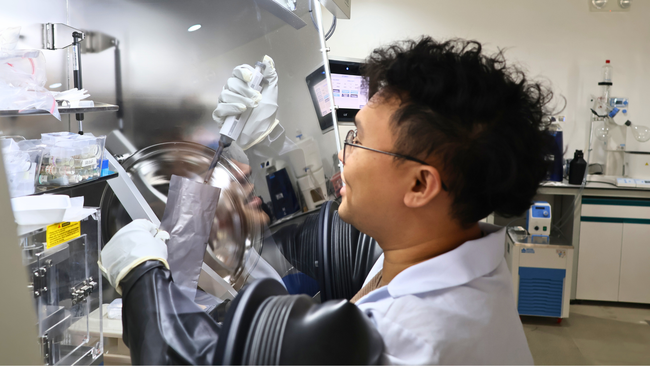
The country may not need to look far for energy storage solutions, as local technology startup Nascent Batteries plans to begin pilot testing its sodium-ion battery packs this year.
“Sodium-ion batteries have many possible applications,” the company’s cofounder, Joey Ocon, told the Inquirer. “For Nascent Technologies, the first market we are looking at is the SLI (starting, lighting, ignition) market or internal combustion engine vehicles.”
“We are the only player in Southeast Asia developing our own sodium-ion battery cell technology,” he added.
The types of batteries currently available in the market include SLI batteries, which are rechargeable lead-acid batteries that are inexpensive but have low energy efficiency. Another option would be lithium-ion batteries, which are more efficient but also more expensive.
Funding challenges
Nascent offers a third option: Sodium-ion batteries that are energy-efficient and expected to be more affordable than lithium-ion given how it is made of metals and minerals that are more widely available.
“We’re already waiting for a set of equipment, and then when that equipment comes, we will be building packs that we will pilot test in the actual environments it could work, such as in trucks, SUVs, cars, and motorcycles,” said Ocon.
When the Inquirer first talked to Nascent in 2024, its cofounder John Echauz had shared the difficulties in securing funding for their young company, which was only formally set up in 2022.
Most conglomerates were not willing to invest in what was called a “technology risk,” or the likelihood that the systems or tools would not deliver the intended results once it becomes available in the market.
But Nascent eventually got backing from the heads of companies such as Metro Pacific Investments Corp. and First Philippine Holdings Corp., and have been running the country’s first private advanced battery research laboratory in Quezon City.
Pilot testing
Now, Ocon said pilot testing of Nascent’s sodium-ion battery packs will “hopefully” take between six months and one year. Afterwards, the company can begin preparing for commercial production.
“You have to approach it very methodically and minimize the risks. That’s why you do pilot testing because you have to collect data … get customer feedback and improve on the design before eventually manufacturing the batteries [for] commercial production,” he said.
Beyond the SLI market, he noted that sodium-ion batteries have other possible applications, such as residential, commercial, and industrial energy storage systems.
“Let’s say, if you have a solar panel at home, you’re saving money by not consuming electricity from Meralco, because you’re generating your own power from your rooftop solar. If you want to add more savings, you have to increase the size of your solar panels,” Ocon said.
“But there’s also a limit on what you can do if you are adding panels. In other countries, they’re also adding batteries along with the panels,” he added. “What makes sodium-ion batteries attractive is that it’s safer than your typical lithium-ion battery solutions.”
One of the risks with lithium-ion batteries is its thermal runaway, which can cause the battery to heat up uncontrollably and result in a fire—a problem that does not occur with sodium-ion batteries.
Fast development
Moreover, production lines used for making lithium-ion batteries can also be retrofitted easily to also produce sodium-ion batteries.
“It’s classified as a ‘drop-in.’ It’s a drop-in technology that can use infrastructure currently for lithium-ion batteries. This is why the development of sodium-ion is fast because there is already infrastructure that you can use,” Ocon said.
Despite this, Ocon does not expect sodium-ion batteries to replace lithium-ion. Rather, he said it will serve as a “complementary technology” to lithium-ion, allowing for more options to be available in the market.
“There is a huge projected demand for batteries as the world undergoes a clean energy transition. So, there will be roles for different types of batteries, different types of energy storage technology,” he said.