











All hands on the table

There are meals that rely on ceremony, and then there are meals that quietly undo it. The boodle fight belongs to the latter. No cutlery, no seating plan, no designated head of the table. Just food laid generously over banana leaves, and the simple instruction to eat together. It is a Filipino feast meant to be shared, not staged.
At its core, a boodle fight is a style of communal dining where dishes are arranged down the center of a long table, traditionally lined with banana leaves, and eaten with bare hands. Guests gather shoulder to shoulder, reaching for food as they please. It is spirited, informal, and deeply social.
And while it appears carefree, the boodle fight carries with it layers of history, discipline, and meaning.
From camaraderie to communal
Its origins trace back to the Philippine Military Academy (PMA) in Baguio City. There, boodle fights were not indulgent affairs but exercises in unity and restraint. Cadets ate together to reinforce camaraderie and equality. Rank dissolved at the table. There were rules: backs straight, posture proper, food eaten swiftly using only the hands, without looking down at what you were taking. Awareness, discipline, and respect were practiced even in the most basic act of eating.
This tradition is deeply personal to me. My father, the late chief superintendent Benjamin F. Valenton, a graduate of the PMA Class of 1962, often spoke of boodle fights—not as festive meals, but as formative experiences. To him, they were about brotherhood and shared discipline.
Today, whenever I partake in a boodle fight that one is hosting, I find myself thinking of him. A once slight young man from Nueva Ecija, who endured the rigors of the PMA and emerged with quiet resolve. He would later become the country’s first Ten Outstanding Young Men of the Philippines awardee for military service in 1968. What appears festive on the table carries, for me, a deeper inheritance.
Over time, the boodle fight has moved beyond the mess hall and into everyday life. Today, it has become part of a fun, engaging expression of Filipino hospitality, often served at family gatherings, beach outings, reunions, and dinners hosted for friends visiting from abroad.
What was once rooted in discipline has softened into celebration, without losing its spirit of equality and togetherness.
Recreating the experience at home
Hosting a boodle fight begins the same way all thoughtful gatherings do: with a clear theme. In this case, the theme is the experience. Once you commit to a boodle fight, everything else follows naturally. Start with the guest list—people who are comfortable eating with their hands, who enjoy closeness, who understand that this meal values connection over formality.
Begin with a welcome drink to set the tone. A tall glass of iced, freshly squeezed calamansi juice is always refreshing and unmistakably Filipino. For something even more elemental, fresh buko served ice-cold in its shell is both practical and generous. For a welcome bite, serve chicharon and anything bite-sized like lumpiang shanghai, fried kangkong leaves, or kamote chips to amuse the palate while guests await the rest of the party.
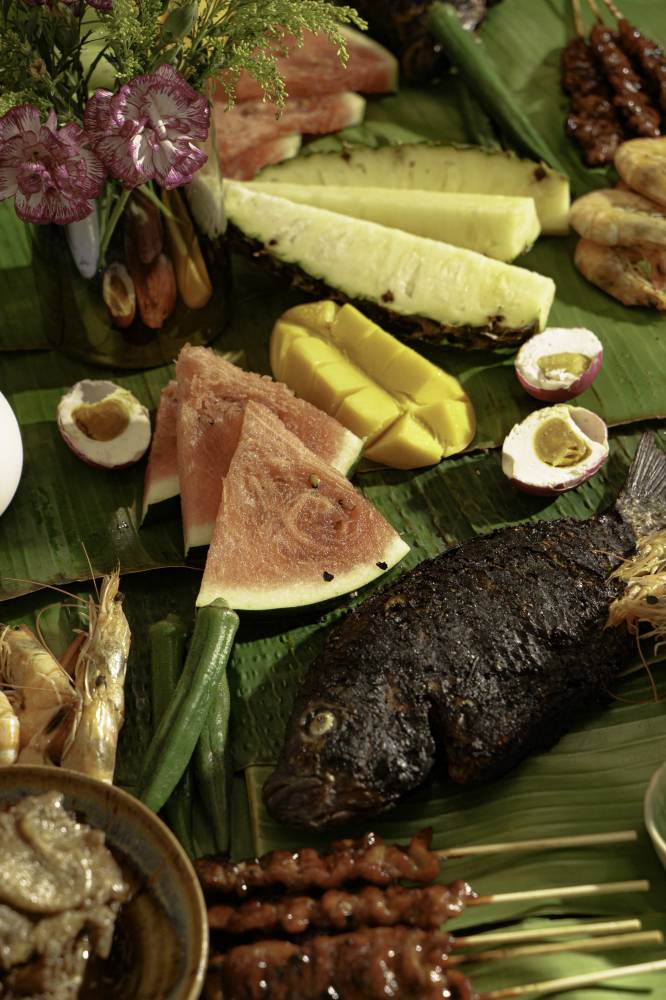
The menu should be familiar, generous, balanced, and designed for hands. Filipino favorites work best: adobo in small bowls; inihaw na isda; pork in comforting forms, either barbecued or deep-fried as lechon kawali. Add steamed prawns, boiled just until tender. Balance the richness with vegetables such as okra, ensaladang talong, chopped tomatoes, and red eggs.
And in-season fruits like mangoes, watermelon, and bananas make for a vibrant and edible centerpiece that serves as a palate cleanser as well, with bananas conveniently doubling as décor.
If you wish to include soup, serve it in individual bowls ready to eat so guests don’t need to step away from the table. Halaan (clam soup) offers something light and briny, while bulalo or sinigang brings warmth and comfort.
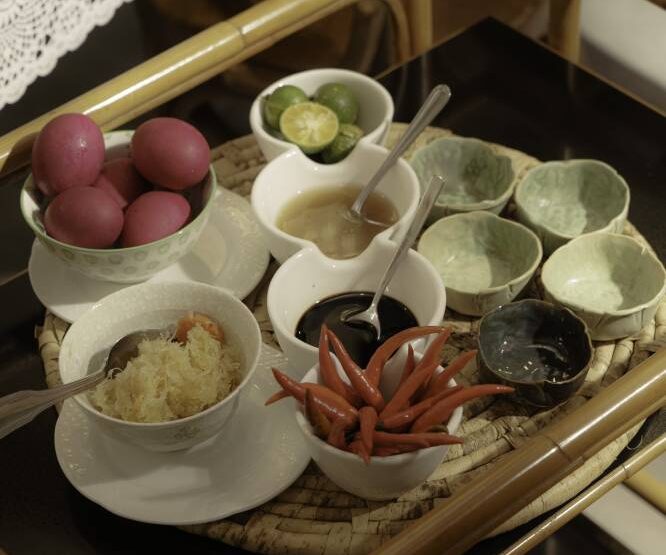
No Filipino table is complete without a sawsawan. Prepare a small condiments station so guests can mix according to taste, using small serving spoons for ease and hygiene. Include soy sauce, calamansi, sliced sili, vinegar, patis, bagoong, and even buro for those who enjoy it. This small detail invites participation and personalization within a shared meal.
It’s all in the details
The table itself deserves as much care as the food. Cleanliness and comfort are essential, especially when food is exposed. If hosting at home, keep the gathering indoors where it is cool and free of flies. For outdoor settings—particularly by the beach or poolside—assign someone to discreetly shoo insects away with a fly whisk. Comfort matters; guests enjoy food best when they can eat with ease and without distraction.
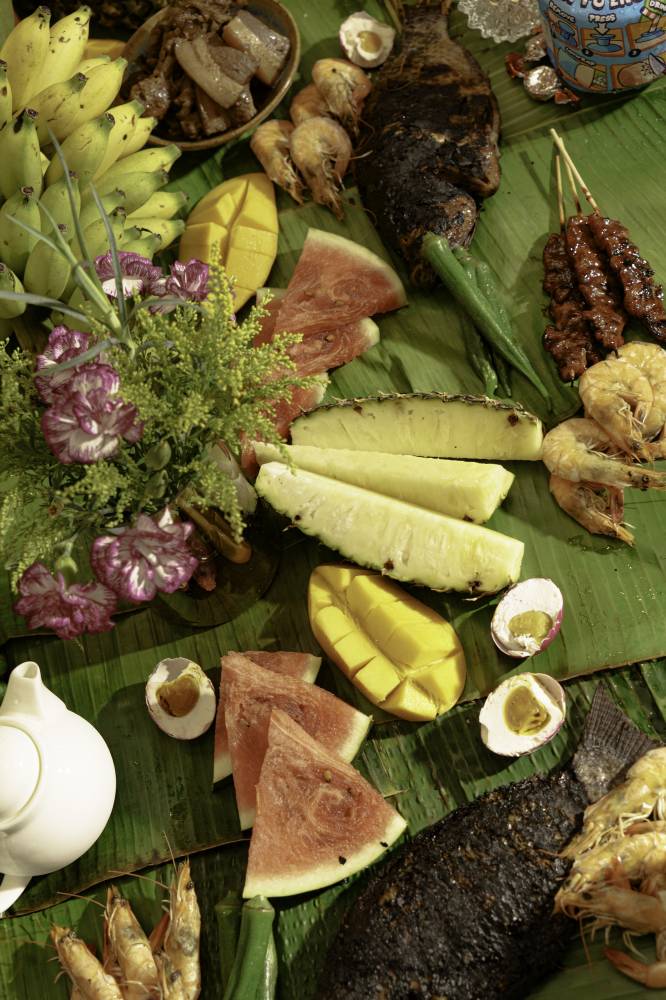
Think of table layering the way you would make a bed. Begin with a clean table, then protect it with a clear plastic table cover. On top, lay your banana leaves. These should be torched or lightly heated—often referred to as wilted banana leaves. Passing them quickly over an open flame, steaming them, or briefly heating them in the oven makes the leaves pliable and glossy, preventing cracks or tears. This process also releases essential oils that add a subtle aroma, sanitizing the surface by killing microorganisms and drying any sap or resin that might otherwise stain hands or clothes.

For ease and aesthetics, remove the spines of the banana leaves so they lie flat, and criss-cross them for visual interest, a style I personally enjoy. As a child, I loved seeing these leaves folded and woven into toys and decorative animal figures, a playful display of Filipino creativity and resourcefulness.
Fresh fruits like pineapples and bananas on the stalk make natural, unfussy centerpieces, while cold buko in the shell adds charm to each place setting. A practical tip is to buy bananas just about to ripen so they stay intact on the stalk throughout the meal.
Because the boodle fight is eaten by hand, hospitality details matter. Offer an oshibori—a hot or cold wet hand towel—before the meal. This is a gesture rooted in the Japanese philosophy of wholehearted hospitality that anticipates a guest’s needs. Guests use it to clean their hands and never for the face or neck. At the beginning of the meal, a hot towel infused with pandan feels welcoming; at the end, a cold towel infused with a slice of calamansi refreshes and cleanses.
Drinks throughout the meal can remain simple: water, soda, and fresh cold buko, if available. Rice is best served Russian-style, brought out as needed, to keep the table neat, the rice warm, and portions mindful. It also allows for sustainability, serving only what is necessary.
When the meal is done, cleanup becomes part of the ritual. The banana leaves are simply folded inward, gathering everything in one efficient motion.
In the end, a boodle fight is not about mess or excess. It is about equality, generosity, and presence. All hands on the table, no one at the head. When the food is gone, and the banana leaves are folded away, what remains is the memory of having shared something essential. Not just a meal, but an experience meant to be enjoyed together.
All hands on deck!
Hosting a Filipino feast? Here is what you will need for a stylish, tasty, and fun table.
- Banana leaves: Available at local markets or from your own (or a friend’s) garden. Torch lightly to not just make them pliable and glossy but also sanitized
- Fresh buko: Wet markets or groceries offer ice-cold coconut drinks. Try ready-to-drink options still in the coconut shell, like Coco Island (just chill, it is ready-to-drink and comes with a straw) or Coconato.
- Grilled meats and seafood: Ineng’s Special Barbecue, Heaven’s BBQ, and Aida’s Chicken House for grilled meat, or even the Salcedo Saturday Market for grilled seafood
- Fruits: In-season local fruits like mangoes, watermelon, and bananas on the stalk double as colorful, natural centerpieces and double as a refreshing palate cleanser between hearty bites
- Condiments: Patis, bagoong, vinegar, and sliced sili are found at any local grocery; use small serving spoons and condiment dishes for convenience.
• Wet towels: Provide small cloth towels or disposable towelettes, lightly scented with natural calamansi or pandan, to keep your table both stylish and hygienic.