











Charles Montañez and his blazing new act

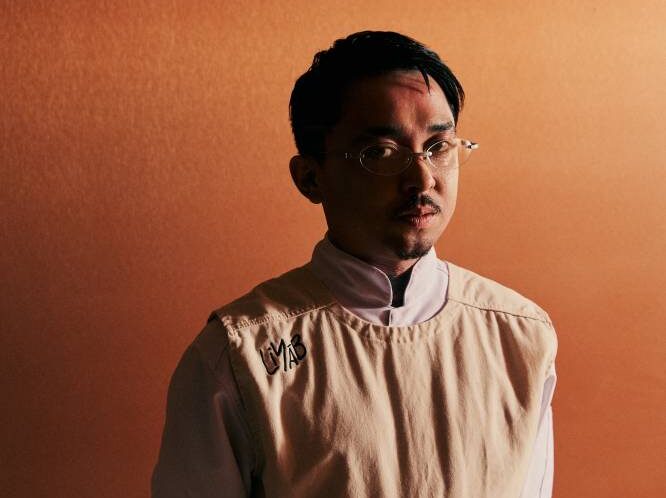
In September 2023, during dinner at his former restaurant Alegria, Charles Montañez pointed to a little flicker of a flame inconspicuously drawn into a small space of the à la carte menu. For as virtually unremarkable as it was amid the flurry of illustrations and text, that little logo marked a significant moment.
Not just because Montañez was already tending to the little spark that would eventually flare up atop a roof deck in BGC (where Skye Bar used to exist), but also because it was a “complex and challenging” time in his life, a period of reckoning with identity, belonging, and, eventually, loss.
“I’ve always believed it would be something truly worth stepping away from Alegria for,” he confesses. “I had already completed the core concept and design mood during those early days. It was simply a matter of time before it came to life.”
That “it”—stemming from a nondescript placement of a logo to remind him and his co-head chef Gilbert Borja of where they are headed—finally arrives in the form of Liyab, arguably one of the hottest new openings in Manila today.
Through the fire
Shaped by fire and faith and a self-understanding that the days of impressing people are long gone, Liyab is the second coming of a chef who knows when to move forward— and when to look back. “In the past, I was relentlessly chasing creativity, always feeling the need to prove something as a chef,” he says. That isn’t the case anymore, although Montañez isn’t one to shy away from showmanship.
Every dinner opens with a fast-burning flash paper lit up to reveal the multi-course tasting menu—a delightful kind of obsession with drama seen and felt in Liyab.
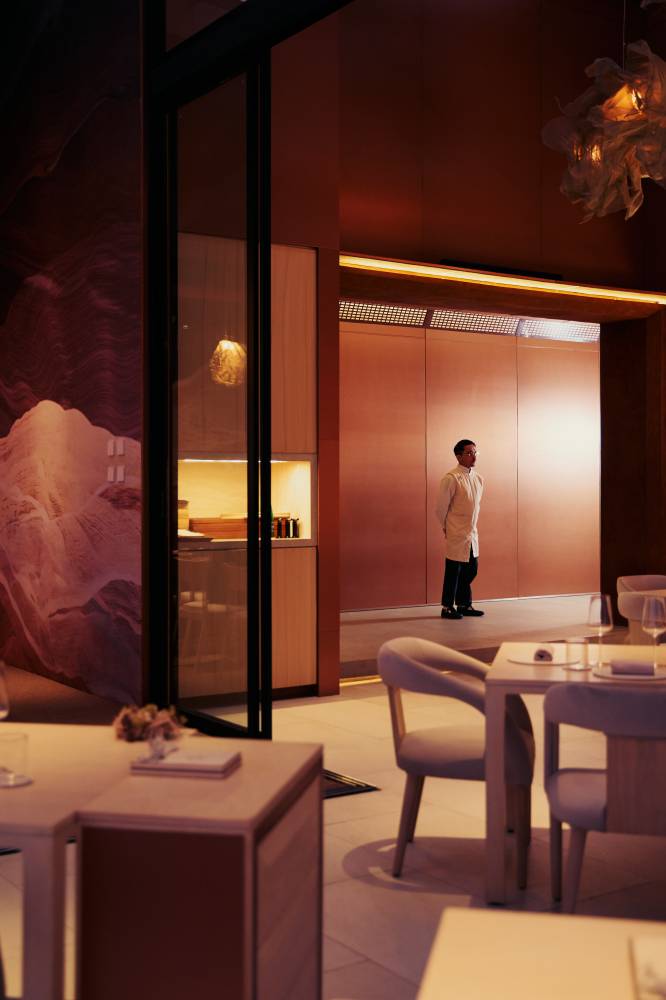
There is also the majestic glasshouse space that changes color depending on the time of day. The dinnerware and cutlery articulating his design ethos act more like symbols of legacy. Service led by restaurant manager Dimitri Bora is rooted in excellence. And soon, an outdoor subconcept will hold a live-fire ihawan.
Everything indicates that Montañez never really lost his exuberance, but now, it’s tempered with a refined polish as he cultivates cooking with precision and purpose, a reverential attention to ingredients like sea urchins from Sagay City, and a sensibility that may as well capture the attention of Michelin Guide inspectors.
“I’d lie if I say no, or even sugarcoat it into something to downplay the desire,” Montañez says when asked if this is his bid for a Michelin star. “I want it, the team wants it, we all want it. And I would say we understand how much it takes to get it, so we are trying our best.”
The vision is clear: Liyab is where Montañez is putting everything on the line, blazing a new trail for himself and his team. And in doing so, he squares off with the smoldering weight of the reality that comes with his raging ambition.
Sure, aspiring for stars is like playing with fire, but with finesse, resilience, and a newfound maturity at his disposal, who knows how far Montañez can really go?
There is less need to impress but more desire to express and explore maximum potential in terms of capabilities.
In the past, I was relentlessly chasing creativity, always feeling the need to prove something as a chef. With this project, I’ve been far more deliberate, approaching it first and foremost from a diner’s perspective. That shift has changed everything because I care more about how the guests would feel with the time they spend in my space and with the team.
What makes Liyab different from what you did in the past?
What we’re trying to communicate here feels immediately understood. In the past, there was often a need to explain our choices, why certain elements were on the plate, or why we approached dishes a particular way.
With Liyab, the connection happens naturally. I’d say the debut menu has been successful at this early stage because the efforts and flavors resonate without effort. Guests form their own interpretations of each course, and many share personal memories the food evokes, stories tied to places, moments, or emotions from their past. That kind of response affirms that the food is speaking clearly, that we get to communicate what we are trying to do effectively.
Let’s talk about this location. Who designed it? What was the feel you were going for? And do you think this would have worked in a different space?
I worked closely with Amanda Brodett of Huephoria Interiors to bring to life a space that goes beyond being simply a place to eat. From the beginning, the vision was to create an environment where guests could pause, breathe, and reflect. The architecture and interiors are designed to gently guide diners into a particular state of mind that is rooted in clarity, openness, and restraint.
The setting was always intended to be on a roof deck, and I don’t think it will be the Liyab I have always wanted to achieve if it would be on a different environment.
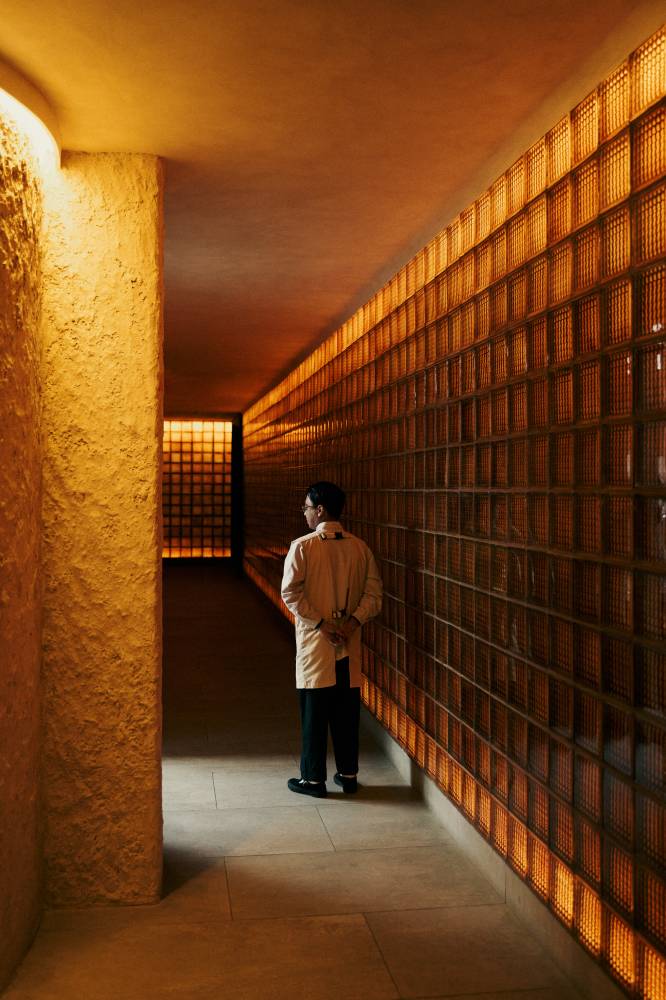
The intentionally empty hallways play an equally important role. These corridors are designed as pauses between moments, more like transitional zones rather than mere passageways. Their visual restraint invites introspection, allowing guests to slow down, reflect, and fully absorb the experience as it unfolds.
Fire has always been at the core of what you do. How are you using fire in Liyab?
Liyab is more than the familiar notion of a “woodfire restaurant.” While the growing trend often leans heavily in being rustic, and most of the time uses it to mask imperfections, we approach fire with clarity, precision, and intention.
At the restaurant, fire and time are tools for building a deeper foundation of flavor and for translating our inspirations into something distinctly our own. Ingredients are cured, smoked, hung-dried, and charcoal-pressed as a primary step before evolving into garums, amino pastes, and misos that add depth and complexity to the cuisine.

And why the tableside service to finish the dishes?
The tableside allows us to be closer to our guests and to communicate care in a more direct, tangible way. That’s what I think meaningful hospitality should be—the sense of intimacy is central to what we aim to create at the restaurant. Guests are invited to see the process, smell the aromas, and observe the movements in the kitchen and elements that shape how a dish is received even before it reaches the palate.
Can you talk about some of the special ingredients you utilize at Liyab?
Among the notable ingredients we work with are sea urchins from Sagay City, flown to Manila three times a week, and various cuts of local F1 wagyu. We also work with marang, which we preserve by turning it into an amino paste and use as a flavor enhancer, a selection of market fish that are aged or cured into what we refer to as fishcuterie.
Other expressions include bihod, our local equivalent of bottarga, processed into an umami-rich seasoning powder, and house-made pandesal processed into miso and used in petit fours. We produce garums from offal, cure native black pigs, and continue to evolve the menu as new ingredients come into focus. One upcoming feature is darag, an heirloom chicken breed traditionally used for chicken inasal.
The restaurant industry can be very trend-focused. How do you stay on top of trends? Or do you even feel the need to?
People can feel honesty in what you choose to share and present. When something is genuine, it resonates naturally. My belief is to stay true to your intent and allow the work to unfold organically. As long as curiosity is present, and you know how to turn it into something meaningful, it will always lead to an output worth sharing when the time feels right.
I don’t feel the need to chase trends. Real fulfillment comes from creating something we’re genuinely proud of. That kind of sincerity never goes out of style.
How can you change the perception of what a tasting menu can or should be?
I believe we have begun to shift the conversation around tasting menus, showing that they don’t have to feel intimidating. Liyab’s debut menu communicates clearly and connects easily with our guests. It also challenges the common perception that tasting menus either leave diners unsatisfied or feel overwhelming in one sitting.
We’ve found a thoughtful balance, with carefully calculated portions that feel complete without excess.
Your other restaurant, Mamacita, holds a Michelin Select recognition, and now you have this. Is Liyab your bid for a star?
I’d lie if I say no, or even sugarcoat it into something to downplay the desire, but Joey Suarez (managing consultant of EAT Public Relations) told me to be proud of the intention—not to manifest it, but to dictate the tone of our work ethic and drive every day. So yes, I want it, the team wants it, we all want it.
And I would say we understand how much it takes to get it, so we are trying our best. Side by side, doing what we do together. Letting it all rip, day in day out.