











Does tumbang preso still matter in this day and age?

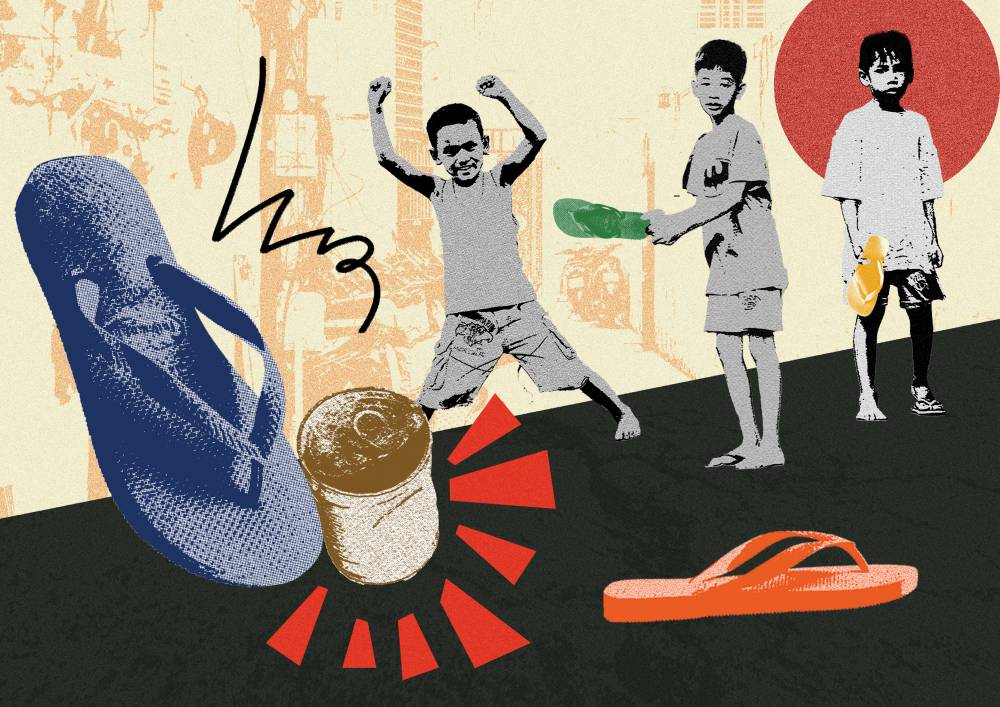
Summertime is upon us, though little actually incentivizes Filipino children to play outdoors. Phones, computers, and consoles provide alternative means of recreation, while the heat itself is a deterrent enough to keep people from going outside.
Tumbang preso (which loosely translates to “knock down the prisoner”) is one of our traditional Filipino street games that’s slowly losing relevance among its supposed player base. And yet, this game, in its own way, represents everything beautiful about Filipinos.
And for us, that alone is reason enough to conserve it.
Tumbang preso: A mirror of local values
Tumbang preso is a fairly simple game that requires little to play.
Participants take turns trying to knock down a can, and the “taya” (or “It”) is tasked with putting the target back up when it’s knocked down. Alternatively, the “taya” can also tag other players who are trying to recover their thrown flip-flops to pass the “taya” role.
That’s it. A few rules and with items readily on hand, tumbang preso can be played anywhere, whether on the streets or even on the beach. And yet, behind these simple rules are remnants of Filipino values we hold dear. Like Filipino resilience, though overdone and wrongly invoked at times, is seen in the act of putting the target back up every time it’s knocked down.
Outside that mechanic, the very idea of creating a game out of flip flops and empty cans speaks of Filipino ingenuity and the ability to make the most out of one’s circumstances.
Not to mention, taking advantage of the brief moment where the “taya” has to put the target back up as you cross to retrieve your flip-flop is no easy feat. If anything, it requires great timing and dexterity, and speaks of our “diskarte.”

Fading relevance and a tale of ignorance
Da cau is the national street sport of Vietnam, and it has a lot in common with tumbang preso. Mirroring its simplicity, it only requires a modified version of the shuttlecock and the participation of a few players. The rules are quite simple as well: kick it around and prevent it from hitting the ground. Much like tumbang preso, it’s also played everywhere.
But the similarities end there. da cau is played regardless of age, and is seen as a worthwhile source of exercise among its older players. Not to mention, da cau is also played professionally—there literally being a World Shuttlecock Championships (WSC), with countries such as China, India, Germany, Hungary, and Italy, among its participants.
While establishing tumbang preso as an international sport is a lofty and probably an unrealistic dream, that isn’t the goal of this comparison. Instead, where da cau has cemented itself in Vietnamese culture and way of life, tumbang preso is slowly being forgotten by Filipinos. Only children, if at all, play the game, and it too falls behind other recreational activities.
Is that all there is to it? To let it fade into obscurity as nothing more than a cultural artifact that’s lost its relevance outside of heritage weeks and textbooks? Not for us—and it’s high time we revisited this traditional game that still has so much to give to our youth.