










“Hold Everything Dear” navigates love, labor, and artistic relationships


From Singapore to Sydney, Ames Yavuz has long worked across borders. But recently, the gallery landed in Manila for an off-site exhibition, “Hold Everything Dear,” putting Filipino artists and their practices firmly in focus.
While highlighting the excellence of Filipino artists, it also asks what it truly means to hold art—and artists—dear, revealing the complexities and intimacies of both contemporary art and relationships between institution and artist.

A space that held multiple narratives
The exhibition, which ran until Dec. 5 at Pasillo 18, La Fuerza Compound in Makati, featured more than 50 Filipino artists and collectives with a wide range of practices, from Elmer Borlongan’s distinctive figurative work to Cian Dayrit’s layered social commentary, as well as Iloilo’s community-rooted Kikik Collective and MM Yu’s thoughtful interventions.
Across generations, regions, and disciplines, other exhibiting artists included Isabel and Alfredo Aquilizan, Pope Bacay, Allan Balisi, Renz Baluyot, Reen Barrera, Micaela Benedicto, Don Bryan Bunag, Zean Cabangis, Rocky Cajigan, Pin Calacal, Bjorn Calleja, Pablo Capati, Kiko Capile, Valerie Chua, Ronyel Compra, Lec Cruz, Uri de Guer, Pepe Delfin, Kiko Escora, Babylyn Geroche Fajilagutan, Carlo Gabuco, Denver Garza, Lui Gonzales, Johanna Helmuth, Miggy Inumerable, Ryan Jara, Is Jumalon, Yeo Kaa, Genavee Lazaro, Veronica Lazo, Christina Lopez, Gene Paul Martin, Mimaaaaaaaaw, Julieanne Ng, Jill Paz, Pam Quinto, Marco Rosario, Brent Sabas, Eunice Sanchez, Kaloy Sanchez, Luis Antonio Santos, Isabel Santos, TRNZ, Derek Tumala, Jezzel Wee, JD Yu and Costantino Zicarelli.

The show acted not so much as a survey with a single narrative but as a space that held multiple narratives of difference, all in balance.
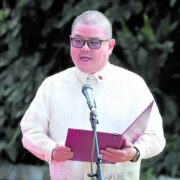
Country manager Belle Castillo reflects on the exhibition’s sensibility. “Filipino artists often transform deeply personal experiences into resonant communal gestures,” she says. “That relational and layered approach to art-making is what we wanted to hold together in this exhibition.
She goes further to say, “I suppose, what makes the gathering distinctly ‘Filipino” is the capacity to hold contradiction with grace—to seamlessly move between fragility and humor, memory, struggle, and intimacy.”

Care as the core
The title “Hold Everything Dear” signals the theme of the exhibition on care and attentiveness, both in the making of art and their efforts towards better relationships between artists and the gallery.
The artists themselves exhibit work that embraces slow, attentive processes like kiln firing, stitching, repeated gestures, and sustained observation coming through on the surfaces.
“Whether they’re tending to memory, material, or the small rituals of everyday life, their practices show a deep respect for the act of making,” Castillo observes. “Apart from the techniques, there is a sensibility of generosity embedded through their practice; a willingness to give time and intention, both to the materials and to the stories they carry.”
For Ames Yavuz, “Hold Everything Dear” is part of an ongoing ecology of connection. The gallery’s engagement with Filipino artists goes, and has gone beyond the exhibition format over the years, with studio visits, collaborative projects, and continuous dialogue.

Yet the idea of care, as Castillo notes, also raises questions about how much galleries can, or do, truly sustain such attention, with an exhibition that aims to foreground these sensibilities. “[Care] means approaching artists not just as contributors to an exhibition, but as people carrying specific histories, vulnerabilities, and hopes,” she says.

In this sense, the show prompts reflection, not just on the gestures within the artworks, but on the conditions under which they are produced and exhibited—in a meditation on care, yes, but also with reflections on the uneven relationships that underpin the contemporary art ecosystem.
Which begs the question: what does “care” really mean when Philippine contemporary art is framed regionally, and now locally, through one of the most visible and established galleries in the region? And more pointedly, how does care function within the high-stakes, hyper-lucrative trade of 21st-century contemporary art?
Still, Castillo emphasizes, “Our aim is that these relationships continue and flourish, reflecting the long-term commitment that has guided our work in the Philippines for nearly a decade.”
With bases in Singapore and Sydney, Ames Yavuz is soon to open its London space. The Manila off-site program shows the gallery’s continuous interest in maintaining intercultural dialogue, especially with Filipino artists.